CoQ10 With Food: Does Timing Really Matter?
Oil-based CoQ10 softgels are commonly taken with food, while one specially formulated product showed favorable uptake when taken fasting. Neither finding sets a best time for every product.
If you have an oil-based CoQ10 softgel, taking it with food is common practice. Food increased absorption in one study, while a human study found favorable fasting uptake for a specially formulated product. That doesn’t make either approach best for every product. These studies don’t establish a best time of day, and greater absorption alone doesn’t show better results for the reason you’re taking it. 1 2 3
Food matters, but the formulation matters too
CoQ10 doesn’t dissolve easily in water, which can limit absorption. Food increased intestinal absorption in one study, including absorption of an emulsion formulation. The study abstract doesn’t identify the population, so that finding doesn’t establish how much a meal helps someone taking a particular supplement. 1
Oil-based softgels are commonly taken with food. But a human comparison found favorable fasting uptake for PureSorb-Q40, a formulation designed to improve absorption without food. The comparison doesn’t show that food improves uptake of PureSorb-Q40 itself. It gives you a useful distinction: taking a conventional oil-based product with food is common practice, while a fasting result for one specially formulated product isn’t an instruction for all CoQ10. 2
Check the directions for your specific product. Other human studies have found higher blood exposure with specially formulated CoQ10 than with the comparison products they tested. Formulation can change absorption, so a rule drawn from one product may not fit another. 3 4
Morning or evening?
The studies comparing food conditions or formulations don’t establish that morning or evening produces better results. You don’t need to choose a clock time based on an absorption result. If your product’s directions are unclear, a pharmacist can help you interpret them. 2 3 4
Absorption is also a different question from benefit. More CoQ10 in the blood after a dose doesn’t by itself show improved energy, migraine symptoms, fertility, or another outcome you care about. The human formulation studies cited here measured uptake or blood levels, not those results. 2 3 4
If you’re considering CoQ10 during fertility treatment
Taking CoQ10 with food or at a particular time hasn’t been shown by these absorption studies to improve fertility-treatment results. They measured uptake or blood levels, not pregnancy or live birth. Don’t treat meal timing as a proven way to change a treatment outcome. 2 3 4
Pregnancy and breastfeeding are separate safety questions. These absorption studies don’t assess CoQ10 safety during either. If you’re pregnant, breastfeeding, or might become pregnant during treatment, ask your fertility or prenatal care team about the supplement before starting it.
Check medicines before adding CoQ10
One study reported that CoQ10 affects the activity of P-glycoprotein, a transporter involved in drug movement. It didn’t establish a clinical interaction with a specific medicine. 5
If you take a prescription medicine, have a pharmacist or prescriber check your medication list and the exact CoQ10 product before you add it. That’s a medication-specific check, not a claim that the transporter finding proves an interaction.
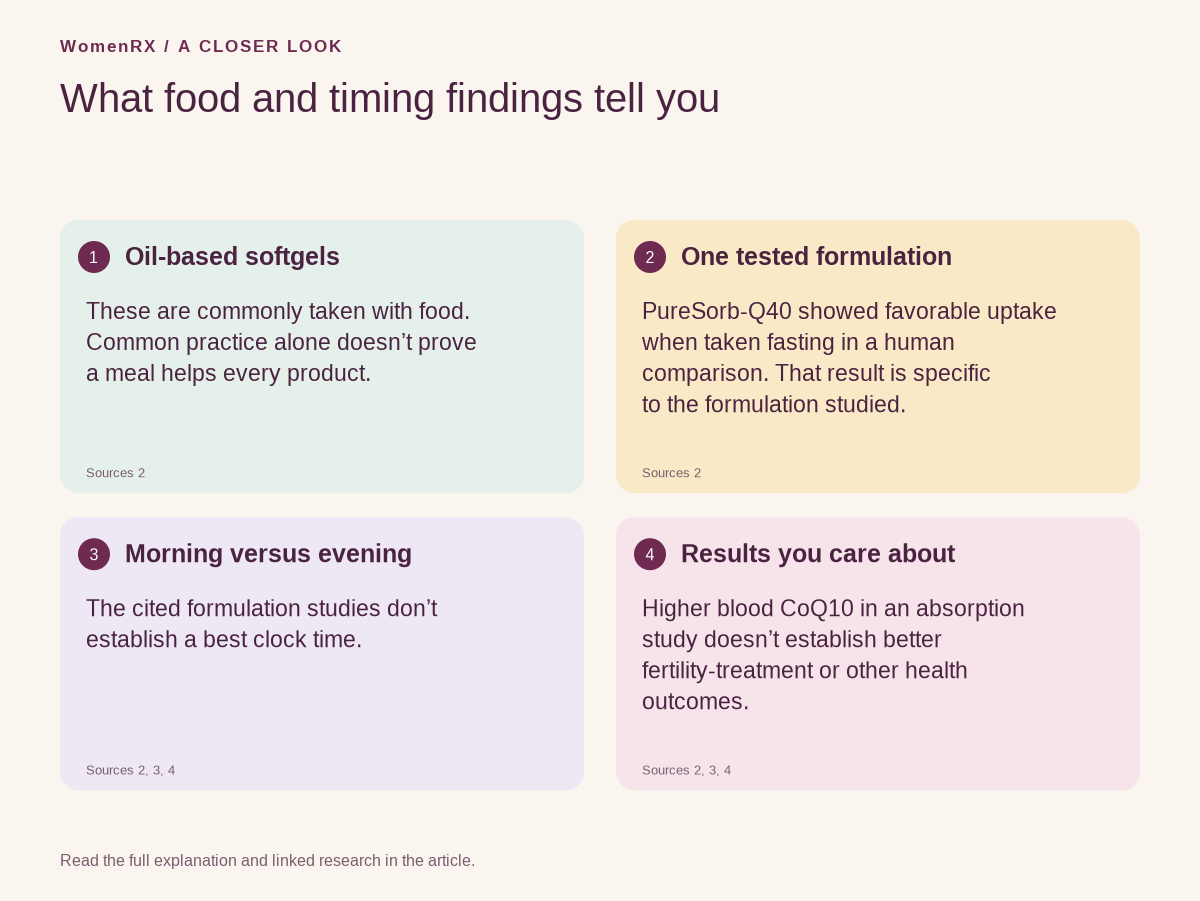
What food and timing findings tell you
Oil-based softgels: These are commonly taken with food. Common practice alone doesn’t prove a meal helps every product.2
One tested formulation: PureSorb-Q40 showed favorable uptake when taken fasting in a human comparison. That result is specific to the formulation studied.2
Morning versus evening: The cited formulation studies don’t establish a best clock time.234
Results you care about: Higher blood CoQ10 in an absorption study doesn’t establish better fertility-treatment or other health outcomes.234
Read the figure as text
Food, formulation, clock time, and health outcomes answer different questions about CoQ10.- Oil-based softgels: These are commonly taken with food. Common practice alone doesn’t prove a meal helps every product.2
- One tested formulation: PureSorb-Q40 showed favorable uptake when taken fasting in a human comparison. That result is specific to the formulation studied.2
- Morning versus evening: The cited formulation studies don’t establish a best clock time.234
- Results you care about: Higher blood CoQ10 in an absorption study doesn’t establish better fertility-treatment or other health outcomes.234
More questions, answered
Does the meal need to be high in fat?
The food-and-absorption study doesn’t establish that you need a high-fat meal. Oil-based softgels are commonly taken with food, but that practice isn’t proof that a particular meal improves every product’s absorption. Follow your product’s directions rather than adding a special meal rule. 1 2
Sources you can check
- Improvement in intestinal coenzyme q10 absorption by food intake.Ochiai A, Itagaki S, Kurokawa T, Kobayashi M, Hirano T, Iseki K. · Yakugaku zasshi : Journal of the Pharmaceutical Society of Japan · 2007Return to first citation
- Comparison of uptake between PureSorb-Q40 and regular hydrophobic coenzyme Q10 in rats and humans after single oral intake.Nukui K, Yamagishi T, Miyawaki H, Kettawan A, Okamoto T, Sato K. · Journal of nutritional science and vitaminology · 2007Return to first citation
- Relative bioavailability of two forms of a novel water-soluble coenzyme Q10.Zmitek J, Smidovnik A, Fir M, Prosek M, Zmitek K, Walczak J, Pravst I. · Annals of nutrition & metabolism · 2008Return to first citation
- A New Food-grade Coenzyme Q10 Formulation Improves Bioavailability: Single and Repeated Pharmacokinetic Studies in Healthy Volunteers.Petrangolini G, Ronchi M, Frattini E, De Combarieu E, Allegrini P, Riva A. · Current drug delivery · 2019Return to first citation
- Interaction of coenzyme Q10 with the intestinal drug transporter P-glycoprotein.Itagaki S, Ochiai A, Kobayashi M, Sugawara M, Hirano T, Iseki K. · Journal of agricultural and food chemistry · 2008Return to first citation