Biotin With Food: Does Timing Really Matter?
There’s no established fasting rule for biotin, but telling your care team about it before certain blood tests can matter.
You don’t need to add a fasting rule based on the absorption information available. The NIH Office of Dietary Supplements reports that oral free biotin is absorbed, but that finding isn’t a direct comparison of taking it with food versus without food. Food’s effect on comfort also isn’t established. Follow your product’s directions, and disclose biotin use before blood tests. 1
Food timing isn’t the same as absorption
If you take biotin with breakfast, there’s no established reason from the available clinical information to think you’re doing it wrong. The NIH Office of Dietary Supplements reports 100% absorption for oral, free biotin, including at pharmacologic intakes. A review of biotin describes absorption as involving a transporter. Neither finding compares the same supplement taken with a meal and while fasting, so neither shows that one timing choice absorbs better. 1 2
The distinction matters: a reported absorption rate is not the same thing as a study testing meal timing. The information available also doesn’t establish whether taking biotin with food prevents stomach discomfort. If your product label gives directions, follow them. If it doesn’t, there’s no established fasting requirement to add based on these absorption findings.
The bigger timing question comes before bloodwork
Biotin can interfere with some laboratory tests that use biotin-streptavidin technology. Depending on the test, a result may be falsely high or falsely low. Tests that may be affected include some thyroid and vitamin D tests, along with certain heart-related tests. This issue concerns how a test measures a substance, not whether you took your supplement with a meal. 1
The NIH Office of Dietary Supplements describes a small study in which six healthy adults took 10 mg of biotin daily for one week and had interference in several assays. It also reports that a single 10 mg dose affected thyroid tests given within 24 hours. These are specific findings for particular doses and tests, not a schedule that applies to every person or blood test. 1
Before lab work, tell the person ordering the test that you take biotin. Mention it even if it’s part of a multivitamin or another combination supplement. Ask whether it could affect the particular test and what to do about your supplement beforehand. There isn’t one pre-test timing rule established by these findings, so don’t assume that taking biotin with food, or changing when you take it, prevents interference. 1
Keep meal timing separate from blood-test interference
For everyday use, check your product’s directions rather than inventing a fasting schedule. Keep the lab question separate: meal timing hasn’t been shown to solve the possibility of test interference, so disclose biotin use when blood tests are planned. That’s the more consequential step, especially if a result seems inconsistent with your health or other test findings. 1
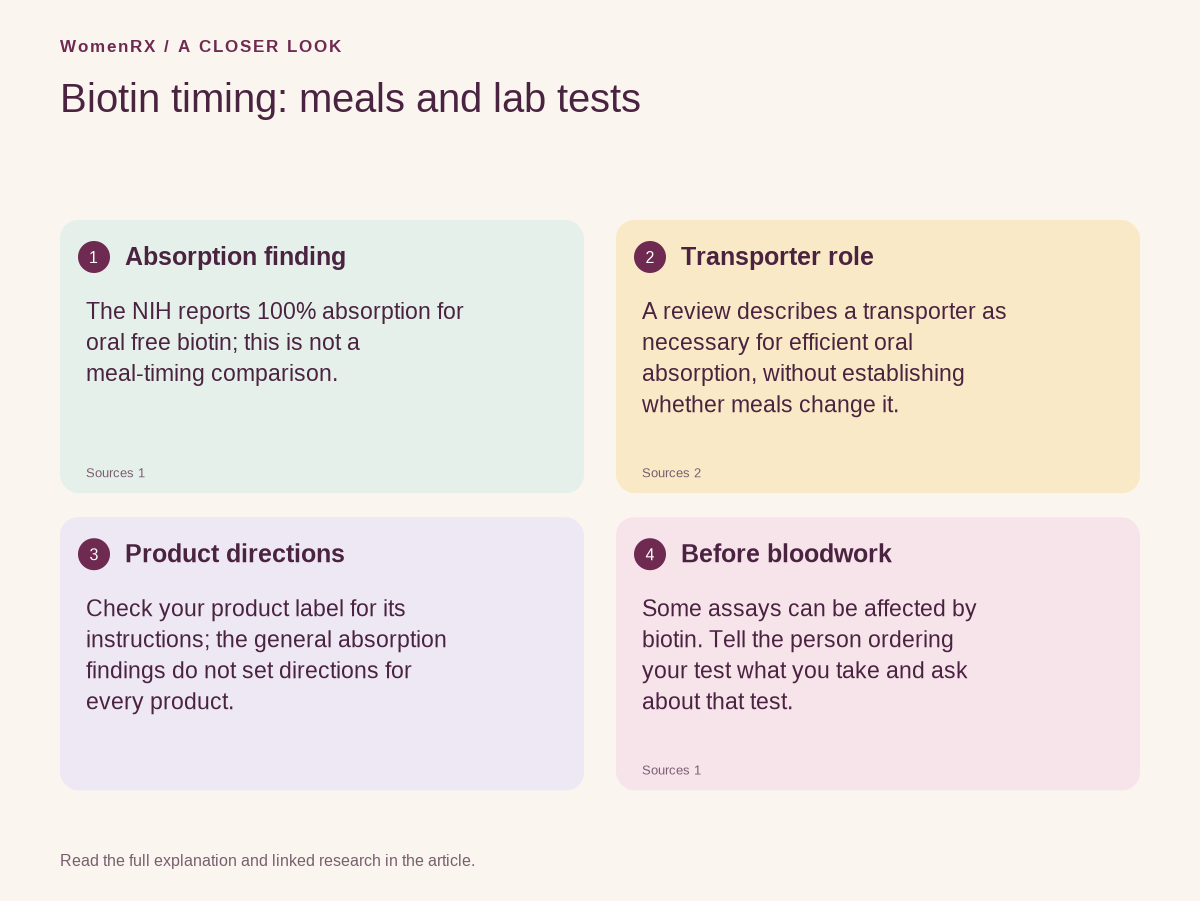
Biotin timing: meals and lab tests
Absorption finding: The NIH reports 100% absorption for oral free biotin; this is not a meal-timing comparison.1
Transporter role: A review describes a transporter as necessary for efficient oral absorption, without establishing whether meals change it.2
Product directions: Check your product label for its instructions; the general absorption findings do not set directions for every product.
Before bloodwork: Some assays can be affected by biotin. Tell the person ordering your test what you take and ask about that test.1
Read the figure as text
These are separate questions: absorption information does not establish a meal-timing advantage, while interference with some lab assays is documented.- Absorption finding: The NIH reports 100% absorption for oral free biotin; this is not a meal-timing comparison.1
- Transporter role: A review describes a transporter as necessary for efficient oral absorption, without establishing whether meals change it.2
- Product directions: Check your product label for its instructions; the general absorption findings do not set directions for every product.
- Before bloodwork: Some assays can be affected by biotin. Tell the person ordering your test what you take and ask about that test.1
More questions, answered
Should I stop biotin before a blood test?
The findings described don’t establish a single stopping schedule for every dose and test. Tell the person ordering the test what biotin products you take and ask what to do for that specific test. 1
Sources you can check
- Biotin - Health Professional Fact SheetAccessed 2026-09-25Return to first citation
- Biological properties of vitamins of the B-complex, part 2 - vitamins B6 and B7 (biotin, vitamin H).Dias P, Siatka T, Vopršalová M, Moravcová M, Pourová J, Přívratská N, Krčmová LK, Javorská L, Mladěnka P. · Nutrition research reviews · 2025Return to first citation