Berberine Before or With Food: Does Timing Matter?
A small human study found lower berberine blood levels after a meal, but it didn’t test common berberine-only supplements or show that fasting is safer.
Food may affect berberine exposure, but the clearest human comparison involved a single dose of a combination syrup, not a typical berberine-only supplement. In that small study, blood levels were lower after a meal than while fasting. It did not test whether taking berberine with food eases stomach symptoms, or whether either schedule is safer. Follow the directions for your specific product rather than treating one schedule as universal. 1

What the food study actually tested
The most direct human comparison was a small, randomized study in 12 healthy men. Participants took one dose of UI026, a syrup combining Coptis extract, which contains berberine, with Pelargonium sidoides extract. Six took it after fasting and six after a high-fat meal. The study measured berberine in blood, not the effects of a typical standalone berberine capsule. 1
Compared with fasting, the fed group had about 33% lower peak berberine concentration and about 67% lower total measured exposure over the study’s sampling period. Those are differences in blood levels for this particular syrup and single-dose test. They don’t establish that every berberine product is absorbed less well with food, or that lower blood levels lead to a meaningful difference in health outcomes. 1
Absorption and stomach comfort are separate questions
The study looked at pharmacokinetics, meaning how berberine levels in the blood changed after a dose. It wasn’t designed to compare digestive symptoms between fed and fasted use. So it can’t tell you whether food prevents nausea, diarrhea, or other stomach problems, or whether taking berberine on an empty stomach makes them more likely. 1
That distinction matters: a meal may change how much of a compound reaches the bloodstream without showing whether someone feels better or worse. The study reported no drug-related adverse events, but it involved only 12 people taking one dose of a combination syrup. That result can’t settle the question of stomach tolerability for routine use of other products. 1
The product may matter as much as the meal
Berberine products aren’t necessarily interchangeable. Human studies of specially formulated berberine products found higher blood exposure than with standard, unformulated berberine, though those studies compared formulations rather than fed and fasted schedules. That’s a reason not to assume the food result for one syrup applies to every capsule, extract, or enhanced-absorption product. 3 4
If your product label gives meal instructions, use those directions for that formulation. If it doesn’t, the available evidence doesn’t establish one best schedule for berberine supplements as a whole. Taking it with food to try to improve stomach comfort may sound reasonable, but the food-effect study did not test whether that works. 1
Meal timing doesn’t answer interaction concerns
Berberine may affect enzymes involved in how the body processes some medicines. A review describes effects on several cytochrome P450 enzymes, including CYP3A4 and CYP2D6, and identifies potential for interactions. The food study did not test whether taking berberine with or without a meal changes those interaction concerns. A meal schedule should not be treated as a way to prevent an interaction. 2
If you take prescription medicines, check the combination with a pharmacist or prescriber before starting berberine, especially if you use medicines with potential for CYP-related interactions. Pregnancy and breastfeeding weren’t studied in the food-effect trial, which enrolled healthy men, so its timing findings don’t establish whether berberine is appropriate during those stages. 1 2
The practical takeaway: use the instructions for your specific product, and don’t choose an empty-stomach schedule on the assumption that it is universally better or safer. The human food-effect finding is real but narrow, and it doesn’t answer the separate questions of stomach comfort or medication interactions.
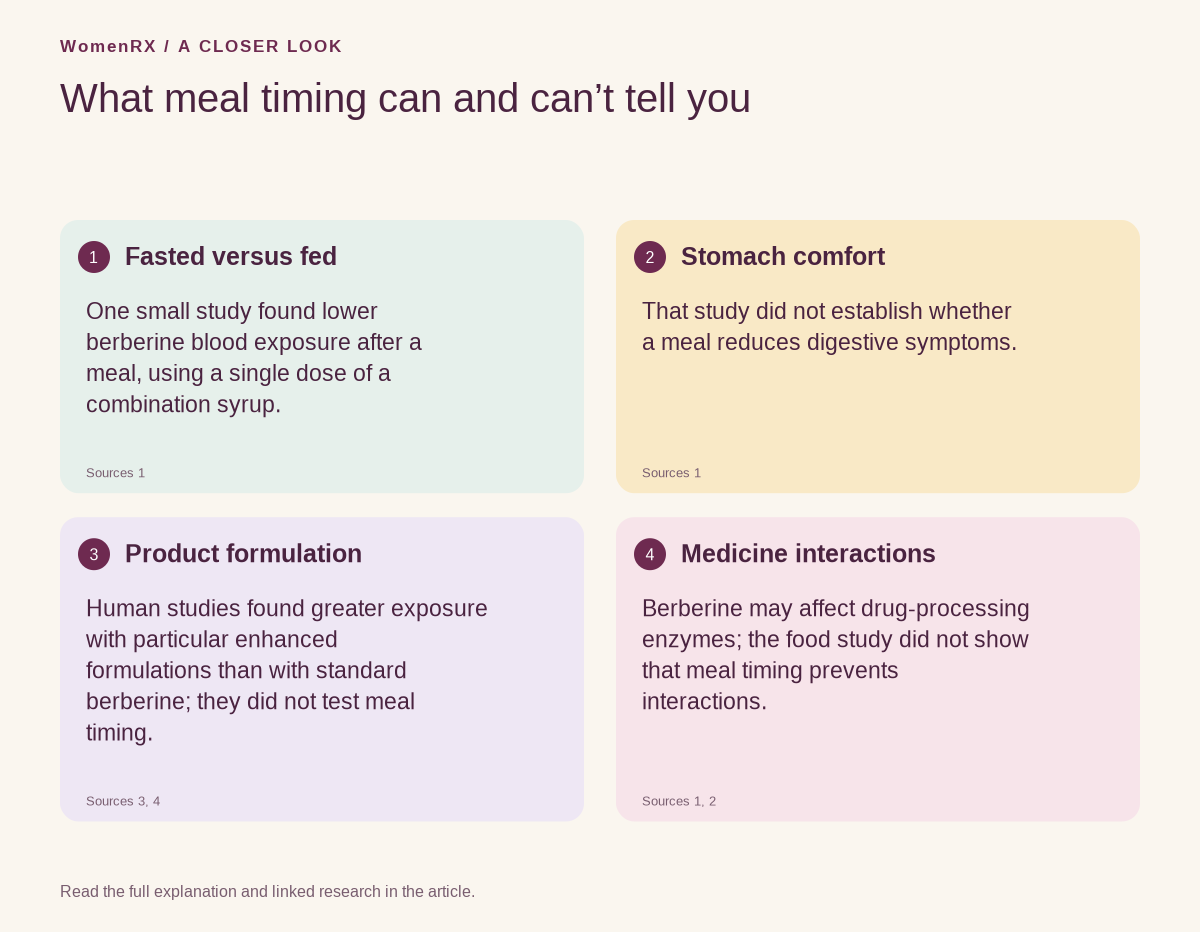
What meal timing can and can’t tell you
Fasted versus fed: One small study found lower berberine blood exposure after a meal, using a single dose of a combination syrup.1
Stomach comfort: That study did not establish whether a meal reduces digestive symptoms.1
Product formulation: Human studies found greater exposure with particular enhanced formulations than with standard berberine; they did not test meal timing.34
Medicine interactions: Berberine may affect drug-processing enzymes; the food study did not show that meal timing prevents interactions.12
Read the figure as text
These distinctions keep a blood-level finding separate from stomach comfort, product directions, and interaction risk.- Fasted versus fed: One small study found lower berberine blood exposure after a meal, using a single dose of a combination syrup.1
- Stomach comfort: That study did not establish whether a meal reduces digestive symptoms.1
- Product formulation: Human studies found greater exposure with particular enhanced formulations than with standard berberine; they did not test meal timing.34
- Medicine interactions: Berberine may affect drug-processing enzymes; the food study did not show that meal timing prevents interactions.12
More questions, answered
Does taking berberine on an empty stomach improve absorption?
One small human study found higher berberine blood exposure while fasting than after a high-fat meal, but it tested a single dose of a combination syrup, not berberine-only supplements generally. It doesn’t establish a best schedule for every product. 1
Can taking berberine with food prevent side effects?
The food-effect study did not compare digestive symptoms between fed and fasted use. It can’t show that taking berberine with a meal prevents stomach problems. 1
Sources you can check
- Evaluation of food effects on the pharmacokinetics of Pelargonium sidoides and Coptis with each bioactive compound berberine and epicatechin after a single oral dose of an expectorant and antitussive agent UI026 in healthy subjects.Park Y, Jung W, Yang E, Nam KY, Bong WR, Kim J, Kim KY, Lee S, Cho JY, Hong JH, Kim J. · Translational and clinical pharmacology · 2022Return to first citation
- Effects of Berberis vulgaris, and its active constituent berberine on cytochrome P450: a review.Bathaei P, Imenshahidi M, Hosseinzadeh H. · Naunyn-Schmiedeberg's archives of pharmacology · 2025Return to first citation
- Characterization and Pharmacokinetic Assessment of a New Berberine Formulation with Enhanced Absorption In Vitro and in Human Volunteers.Solnier J, Zhang Y, Kuo YC, Du M, Roh K, Gahler R, Wood S, Chang C. · Pharmaceutics · 2023Return to first citation
- Development of an Innovative Berberine Food-Grade Formulation with an Ameliorated Absorption: In Vitro Evidence Confirmed by Healthy Human Volunteers Pharmacokinetic Study.Petrangolini G, Corti F, Ronchi M, Arnoldi L, Allegrini P, Riva A. · Evidence-based complementary and alternative medicine : eCAM · 2021Return to first citation