Choline Before Food: Does Timing Matter?
There’s no demonstrated absorption or tolerability benefit to taking choline on an empty stomach.
For most people, current evidence doesn’t establish an advantage to taking choline on an empty stomach. A small human study found that several forms raised blood choline, but participants took them with food, and the study didn’t compare fasting with taking choline alongside food. It also included only six men and didn’t test whether food affects digestive symptoms. Check the form and amount on your label. 12
What the absorption evidence can tell you
Choline from food and supplements doesn’t all take the same route through the body. Free choline and some water-soluble forms are absorbed in the small intestine and travel through the portal circulation to the liver. Some fat-soluble forms, including phosphatidylcholine, can be absorbed intact and travel through the lymphatic system. 1
The NIH Office of Dietary Supplements says that studies haven’t compared the relative bioavailability of the different choline supplement forms it lists, including choline bitartrate, phosphatidylcholine, and lecithin. 1 A small later trial did compare four forms, but it measured acute blood choline concentrations and their timing after single doses. That’s a narrower question than establishing relative bioavailability across forms, so the trial doesn’t resolve the broader comparison. 12
In that randomized crossover study, six healthy adult men took choline chloride, choline bitartrate, alpha-GPC (also called glycerophosphocholine), and egg phosphatidylcholine on separate occasions. The researchers found no difference in the overall blood-choline response, though the timing of the peak differed, with egg phosphatidylcholine peaking latest. 2
This study doesn’t establish that taking choline while fasting changes absorption. Participants had fasted overnight, but they took each supplement with a butter pretzel and drink, then fasted for the next six hours. There was no fasting-versus-fed comparison. The study also measured blood markers, not a health benefit from taking a supplement at a particular time. 2
Food timing and stomach symptoms are separate questions
This trial did not test whether taking choline with food makes it easier on your stomach. The small study was designed to compare blood levels and metabolites, not digestive comfort. The NIH fact sheet lists vomiting among effects associated with high choline intakes, along with fishy body odor, excessive sweating or salivation, low blood pressure, and liver toxicity. It doesn’t link those effects to taking choline without food. 12
So don’t assume that fasting improves choline’s effects, or that a meal prevents side effects. If you’re trying a product, use its label to identify the form and amount of choline per serving, and follow its directions.
If you’re pregnant or breastfeeding
The timing study included six men, not pregnant or breastfeeding participants, so it can’t answer whether meal timing matters in those life stages. Choline needs do differ: the NIH lists an adequate intake of 425 mg per day for adult women, 450 mg per day during pregnancy, and 550 mg per day while breastfeeding. These figures refer to total daily intake, not a recommended supplement amount. 12
If you’re reviewing a prenatal or other supplement, check how much choline it provides alongside what you get from food. The NIH notes that prenatal supplements typically contain little or no choline, and lists eggs, meat, fish, dairy, beans, and some vegetables among food sources. 1
For a general adult, then, meal timing isn’t an evidence-backed way to improve choline absorption or avoid digestive symptoms. The more useful first check is what form you have and how much choline the serving provides.
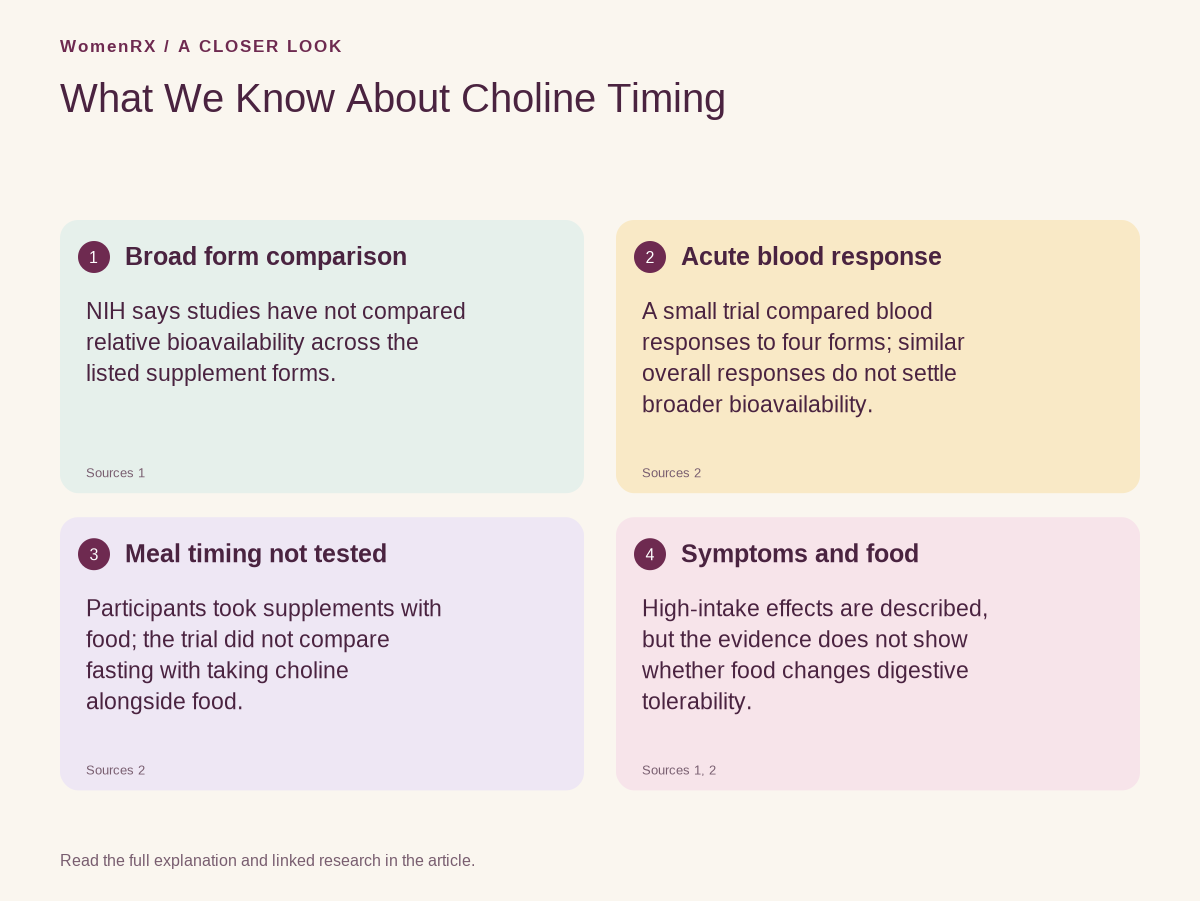
What We Know About Choline Timing
Broad form comparison: NIH says studies have not compared relative bioavailability across the listed supplement forms.1
Acute blood response: A small trial compared blood responses to four forms; similar overall responses do not settle broader bioavailability.2
Meal timing not tested: Participants took supplements with food; the trial did not compare fasting with taking choline alongside food.2
Symptoms and food: High-intake effects are described, but the evidence does not show whether food changes digestive tolerability.12
Read the figure as text
The evidence separates broad comparisons of supplement forms from acute blood measurements, meal timing, and digestive symptoms.- Broad form comparison: NIH says studies have not compared relative bioavailability across the listed supplement forms.1
- Acute blood response: A small trial compared blood responses to four forms; similar overall responses do not settle broader bioavailability.2
- Meal timing not tested: Participants took supplements with food; the trial did not compare fasting with taking choline alongside food.2
- Symptoms and food: High-intake effects are described, but the evidence does not show whether food changes digestive tolerability.12
Sources you can check
- Choline - Health Professional Fact SheetAccessed 2026-09-25Return to first citation
- Differential metabolism of choline supplements in adult volunteers.Böckmann KA, Franz AR, Minarski M, Shunova A, Maiwald CA, Schwarz J, Gross M, Poets CF, Bernhard W. · European journal of nutrition · 2022Return to first citation