Choline: Food Sources, Needs, and Supplement Questions
Pregnancy and lactation have different choline reference values, and a supplement label may not show the whole picture.
Choline is found in foods such as eggs, meat, fish, soybeans, and some vegetables. The Adequate Intake is 450 mg a day during pregnancy and 550 mg during lactation for adults; it’s 425 mg for nonpregnant adult women. These are planning references, not tests of whether you’re deficient. To assess your intake, add up food and any choline listed on supplement labels.
Choline helps make cell membranes and supports processes including nervous system function and lipid metabolism. You need it throughout life, but the intake reference changes during pregnancy and lactation. That makes it useful to look at your usual food pattern and supplement labels together, rather than assuming a prenatal vitamin covers choline. 2
The reference value depends on life stage
For adults age 19 and older, the Adequate Intake (AI) is 425 mg per day for women, 450 mg during pregnancy, and 550 mg during lactation. For ages 14-18, the corresponding values are 400 mg, 450 mg, and 550 mg. 1
An AI is used when there isn’t enough evidence to set a Recommended Dietary Allowance (RDA). For choline, there also isn’t an Estimated Average Requirement (EAR), the value generally used to assess how many people in a group have adequate intakes. So the AI is a helpful reference for planning, but it isn’t a personal deficiency cutoff: an intake below it doesn’t by itself diagnose inadequacy. 1
Pregnancy and lactation have different AIs because the reference values account for those life stages. They’re not supplement doses, and they don’t mean every person needs a supplement. 1
Build an estimate from foods first
Choline is found in both animal and plant foods. Examples include eggs, meat, poultry, fish, dairy, soybeans, beans, cruciferous vegetables, nuts, seeds, and whole grains. Some foods provide more per serving than others: one large hard-boiled egg has 147 mg, half a cup of roasted soybeans has 107 mg, and half a cup of cooked broccoli has 31 mg. 1
For a simple illustration, those three servings together provide 285 mg of choline. That’s a food tally, not a sample meal plan or a judgment about whether someone’s intake is adequate. Your own estimate depends on what you eat across the day, and the AI is not a diagnostic threshold. 1
Food labels may not make this tally easy. In the United States, choline doesn’t have to be listed on a food label unless it has been added to the food. A missing number on a label therefore doesn’t necessarily mean the food contains none. 1
Check what your prenatal supplement actually adds
Prenatal supplements vary. In one 2022 evaluation of 188 prenatal products sold in the United States, 40% included choline, and the median amount among those products was 25 mg per serving. Check your own product’s label rather than assuming it contains choline or provides a substantial amount. 2
To estimate total intake, add the choline in foods you eat to the amount listed for any supplement you take. If a label doesn’t list choline, you may not be able to count a contribution from that product. This is a practical estimate, not a precise measurement: choline appears in different forms in foods, and precise human absorption estimates for those forms aren’t available. 1
If your usual food choices leave a gap, a choline-containing supplement may be one option to discuss, particularly during pregnancy or lactation. That isn’t the same as evidence that every pregnant or breastfeeding person should take one. Human studies have reported associations between lower maternal choline and certain outcomes, and a systematic review found some promising results from interventions, but the intervention evidence has limitations. It does not establish a guaranteed benefit for an individual or a single routine supplement plan. 3
Keep the question practical
A useful next step is to check a few typical days of meals and snacks, then read the supplement facts panel on your prenatal or other supplements. Bring those labels and your estimate to a prenatal or postpartum nutrition conversation if you want help deciding whether food changes or a supplement make sense for you. The question is how much choline your overall diet and supplements contribute, not whether one product has a reassuring-sounding name. 12
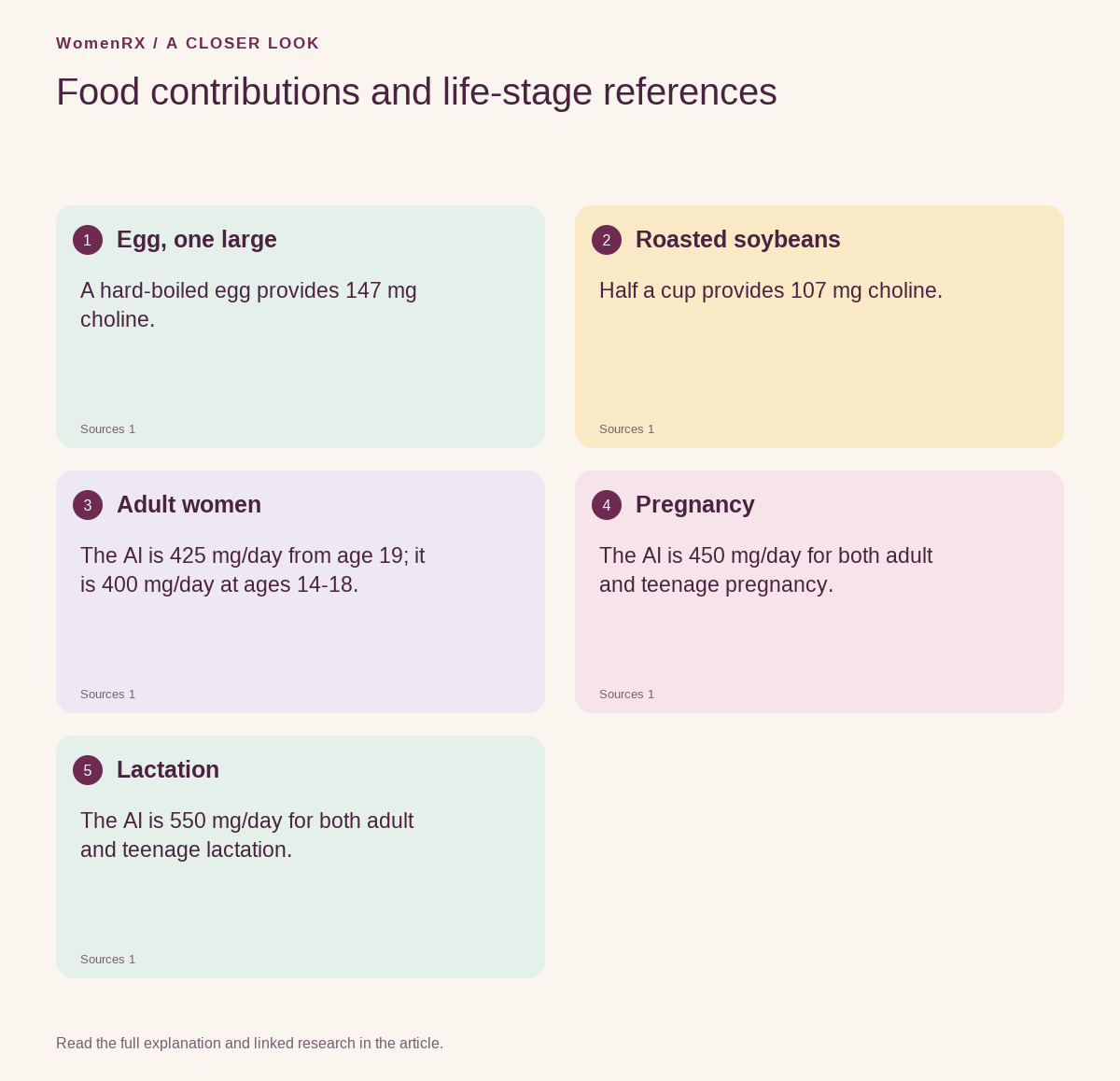
Food contributions and life-stage references
Egg, one large: A hard-boiled egg provides 147 mg choline.1
Roasted soybeans: Half a cup provides 107 mg choline.1
Adult women: The AI is 425 mg/day from age 19; it is 400 mg/day at ages 14-18.1
Pregnancy: The AI is 450 mg/day for both adult and teenage pregnancy.1
Lactation: The AI is 550 mg/day for both adult and teenage lactation.1
Read the figure as text
Compare example food amounts with the choline AI for each life stage. The food figures are examples, not a complete-day tally or a diagnostic test.- Egg, one large: A hard-boiled egg provides 147 mg choline.1
- Roasted soybeans: Half a cup provides 107 mg choline.1
- Adult women: The AI is 425 mg/day from age 19; it is 400 mg/day at ages 14-18.1
- Pregnancy: The AI is 450 mg/day for both adult and teenage pregnancy.1
- Lactation: The AI is 550 mg/day for both adult and teenage lactation.1
Sources you can check
- Choline - Health Professional Fact SheetAccessed 2026-09-25Return to first citation
- Dietary Supplements and Life Stages: Pregnancy - Health Professional Fact SheetAccessed 2026-09-25Return to first citation
- Association between Maternal Choline, Fetal Brain Development, and Child Neurocognition: Systematic Review and Meta-Analysis of Human Studies.Obeid R, Derbyshire E, Schön C. · Advances in nutrition (Bethesda, Md.) · 2022Return to first citation