Choline in Pregnancy: Intake Needs and Supplement Evidence
Choline is essential, but a supplement’s usefulness depends first on how much you already get from food and your prenatal vitamin.
Choline helps build cell membranes and supports early brain development, so intake needs rise during pregnancy and lactation. In the U.S., the adequate intake is 450 mg a day during pregnancy and 550 mg while breastfeeding. A supplement can help fill a dietary shortfall, but evidence that it improves outcomes is limited and varies by outcome: neural-tube-defect findings are observational and conflicting, while human neurocognitive trial evidence remains limited. 1 2 3
Choline is an essential nutrient, not a proven all-purpose pregnancy booster. Your body uses it to make cell-membrane components and acetylcholine, a messenger involved in nervous-system function. It also has roles in early brain development. Those roles explain why getting enough matters; they don’t by themselves show that taking extra choline improves outcomes. 1 2
The practical question is whether your usual food and supplements bring you near the intake benchmark for your life stage. A separate choline pill isn’t automatically needed, and more isn’t automatically better.
The U.S. intake benchmarks
The U.S. recommendations are adequate intakes (AIs), not RDAs. An AI is used when there isn’t enough evidence to set an Estimated Average Requirement and calculate an RDA. It’s a useful planning benchmark, not a test of whether you personally have a deficiency. 1
For females ages 19 and older, the AI is 425 mg a day when not pregnant or lactating, 450 mg during pregnancy, and 550 mg during lactation. For ages 14-18, it’s 400 mg, 450 mg, and 550 mg, respectively. The upper limit for total intake from food and supplements is 3,500 mg daily for adults and 3,000 mg for ages 14-18, including during pregnancy and lactation. These are ceilings, not targets. 1
Most pregnant women in the U.S. don’t reach the pregnancy AI. In an analysis of pregnant women ages 20-40 using 2001-2014 data, average intake from food was 321 mg a day, and 7.7% had food intake above the AI. That describes a population, not your own intake, but it helps explain why checking can be worthwhile. 2
A food-first way to check your intake
Choline is found in foods across several groups. For example, one large hard-boiled egg provides about 147 mg; half a cup of roasted soybeans, 107 mg; and three ounces of roasted chicken breast, 72 mg. Broccoli and Brussels sprouts contribute smaller amounts, about 31-32 mg per half-cup serving. These are examples, not a required menu. 1
Try this simple label-and-food check:
- Start with your life stage. Use the pregnancy or lactation AI if it applies; don’t use the nonpregnant figure as your target.
- Notice regular food sources. Eggs, meat, poultry, fish, dairy, soybeans, some beans, nuts, seeds, and whole grains can all contribute. If you avoid animal foods or eggs, pay particular attention to the plant sources you eat. 1 2
- Read your prenatal label. In a 2022 evaluation of 188 prenatal supplements sold in the U.S., 40% contained choline; among products that did, the median amount was 25 mg per serving. A product with a small amount may add to your total without covering much of the gap. 2
- Add what you can verify. Food labels aren’t required to list choline unless it has been added, so a blank label doesn’t mean the food contains none. Check serving sizes and avoid counting the same supplement twice if you take more than one product. 1
The goal is a reasonable estimate of your usual intake, not a perfect daily tally. If you’re pregnant or breastfeeding and your diet excludes several common sources, reviewing your food pattern and supplement label with your prenatal care team can help you decide whether a product is useful.
Pregnancy, planning, and breastfeeding aren’t identical
If you’re pregnant, the U.S. AI is 450 mg daily. Choline has roles in fetal growth and central nervous system development, and a supplement can help increase intake when food alone falls short. But most prenatal products contain little or no choline, so the label matters. 2
If you’re planning pregnancy, it’s reasonable to look at your usual diet and the choline listed in any prenatal product you’re considering. The U.S. intake table gives a pregnancy AI, but it doesn’t set a separate preconception choline target. 1
If you’re breastfeeding, the AI rises to 550 mg daily. Choline is present in breast milk, but the higher intake benchmark alone doesn’t prove that supplementation beyond what you need improves an infant outcome. Use the lactation figure when assessing your intake, rather than carrying over the pregnancy number. 1
What supplementation has, and hasn’t, shown
It helps to separate nutrient function from proof that a supplement changes an outcome. Choline is needed for normal development, but that fact alone doesn’t establish that extra choline prevents a birth defect or improves a child’s cognition. 1 2
For neural tube defects, the pregnancy evidence described by NIH is observational: some studies found an association between lower choline levels and higher risk, while another found no relationship between pregnancy choline levels and neural tube defects in offspring. These conflicting associations do not show that taking a choline supplement prevents neural tube defects. 1
For neurocognitive outcomes, a review describes extensive preclinical research alongside more limited human studies, and says human trial evidence remains limited in scale and duration. It concludes that causal claims for most outcomes can’t yet be drawn. That supports a narrower takeaway: a supplement may help bring intake closer to the AI, but the evidence cited here doesn’t establish that extra choline improves a child’s cognitive outcomes. 3
High intakes can cause problems, including fishy body odor, vomiting, excessive sweating or salivation, low blood pressure, and liver toxicity. The upper limit applies to choline from foods and supplements together; it’s a safety boundary, not a dose to aim for. 1
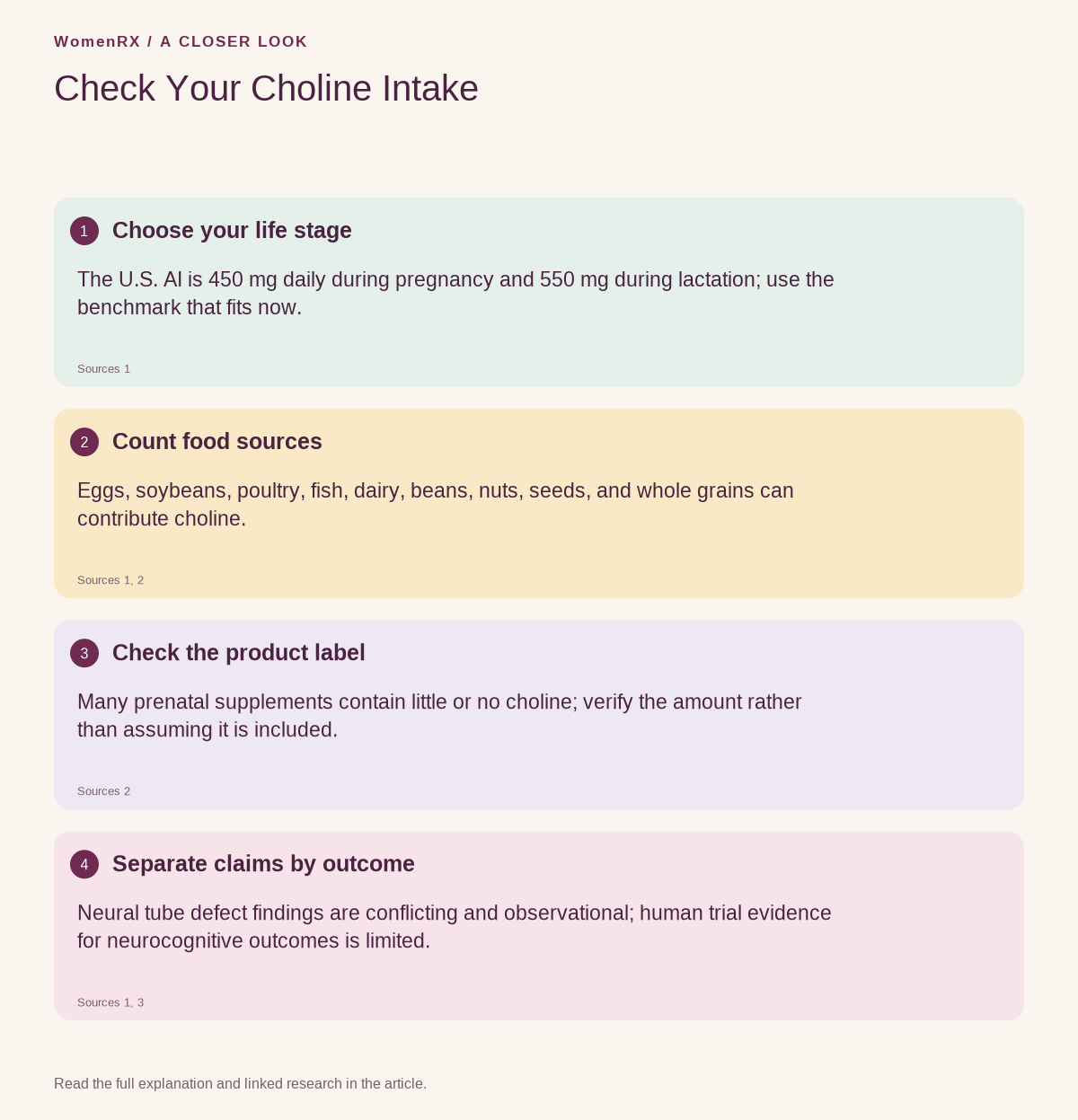
Check Your Choline Intake
Choose your life stage: The U.S. AI is 450 mg daily during pregnancy and 550 mg during lactation; use the benchmark that fits now.1
Count food sources: Eggs, soybeans, poultry, fish, dairy, beans, nuts, seeds, and whole grains can contribute choline.12
Check the product label: Many prenatal supplements contain little or no choline; verify the amount rather than assuming it is included.2
Separate claims by outcome: Neural tube defect findings are conflicting and observational; human trial evidence for neurocognitive outcomes is limited.13
Read the figure as text
Use these steps to compare your life-stage benchmark with food and supplement sources, without treating an estimate as a diagnosis.- Choose your life stage: The U.S. AI is 450 mg daily during pregnancy and 550 mg during lactation; use the benchmark that fits now.1
- Count food sources: Eggs, soybeans, poultry, fish, dairy, beans, nuts, seeds, and whole grains can contribute choline.12
- Check the product label: Many prenatal supplements contain little or no choline; verify the amount rather than assuming it is included.2
- Separate claims by outcome: Neural tube defect findings are conflicting and observational; human trial evidence for neurocognitive outcomes is limited.13
More questions, answered
Does a prenatal vitamin usually provide enough choline?
Not necessarily. In a 2022 evaluation of 188 prenatal supplements sold in the U.S., 40% included choline, and the median amount among those products was 25 mg per serving. Check your product’s label rather than assuming it contains choline. 2
Does a low choline estimate mean I’m deficient?
No. The AI is a population-level planning benchmark, not a diagnostic cutoff, and choline status isn’t routinely measured in healthy people. A food estimate below the AI can flag a possible gap, but it doesn’t diagnose deficiency. 1
Sources you can check
- Choline - Health Professional Fact SheetAccessed 2026-09-25Return to first citation
- Dietary Supplements and Life Stages: Pregnancy - Health Professional Fact SheetAccessed 2026-09-25Return to first citation
- Choline, a nexus for neurocognitive nutrients: A narrative review.Boldon N, Strupp B, Cherrington B, Prather J, Keith JF. · Nutrition research (New York, N.Y.) · 2026Return to first citation