Choline Benefits: What Supplement Trials Actually Show
Choline has essential roles in the body, but meeting an intake benchmark is not the same as proving a supplement prevents disease or improves a child’s development.
Choline is an essential nutrient, and getting enough matters, especially during pregnancy and lactation. But evidence that supplements improve specific health outcomes is much less certain: pregnancy studies have not consistently linked higher choline with better child neurodevelopment, and findings about neural tube defects are mixed. An adequate intake is a nutrition benchmark, not proof that taking more will prevent a condition. 1 2 3
A nutrient’s role is not a supplement result
Choline helps build cell membranes and supports processes including nervous-system function and lipid metabolism. Those are established reasons the body needs choline. They don’t, by themselves, show that a choline pill prevents a disease or improves a measurable health outcome in someone who already gets enough. 2
The distinction matters because the intake reference for choline is an Adequate Intake (AI), not a Recommended Dietary Allowance. An AI is used when there isn’t enough evidence to set an RDA. For adult women, the AI is 425 mg a day; it’s 450 mg during pregnancy and 550 mg during lactation. The reference was based on preventing liver damage, not on trials showing that supplements prevent a particular disease or produce a specific pregnancy outcome. 1 2
Pregnancy: important nutrient, unsettled outcome evidence
Choline is relevant to fetal growth and nervous-system development, and most pregnant women in the United States don’t reach the AI through food. In one analysis of U.S. pregnant women ages 20 to 40, average food intake was 321 mg a day, and 7.7% had intake above the AI. Those figures describe intake, not how many women were clinically deficient or whether supplements would improve an outcome. 2
The best direct overview of pregnancy and child development reviewed four randomized trials and five observational studies. Most outcomes assessed did not support a benefit from higher prenatal choline. Some individual trial results favored supplementation on a neurodevelopment measure, but the trials assessed multiple outcomes and most were null. The review concluded that the evidence is insufficient to support or rule out improved child neurodevelopment from increasing choline during pregnancy. 3
That means the appealing claim that choline supplements make children smarter or reliably improve development goes beyond what human studies have established. It also doesn’t mean choline is unimportant: a nutrient can have an essential biological role while evidence for the added benefit of supplementation remains uncertain.
What about neural tube defects?
Some studies have associated lower choline levels in pregnancy with neural tube defects, while other research found no relationship. These conflicting findings do not establish that taking choline supplements prevents neural tube defects. 1
What about other pregnancy outcomes?
Choline’s role in fetal development is a reason to pay attention to adequate intake, but it shouldn’t be confused with proof that supplements prevent pregnancy complications or improve birth outcomes. A rapid review found the clinical evidence for supplementation in healthy pregnant people mixed for infant and child neurodevelopmental outcomes and behavioral symptoms; it also described little-to-no difference in reported safety outcomes. 4
Outside pregnancy, deficiency and prevention are different questions
In controlled settings, choline deficiency can cause liver and muscle damage. But frank deficiency is very rare in healthy nonpregnant women, even though many people consume less than the AI. So evidence that deficiency can harm the body doesn’t establish that supplements prevent liver disease, heart disease, or cognitive decline in women who aren’t deficient. 1
For broader health claims, the key question is what an intervention trial actually measured in people like you. A biological mechanism, an association between dietary intake and an outcome, or an animal result can help researchers decide what to study. None is a substitute for human trials showing that a supplement changes that outcome. The pregnancy neurodevelopment review, for example, found mixed observational results as well as mostly null trial outcomes. 3
A practical way to think about intake
If you’re pregnant or breastfeeding, it can be useful to check whether choline is present in your prenatal product and how much it provides. A U.S. evaluation found choline in 40% of prenatal supplements assessed, with a median of 25 mg per serving, so the word “prenatal” doesn’t guarantee that a product supplies much choline. 2
Food can contribute too. Examples include an egg, which provides about 147 mg, or half a cup of roasted soybeans, which provides about 107 mg. These are examples of food sources, not a prescribed menu or a reason to aim for a supplement dose. 1
More isn’t automatically better. High choline intakes can cause side effects including fishy body odor, vomiting, sweating, low blood pressure, and liver toxicity. If you’re considering a supplement, focus first on the gap between your usual intake and the relevant AI rather than assuming that a higher intake will deliver a health benefit. 1
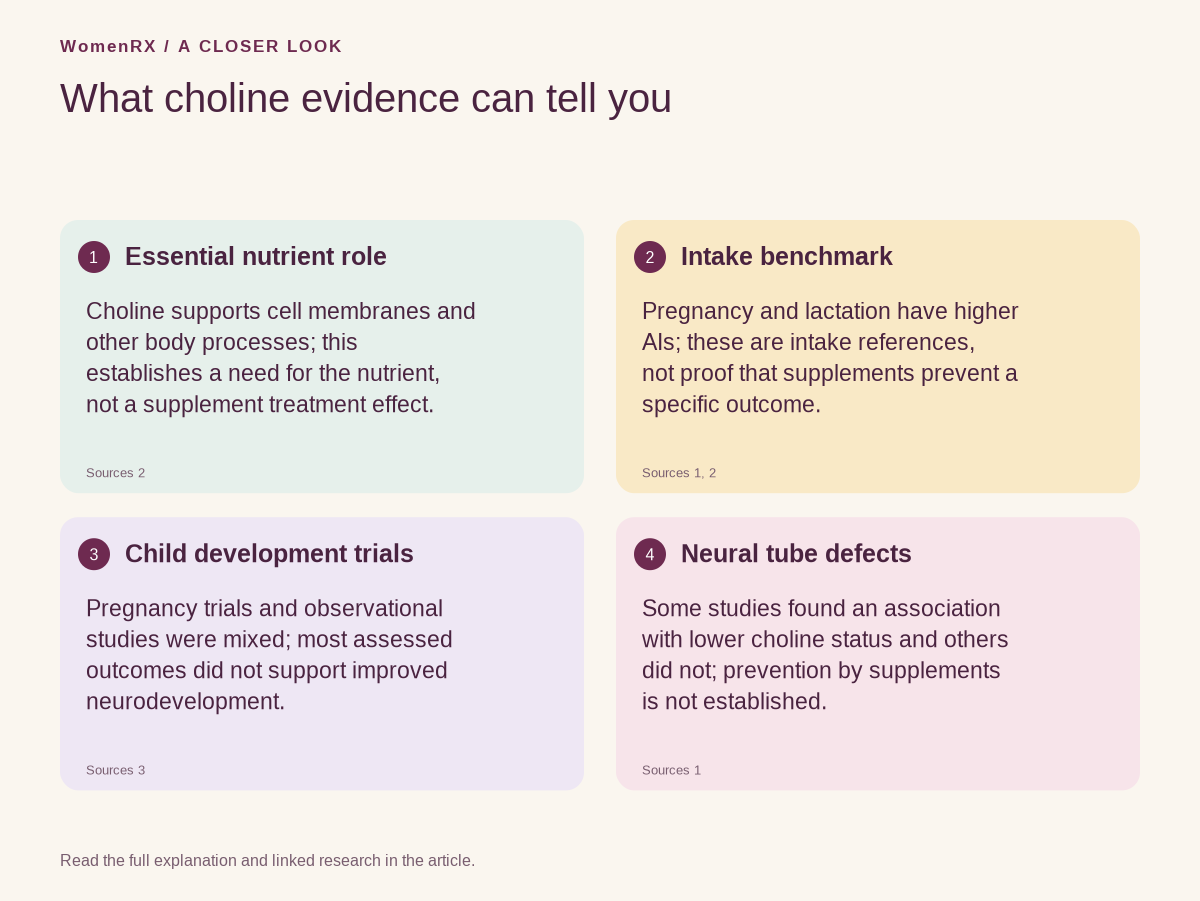
What choline evidence can tell you
Essential nutrient role: Choline supports cell membranes and other body processes; this establishes a need for the nutrient, not a supplement treatment effect.2
Intake benchmark: Pregnancy and lactation have higher AIs; these are intake references, not proof that supplements prevent a specific outcome.12
Child development trials: Pregnancy trials and observational studies were mixed; most assessed outcomes did not support improved neurodevelopment.3
Neural tube defects: Some studies found an association with lower choline status and others did not; prevention by supplements is not established.1
Read the figure as text
Separate established nutrient needs from intake observations and the still-uncertain effects of supplements.- Essential nutrient role: Choline supports cell membranes and other body processes; this establishes a need for the nutrient, not a supplement treatment effect.2
- Intake benchmark: Pregnancy and lactation have higher AIs; these are intake references, not proof that supplements prevent a specific outcome.12
- Child development trials: Pregnancy trials and observational studies were mixed; most assessed outcomes did not support improved neurodevelopment.3
- Neural tube defects: Some studies found an association with lower choline status and others did not; prevention by supplements is not established.1
More questions, answered
Does eating below the AI mean I’m choline deficient?
No. The AI is a reference for intake, not a test that diagnoses deficiency. The NIH fact sheet says frank choline deficiency is very rare in healthy nonpregnant women, even though many people consume less than the AI. 1
Is choline relevant while breastfeeding?
Yes. The AI is 550 mg a day during lactation, compared with 425 mg for adult women who aren’t pregnant or lactating. That benchmark reflects intake guidance; it doesn’t establish that a supplement improves a particular breastfeeding or infant outcome. 1
Sources you can check
- Choline - Health Professional Fact SheetAccessed 2026-09-25Return to first citation
- Dietary Supplements and Life Stages: Pregnancy - Health Professional Fact SheetAccessed 2026-09-25Return to first citation
- Choline During Pregnancy and Child Neurodevelopment: A Systematic Review of Randomized Controlled Trials and Observational Studies.Gould JF, Hines S, Best KP, Grzeskowiak LE, Jansen O, Green TJ. · Nutrients · 2025Return to first citation
- Choline Supplementation for Infants, Children, and Pregnant People: Rapid Review2024Return to first citation