Do You Need a Choline Supplement During Pregnancy?
During pregnancy, estimate choline from food and count what’s in your prenatal before adding a supplement. Breastfeeding needs a separate assessment.
Not necessarily. The U.S. adequate intake for choline during pregnancy is 450 mg a day, but many pregnant women get less, and fewer than half of U.S. prenatal supplements contain choline.7 Check your usual foods and supplement labels before adding a product. A supplement can help close an intake gap.7 It hasn’t been shown to guarantee better child developmental outcomes.3 If you’re breastfeeding, don’t use the pregnancy benchmark to assess your intake; this guide doesn’t provide a lactation target.4
Start with your pregnancy intake, not a product
Choline helps the body make components of cell membranes and supports processes involved in fetal growth and nervous system development. Your body makes some choline, but it also needs choline from your diet.23 During pregnancy, the U.S. adequate intake (AI) is 450 mg a day. An AI is an intake reference used when there isn’t enough evidence to set a recommended dietary allowance; it isn’t a precise measure of one person’s requirement.67
The benchmark deserves attention: most pregnant women in the United States don’t consume the recommended amount, and fewer than half of prenatal supplements on the U.S. market contain choline. Even a prenatal that includes it may provide only a small amount.7 That makes the question less “Which choline pill is best?” and more “What am I already getting, and what might be missing?”
Count food and supplements together
Look at how you usually eat, rather than judging one unusual day. Eggs are a notable food source of choline, but not eating eggs doesn’t, by itself, mean you need a supplement. Food choices vary, and estimating a person’s exact choline intake from memory is difficult. To estimate food intake, look up foods you eat regularly in the NIH Office of Dietary Supplements’ Choline Content of Selected Foods table or a choline food-composition database. Match values to your usual portions, account for how often you eat them, and average over a usual week.625 This gives you an approximate daily food amount, not a precise measurement. Add it to the daily choline amounts on your supplement labels when comparing your intake with the pregnancy AI.
Next, read your prenatal’s Supplement Facts panel for an amount of choline. Don’t assume a product labeled “prenatal” contains it.7 Check any other multivitamin or stand-alone choline supplement too, so you’re considering all the choline you take, not just the newest bottle.
For example, if your prenatal lists choline and you also take a separate choline product, both amounts belong in your supplement tally. If the label names a form such as choline bitartrate but you can’t tell how much choline it provides, bring it to your prenatal care visit or ask the manufacturer to clarify the amount before including it in your estimate. Choline bitartrate is one form used in supplements.4
What an extra supplement can and can’t promise
An additional supplement may be a practical way to raise intake when food and a prenatal together leave a gap. That’s different from taking more choline in hopes of guaranteeing a particular outcome. A 2025 systematic review found four randomized pregnancy supplementation trials and five observational studies examining child neurodevelopment. Most measured outcomes in the trials did not show a benefit; the observational findings were mixed. The reviewers concluded that the human evidence is insufficient to support or refute a neurodevelopmental benefit from increasing choline intake during pregnancy.3
There’s also a reason not to keep adding products without counting them. For pregnant adults ages 19 to 50, the U.S. upper intake level for choline is 3,500 mg a day; for pregnant teens ages 14 to 18, it’s 3,000 mg a day. An upper limit is a safety boundary, not an intake goal.76 If you’re pregnant, review a proposed new supplement with your prenatal care provider, especially if you already take a prenatal and other supplements.1
If you’re breastfeeding
Don’t carry the 450 mg pregnancy figure forward as a breastfeeding target. Choline needs also change during lactation, and a review reports that many lactating women do not meet recommended intakes.4 The same food-and-label check can help you estimate what you’re getting. Ask your health care provider or a dietitian for a lactation-specific intake comparison before deciding whether to add a supplement.
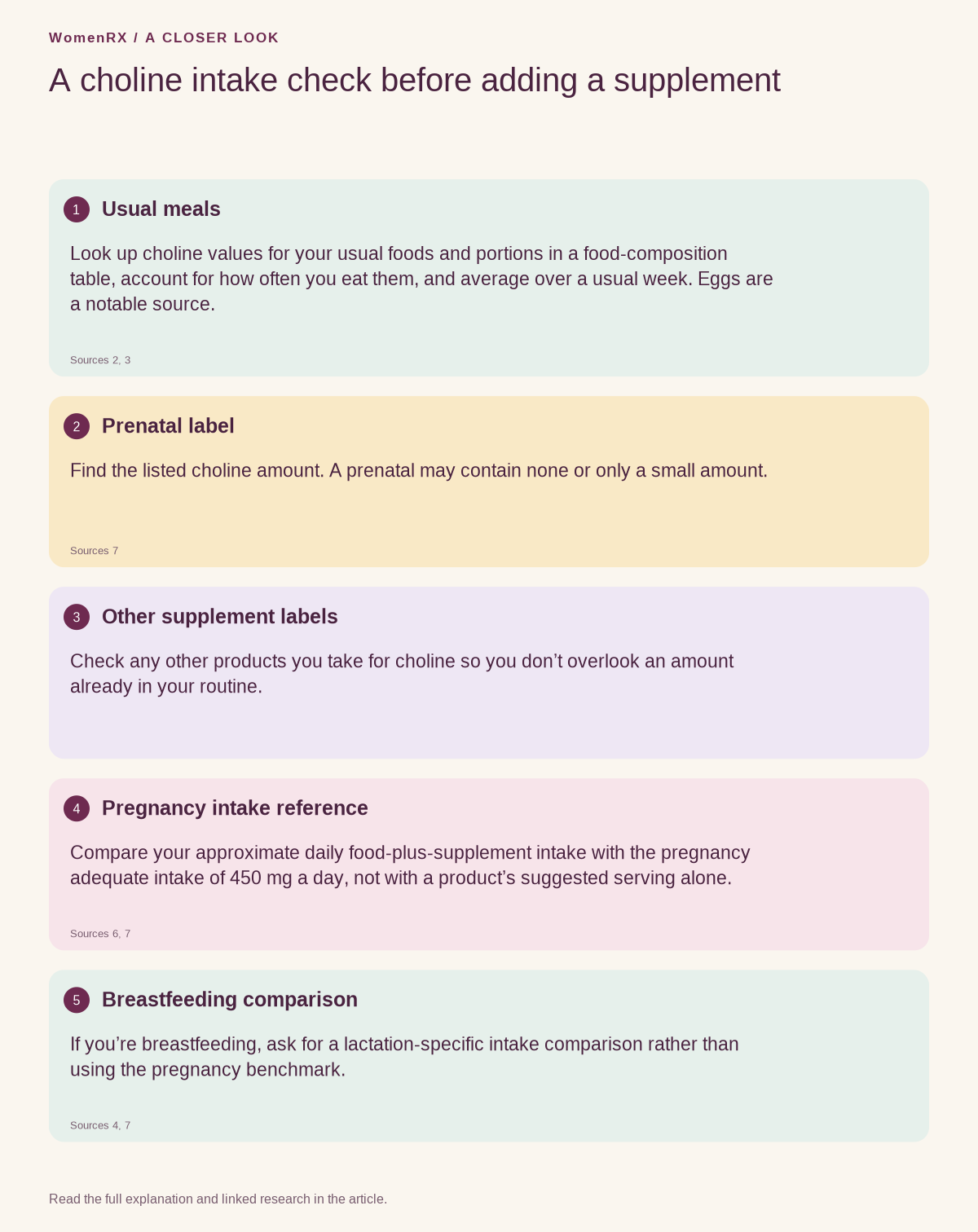
A choline intake check before adding a supplement
Usual meals: Look up choline values for your usual foods and portions in a food-composition table, account for how often you eat them, and average over a usual week. Eggs are a notable source.23
Prenatal label: Find the listed choline amount. A prenatal may contain none or only a small amount.7
Other supplement labels: Check any other products you take for choline so you don’t overlook an amount already in your routine.
Pregnancy intake reference: Compare your approximate daily food-plus-supplement intake with the pregnancy adequate intake of 450 mg a day, not with a product’s suggested serving alone.67
Breastfeeding comparison: If you’re breastfeeding, ask for a lactation-specific intake comparison rather than using the pregnancy benchmark.47
Read the figure as text
Estimate food intake and check product labels for a pregnancy comparison.- Usual meals: Look up choline values for your usual foods and portions in a food-composition table, account for how often you eat them, and average over a usual week. Eggs are a notable source.23
- Prenatal label: Find the listed choline amount. A prenatal may contain none or only a small amount.7
- Other supplement labels: Check any other products you take for choline so you don’t overlook an amount already in your routine.
- Pregnancy intake reference: Compare your approximate daily food-plus-supplement intake with the pregnancy adequate intake of 450 mg a day, not with a product’s suggested serving alone.67
- Breastfeeding comparison: If you’re breastfeeding, ask for a lactation-specific intake comparison rather than using the pregnancy benchmark.47
More questions, answered
Does a prenatal vitamin already cover choline?
Not always. Fewer than half of prenatal supplements on the U.S. market contain choline, and products that do may provide only small amounts. Check the choline amount on your own Supplement Facts panel rather than relying on the word “prenatal.”7
What if a label names a choline form but not a clear choline amount?
Choline bitartrate is one form used in supplements.4 If you can’t tell how much choline the product contributes, ask your health care provider or the manufacturer to clarify the amount before including it in your intake estimate.
Sources you can check
- Pregnancy and Medicines | MedlinePlusAccessed 2026-09-25Return to first citation
- Development of a Choline Database to Estimate Australian Population Intakes.Probst Y, Guan V, Neale E. · Nutrients · 2019Return to first citation
- Choline During Pregnancy and Child Neurodevelopment: A Systematic Review of Randomized Controlled Trials and Observational Studies.Gould JF, Hines S, Best KP, Grzeskowiak LE, Jansen O, Green TJ. · Nutrients · 2025Return to first citation
- Choline in Pregnancy and Lactation: Essential Knowledge for Clinical Practice.Derbyshire EJ. · Nutrients · 2025Return to first citation
- Dietary Choline Intake During Pregnancy and Congenital Heart Defects in a Chinese Population.Li YH, Xiao Z, Guo R, Rekemubieke B, Hu W, Liu X, Yang J. · Nutrients · 2025Return to first citation
- Choline - Health Professional Fact SheetAccessed 2026-09-25Return to first citation
- Dietary Supplements and Life Stages: Pregnancy - Health Professional Fact SheetAccessed 2026-09-25Return to first citation