How to Compare Choline Supplements and Estimate Your Intake
Compare the choline amount on each label, then add food and supplements before deciding whether a separate product might help.
There isn’t one choline supplement every woman needs. Compare the amount of choline per serving in your prenatal and any standalone product, then add food contributions to estimate your usual total. For adults, the adequate intake is 450 mg during pregnancy and 550 mg while breastfeeding; these are food-plus-supplement reference amounts, not supplement targets or individual deficiency tests. 1 2
Start with the amount of choline, not the product name
A prenatal bottle may contain choline, but the amount can be small. In an evaluation of 188 prenatal supplements on the U.S. market, 40% contained choline, and the median amount among those products was 25 mg per serving. Check the label for the amount of choline and the serving size; don’t assume that a product with “choline,” “lecithin,” or “phosphatidylcholine” in its name supplies the same amount as another product. 2
Choline bitartrate, phosphatidylcholine, and lecithin are forms found in supplements. There are no studies comparing the relative bioavailability of these forms, so the evidence doesn’t establish one as the best choice for meeting your intake. Compare the stated choline amounts rather than choosing based on a form’s marketing claims. 1
Add the labels, then include food
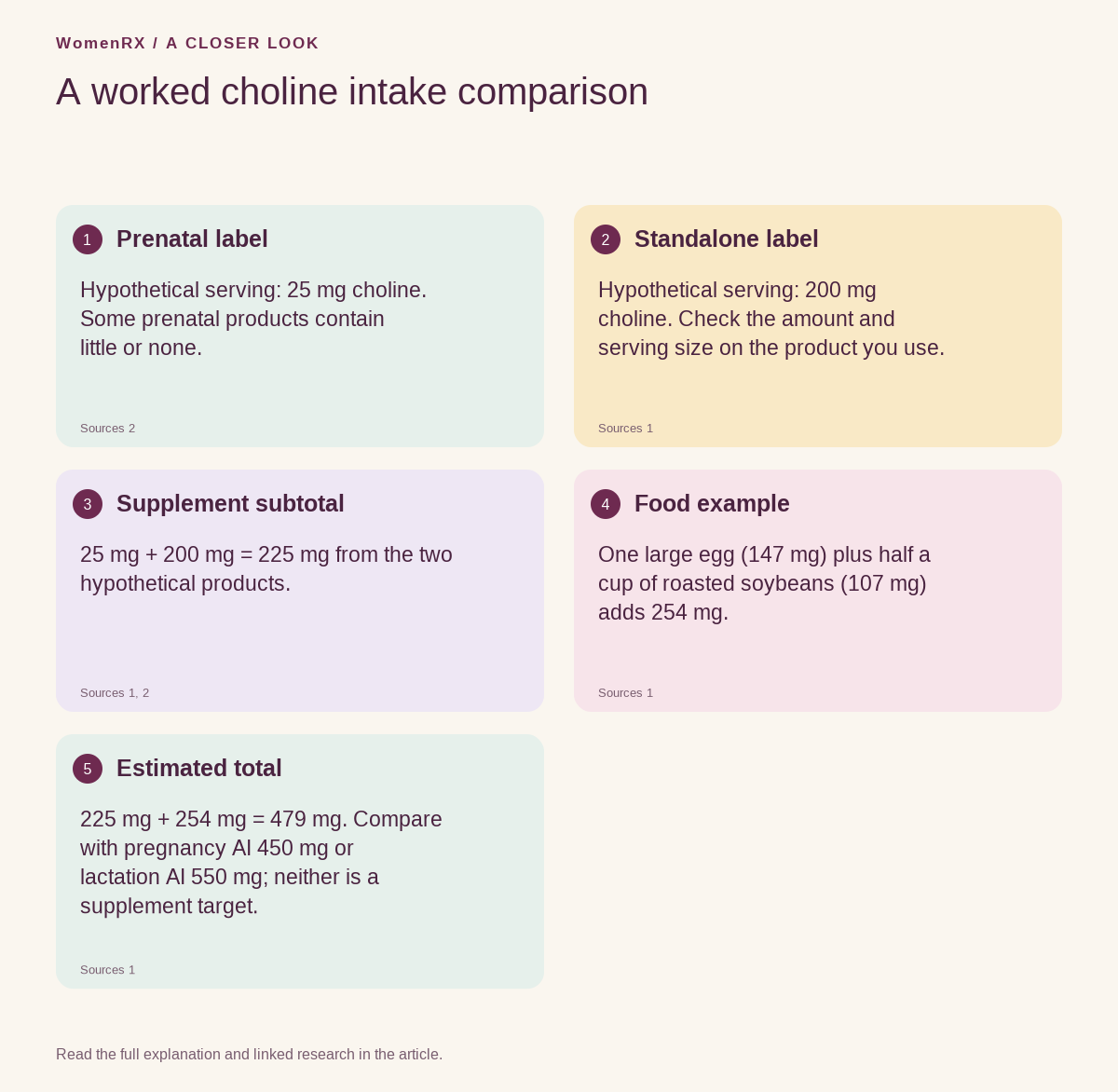
Here’s an illustrative calculation, not a recommendation or a claim about a specific product. Suppose a prenatal label provides 25 mg of choline per serving and a separate supplement label provides 200 mg. Together, those products contribute 225 mg. If that day’s food includes one large hard-boiled egg (147 mg) and half a cup of roasted soybeans (107 mg), the estimated total is 479 mg. 1
That example comes out above the 450 mg adequate intake for pregnancy, but a single day’s total doesn’t tell you whether your usual intake is adequate. Food values are estimates, and choline isn’t required on food labels unless it has been added. Foods can contribute substantially: eggs, meat, poultry, fish, and dairy are common sources, and soybeans, beans, cruciferous vegetables, nuts, seeds, and whole grains also contribute. 1 2
For a quick comparison, write down the choline amount per serving for your prenatal and any other supplement. Add only the servings you actually take, then add estimated food contributions. Keep the FDA Daily Value of 550 mg separate from the pregnancy adequate intake of 450 mg: the Daily Value is a label-comparison reference, not the pregnancy target. 1 2
Match the comparison to your life stage
For adults, the adequate intake (AI) is 425 mg per day for women who aren’t pregnant or breastfeeding, 450 mg during pregnancy, and 550 mg during lactation. The AI is used because there isn’t enough evidence to set a recommended dietary allowance for choline. It’s a reference for planning and assessing intake, not a test that diagnoses deficiency or proof that every individual needs a supplement to reach that number. 1
Pregnancy deserves a closer label check: U.S. data summarized by the NIH Office of Dietary Supplements found that pregnant women ages 20 to 40 had a mean food intake of 321 mg per day, and 7.7% had food intake above the pregnancy AI. Supplements did not add substantially to total intake in that analysis. These population findings describe a gap worth checking; they don’t show that every pregnant woman needs a separate choline product. 2
While breastfeeding, the AI rises to 550 mg per day. Use that life-stage figure when you compare your food and supplement contributions, rather than carrying over the pregnancy AI. Choline is present in breast milk, and foods such as eggs, meat, fish, dairy, soybeans, and beans can contribute to intake. 1
When might a separate product be worth considering?
A separate product may be worth discussing if the amount in your prenatal is low or absent and your usual diet has few choline-rich foods. This can be especially relevant if you avoid eggs or follow a vegan diet, situations the NIH fact sheet identifies as ones where a choline-containing supplement may be useful. First total what you already get from products and food; stacking supplements without checking their amounts can push intake higher than intended. 2
For context, the upper intake level for adults, including during pregnancy and lactation, is 3,500 mg per day from food and supplements combined. It is a safety boundary, not a target. High intakes have been associated with effects including fishy body odor, vomiting, excessive sweating, low blood pressure, and liver toxicity. 1 If you’re pregnant and considering adding a supplement, bring the product label into your prenatal care conversation before starting it. 3
The practical takeaway is to compare the label amount, total the products you use, and then add realistic food estimates. If your usual total looks low, that gives you a specific question to discuss; it doesn’t mean a particular brand or form has been proven best.
A worked choline intake comparison
Prenatal label: Hypothetical serving: 25 mg choline. Some prenatal products contain little or none.2
Standalone label: Hypothetical serving: 200 mg choline. Check the amount and serving size on the product you use.1
Supplement subtotal: 25 mg + 200 mg = 225 mg from the two hypothetical products.12
Food example: One large egg (147 mg) plus half a cup of roasted soybeans (107 mg) adds 254 mg.1
Estimated total: 225 mg + 254 mg = 479 mg. Compare with pregnancy AI 450 mg or lactation AI 550 mg; neither is a supplement target.1
Read the figure as text
This hypothetical example adds two supplement-label amounts to two sourced food amounts. Compare the total with the relevant life-stage AI, not with the separate FDA Daily Value.- Prenatal label: Hypothetical serving: 25 mg choline. Some prenatal products contain little or none.2
- Standalone label: Hypothetical serving: 200 mg choline. Check the amount and serving size on the product you use.1
- Supplement subtotal: 25 mg + 200 mg = 225 mg from the two hypothetical products.12
- Food example: One large egg (147 mg) plus half a cup of roasted soybeans (107 mg) adds 254 mg.1
- Estimated total: 225 mg + 254 mg = 479 mg. Compare with pregnancy AI 450 mg or lactation AI 550 mg; neither is a supplement target.1
More questions, answered
Does the 450 mg pregnancy AI mean I need a 450 mg supplement?
No. The AI refers to total daily intake from food and supplements combined. It is a planning reference, not a supplement dose or an individual deficiency test. 1 2
Is phosphatidylcholine better than choline bitartrate?
The available reference does not identify one form as better for meeting needs; it reports that studies have not compared their relative bioavailability. Compare the stated choline amount per serving instead. 1
Sources you can check
- Choline - Health Professional Fact SheetAccessed 2026-09-25Return to first citation
- Dietary Supplements and Life Stages: Pregnancy - Health Professional Fact SheetAccessed 2026-09-25Return to first citation
- Pregnancy and Medicines | MedlinePlusAccessed 2026-09-25Return to first citation