Can You Take Choline Every Day Long Term?
Add choline from food and every supplement before comparing your total with the intake target and upper limit.
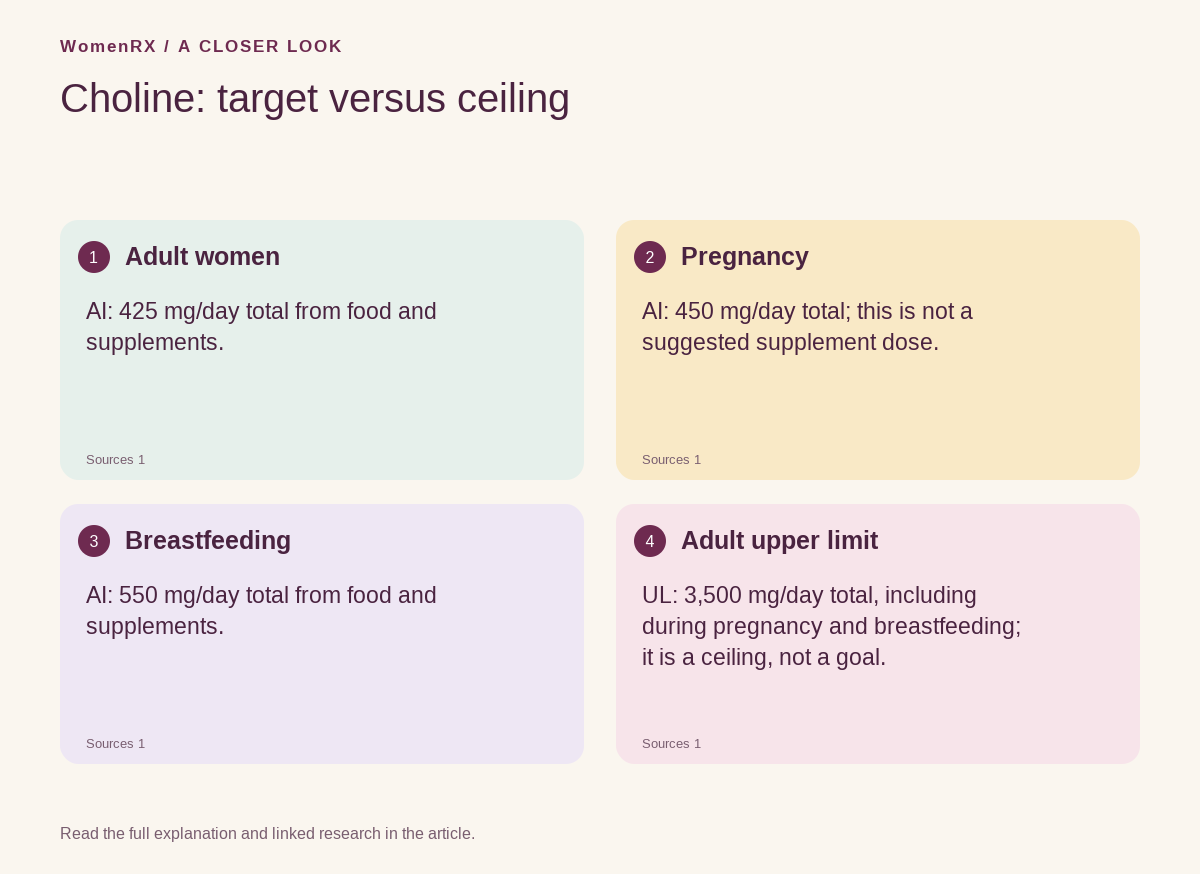
For adult women, the adequate intake for choline is 425 mg per day; it’s 450 mg during pregnancy and 550 mg while breastfeeding. These are totals from food and supplements, not suggested supplement doses. The upper limit is 3,500 mg per day for adults, including during pregnancy and breastfeeding. Staying below it doesn’t establish that a particular supplement is proven safe for years of use. 1

Start with your total, not the supplement bottle
Choline is found in foods such as eggs, meat, fish, dairy, soybeans, beans, and some vegetables. Supplements may contain choline on its own or as part of a multivitamin, prenatal, B-complex product, or another formula. For an intake check, add the choline you get from food to the amounts listed for all your supplements. 1
For example, one large hard-boiled egg contains 147 mg of choline, and 3 ounces of roasted chicken breast contains 72 mg. Together that’s 219 mg, before counting anything else you eat or take. Food labels aren’t required to list choline unless it’s been added, so a label may not give you a complete food total. 1
If your supplement routine includes several products, check each label for choline rather than assuming a prenatal or multivitamin is the only source. The NIH fact sheet describes supplement amounts commonly ranging from 10 to 250 mg, but products and combinations vary. It also reports that studies haven’t compared the relative bioavailability of the different supplement forms, including choline bitartrate, phosphatidylcholine, and lecithin. 1
An intake target is not a supplement dose
The reference intake for healthy women ages 19 and older is an Adequate Intake (AI) of 425 mg per day. It rises to 450 mg during pregnancy and 550 mg while breastfeeding. These figures are for total daily intake, not an amount to add on top of food. During pregnancy or breastfeeding, compare your total with the life-stage figure rather than automatically adding a separate choline supplement. 1
The AI is not a measure of how much choline a particular woman must take in pill form. It was set because evidence wasn’t sufficient to establish an Estimated Average Requirement, and the choline AI was based on preventing liver damage. The fact sheet also notes that choline needs can be influenced by factors including pregnancy, lactation, diet, and individual biology. 1
That distinction matters if your total looks below the AI: it doesn’t by itself show that you have a deficiency or that a supplement will improve an outcome. The fact sheet reports that frank deficiency is very rare in healthy nonpregnant women, even though many people consume less than the AI. 1
The upper limit is a ceiling, not a goal
For adults, the Tolerable Upper Intake Level (UL) is 3,500 mg per day. It applies to total intake from food and supplements and is the same for women who are pregnant or breastfeeding. The UL is the level unlikely to cause adverse effects for healthy people, not a recommended amount to approach or a guarantee that long-term use below it has been studied for every product or person. 1
High choline intake has been associated with fishy body odor, vomiting, excessive sweating and salivation, low blood pressure, and liver toxicity. The UL was set based on amounts associated with low blood pressure and fishy body odor. If you’re using more than one product, counting only the single-supplement dose could miss your total exposure. 1
What long-term evidence can tell you
A reference limit and a record of possible adverse effects are useful for a safety check, but they don’t answer every question about taking a particular supplement every day for years. A 2023 review of over-the-counter supplements marketed for memory called for more rigorous research on long-term use; it does not establish long-term safety for choline supplements specifically. 2
There’s also no basis here to assume that taking more choline will improve memory or another health outcome. The NIH fact sheet describes limited and mixed evidence for possible health benefits, and reports that a systematic review found no clear cognitive improvement from choline supplements in healthy adults. 1
A practical next step is to write down the choline amounts from your regular foods and every supplement, then compare the total with the AI for your life stage and keep it below the UL. If you’re pregnant or breastfeeding, or considering a high-dose product, bring the product label and your total to the person managing your care so the discussion is about your complete intake, not just one capsule.
Choline: target versus ceiling
Adult women: AI: 425 mg/day total from food and supplements.1
Pregnancy: AI: 450 mg/day total; this is not a suggested supplement dose.1
Breastfeeding: AI: 550 mg/day total from food and supplements.1
Adult upper limit: UL: 3,500 mg/day total, including during pregnancy and breastfeeding; it is a ceiling, not a goal.1
Read the figure as text
Compare total daily intake from food and supplements with the life-stage AI, then keep the separate adult upper limit in view.- Adult women: AI: 425 mg/day total from food and supplements.1
- Pregnancy: AI: 450 mg/day total; this is not a suggested supplement dose.1
- Breastfeeding: AI: 550 mg/day total from food and supplements.1
- Adult upper limit: UL: 3,500 mg/day total, including during pregnancy and breastfeeding; it is a ceiling, not a goal.1
More questions, answered
Does the upper limit apply during pregnancy and breastfeeding?
Yes. For adults, the choline UL is 3,500 mg per day during pregnancy and lactation as well as for other adults. It counts food and supplements together. 1
Is choline known to interact with medications?
The NIH Office of Dietary Supplements fact sheet says choline is not known to have clinically relevant medication interactions. That doesn’t answer whether a specific product’s other ingredients interact with a medicine, so check the full label. 1
Sources you can check
- Choline - Health Professional Fact SheetAccessed 2026-09-25Return to first citation
- Over the Counter Supplements for Memory: A Review of Available Evidence.Hersant H, He S, Maliha P, Grossberg G. · CNS drugs · 2023Return to first citation