How to Add Up Choline From Food and Supplements
Compare your usual food and supplement intake with the right life-stage reference, without mistaking an intake guide for a supplement dose.
For U.S. women, the adequate intake (AI) for choline is 425 mg a day from age 19, 450 mg during pregnancy, and 550 mg while breastfeeding; for ages 14-18, it is 400 mg, 450 mg, and 550 mg, respectively. Add choline from food, multivitamins, and standalone supplements, then compare the total with the AI and the upper limit. The AI is a reference, not a prescribed supplement dose. 1
Start with the right reference
Choline guidance changes with age and life stage. In the U.S., the adequate intake (AI) is 425 mg a day for women age 19 and older, 450 mg during pregnancy, and 550 mg while breastfeeding. For ages 14-18, the corresponding values are 400 mg, 450 mg, and 550 mg. These amounts refer to total daily intake, not to how much to take as a supplement. 1
An AI is used because there isn’t enough evidence to set a Recommended Dietary Allowance (RDA) for choline. It’s a planning reference for healthy people, not a test of whether you’re deficient. Falling short on an estimate doesn’t by itself diagnose a deficiency or tell you that you need a pill. 1
Make a simple total-intake worksheet
Use a typical day as an estimate. Choline comes from many foods, and the amount can add up across meals.
| Source | What to write down |
|---|---|
| Food and drinks | Food, portion, and choline amount, if available |
| Multivitamin or prenatal | Choline amount listed per serving |
| Standalone choline product | Choline amount listed per serving |
| Daily total | Add the amounts from all three rows |
For a concrete food example, one large hard-boiled egg has about 147 mg of choline, 3 ounces of roasted chicken breast has 72 mg, and half a cup of cooked broccoli has 31 mg. Together, those portions provide about 250 mg. If a supplement label lists another 100 mg of choline per serving, the illustrative total is 350 mg. That’s an example of the arithmetic, not a suggested menu or dose. 1
The label may not give you a complete food tally: U.S. food labels aren’t required to list choline unless it has been added. Food sources include eggs, meat, poultry, fish, and dairy, as well as soybeans, beans, nuts, seeds, whole grains, and vegetables such as broccoli and Brussels sprouts. 1
Check every supplement you use, not just the one marketed for choline. Choline can appear in a multivitamin or B-complex product as well as a standalone supplement. A prenatal label deserves a close look: formulations vary, and many contain little or no choline. In a 2022 evaluation of 188 prenatal supplements on the U.S. market, 40% contained choline, with a median of 25 mg per serving among those products. 12
Compare the total with the upper limit
For healthy adults age 19 and older, the tolerable upper intake level (UL) is 3,500 mg per day. For ages 14-18, including during pregnancy or lactation, it is 3,000 mg per day. These ULs count choline from both food and supplements. They’re not goals to aim for: they mark daily intake levels unlikely to cause harm for healthy people, and they don’t apply to high doses used under medical supervision. 1
Very high choline intake can cause a fishy body odor, vomiting, excessive sweating or salivation, low blood pressure, and liver toxicity. If you’re considering adding a product, compare its listed choline amount with what you already get from your multivitamin or prenatal and your usual food intake. 1
Pregnancy and breastfeeding change the comparison
The AI rises during pregnancy and breastfeeding, and the two life stages have different reference values: 450 mg a day in pregnancy and 550 mg while breastfeeding for adults. Choline is involved in cell membranes and nervous system function, and it is relevant to fetal growth and early development. 12
The reference value doesn’t mean that taking a choline supplement at that amount has been shown to improve a pregnancy or a child’s development. A rapid review of supplementation studies in healthy pregnant people found mixed evidence for infant and child neurodevelopment outcomes. The practical use of the AI is to compare total intake with a planning reference, not to justify a high-dose product for a promised outcome. 4
If you’re pregnant and considering a separate choline product, have your prenatal care team review it alongside your prenatal vitamin. Supplement formulas vary, so the actual label matters more than the product category. 23
What to take from the calculation
A food-and-label total can show where your intake seems to sit relative to the AI, while the UL helps flag a very different question: whether total intake is unusually high. Don’t treat the gap between your estimate and the AI as an automatic supplement dose. If your usual foods are hard to estimate, or you’re weighing a product during pregnancy or breastfeeding, use the calculation as a starting point for a focused discussion about your diet and the exact label.
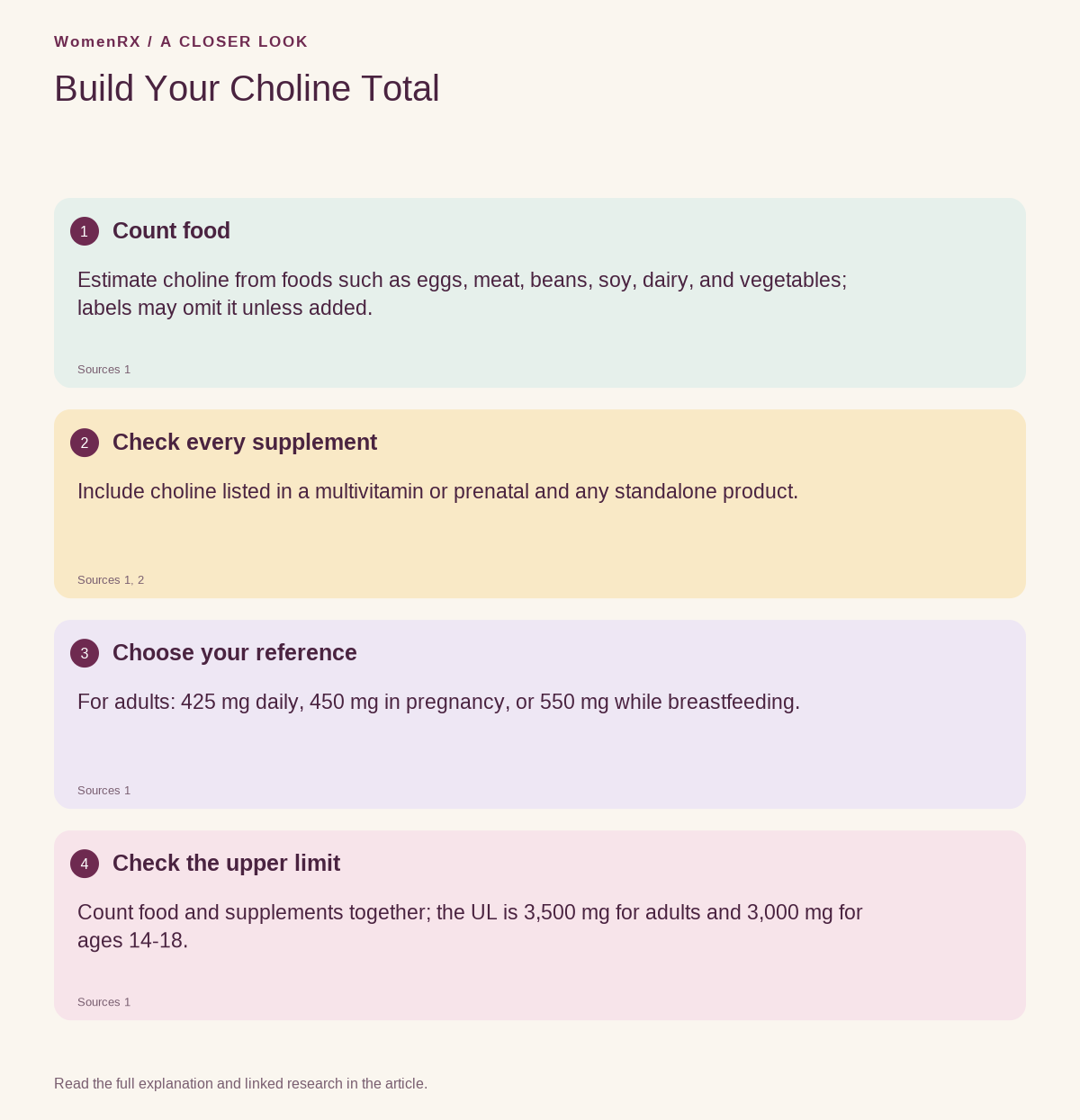
Build Your Choline Total
Count food: Estimate choline from foods such as eggs, meat, beans, soy, dairy, and vegetables; labels may omit it unless added.1
Check every supplement: Include choline listed in a multivitamin or prenatal and any standalone product.12
Choose your reference: For adults: 425 mg daily, 450 mg in pregnancy, or 550 mg while breastfeeding.1
Check the upper limit: Count food and supplements together; the UL is 3,500 mg for adults and 3,000 mg for ages 14-18.1
Read the figure as text
Add each source once, then compare the total with the AI for your life stage and the relevant upper limit.- Count food: Estimate choline from foods such as eggs, meat, beans, soy, dairy, and vegetables; labels may omit it unless added.1
- Check every supplement: Include choline listed in a multivitamin or prenatal and any standalone product.12
- Choose your reference: For adults: 425 mg daily, 450 mg in pregnancy, or 550 mg while breastfeeding.1
- Check the upper limit: Count food and supplements together; the UL is 3,500 mg for adults and 3,000 mg for ages 14-18.1
More questions, answered
Does being below the AI mean I have a choline deficiency?
No. The AI is a planning reference, not a diagnostic cutoff. The evidence was not sufficient to establish an RDA for choline, and frank deficiency is rare in healthy men and nonpregnant women. 1
Are different forms of choline supplements interchangeable?
Common forms include choline bitartrate, phosphatidylcholine, and lecithin, but studies have not compared the relative bioavailability of these forms. The available evidence doesn’t establish that one is better absorbed than another. 1
Sources you can check
- Choline - Health Professional Fact SheetAccessed 2026-09-25Return to first citation
- Dietary Supplements and Life Stages: Pregnancy - Health Professional Fact SheetAccessed 2026-09-25Return to first citation
- Pregnancy and Medicines | MedlinePlusAccessed 2026-09-25Return to first citation
- Choline Supplementation for Infants, Children, and Pregnant People: Rapid Review2024Return to first citation