When to Take Choline: Morning or Night?
Choline guidance focuses on how much you get over a day, not a preferred time to take a supplement.
There’s no morning-or-night schedule in NIH’s choline guidance, which describes daily intake, supplement forms, and safety instead. Follow your product’s directions, then choose a time that fits your routine. Before adding a separate supplement, check your multivitamin or prenatal and other products for choline, phosphatidylcholine, or lecithin so you can see what you’re already getting. 1
Pick a time you can stick with
Morning and bedtime aren’t established as better times to take choline in NIH’s nutrition guidance. It describes choline as a daily nutrient and lists common supplement forms, but doesn’t set a time-of-day schedule. That doesn’t tell us whether direct morning-versus-night comparisons have found a difference; it means a preferred time isn’t established by this guidance. 1
For a practical routine, follow the directions on your specific product and choose a time you’re likely to remember. If its directions give a specific instruction, use that rather than assuming all choline products are taken the same way. The available guidance doesn’t establish that taking choline with food, in the morning, or at night is superior.
Choline supplements come in different forms, including choline bitartrate, phosphatidylcholine, and lecithin. NIH notes that studies haven’t compared the relative bioavailability of these forms, so the form’s name alone doesn’t establish a best time to take it. 1
If you’re considering choline for cognitive performance, that’s a separate question from timing. A systematic review that included choline among supplements marketed for cognitive performance described the evidence as low-certainty and inconsistent, making consumer recommendations difficult. It doesn’t provide a basis for choosing morning over night. 2
Check for choline in other products
Before adding a stand-alone supplement, look at the Supplement Facts panels on the products you already take. Choline may be included in a multivitamin, a B-complex, or another supplement. Check for choline and forms such as phosphatidylcholine; lecithin is also a choline-containing source. 1
This is especially worth doing if you take a prenatal. NIH reports that prenatal supplements typically contain little or no choline, but products vary, so check your own label rather than assuming it supplies none or enough. 1
Think about total intake from food and supplements, not just the amount in one capsule. Choline also comes from foods such as eggs, meat, fish, dairy, beans, and some vegetables. 1
Keep daily intake separate from timing
Pregnancy and lactation change the daily Adequate Intake (AI), not the time-of-day guidance. For women age 19 and older, the AI is 425 mg per day; it’s 450 mg during pregnancy and 550 mg while breastfeeding. These are daily intake reference values, not instructions for how much supplement to take. 1
The adult Tolerable Upper Intake Level is 3,500 mg per day, including choline from food and supplements; the same limit applies during pregnancy and lactation. It’s a safety ceiling, not a target. Taking more or splitting a supplement across different times of day doesn’t make that ceiling higher. 1
So, if you use choline, there’s no established clock-based advantage to chase in this guidance. Check the product directions, add up the sources you’re using, and choose a manageable time.
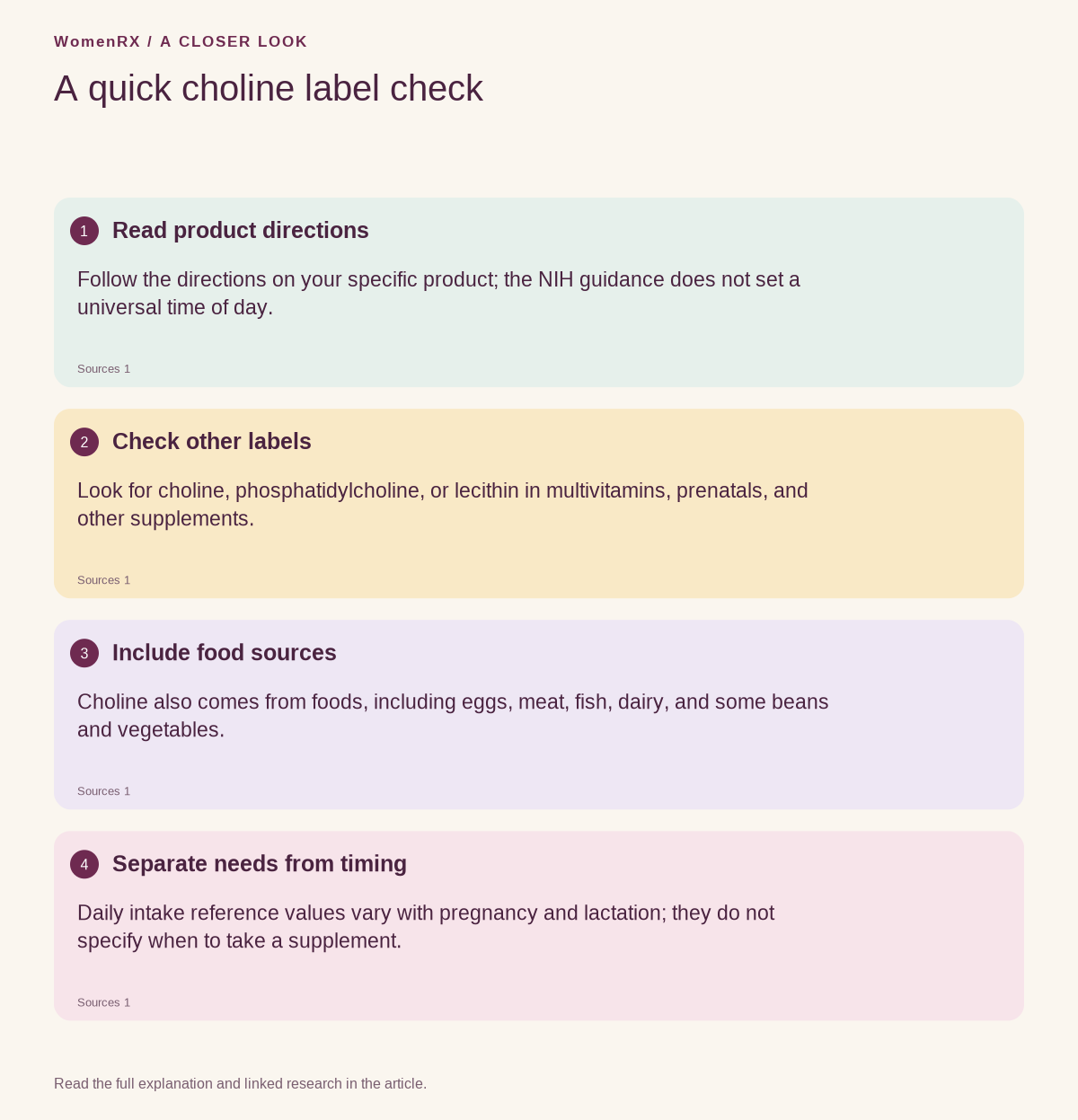
A quick choline label check
Read product directions: Follow the directions on your specific product; the NIH guidance does not set a universal time of day.1
Check other labels: Look for choline, phosphatidylcholine, or lecithin in multivitamins, prenatals, and other supplements.1
Include food sources: Choline also comes from foods, including eggs, meat, fish, dairy, and some beans and vegetables.1
Separate needs from timing: Daily intake reference values vary with pregnancy and lactation; they do not specify when to take a supplement.1
Read the figure as text
Use this checklist to keep supplement timing practical while checking for overlapping sources and daily intake.- Read product directions: Follow the directions on your specific product; the NIH guidance does not set a universal time of day.1
- Check other labels: Look for choline, phosphatidylcholine, or lecithin in multivitamins, prenatals, and other supplements.1
- Include food sources: Choline also comes from foods, including eggs, meat, fish, dairy, and some beans and vegetables.1
- Separate needs from timing: Daily intake reference values vary with pregnancy and lactation; they do not specify when to take a supplement.1
More questions, answered
Should I take choline with food?
The NIH choline guidance doesn’t establish that taking a supplement with food is better. Follow the directions on your product rather than treating one schedule as universal. 1
Does my prenatal vitamin contain choline?
Some prenatal products may contain little or no choline, so check the Supplement Facts panel on yours. If it lists choline, also check whether other supplements you take contain choline or choline-containing ingredients. 1
Sources you can check
- Choline - Health Professional Fact SheetAccessed 2026-09-25Return to first citation
- Dietary Supplement Ingredients for Optimizing Cognitive Performance Among Healthy Adults: A Systematic Review.Crawford C, Boyd C, Deuster PA. · Journal of alternative and complementary medicine (New York, N.Y.) · 2021Return to first citation