Choline Safety: Side Effects and How to Count It
The adult upper limit counts choline from food and supplements together, so overlapping products matter more than any one bottle alone.
For adults, the choline upper limit is 3,500 mg a day from all sources, including food and supplements. It’s a safety ceiling, not an intake goal. High intakes have been linked with fishy body odor, vomiting, sweating, excess saliva, low blood pressure, and liver toxicity. Check prenatal vitamins, multivitamins, standalone choline, and fortified products for overlap. 1
Choline can show up in more places than a standalone supplement: a prenatal vitamin, a multivitamin, a product with lecithin, and some fortified foods may all contribute. To assess a product, look at the choline amount per serving and how many servings you take, then check the other products you use. The safety limit applies to your total intake, not just the amount in one supplement. 1
The upper limit is a ceiling, not a target
For adults 19 and older, the tolerable upper intake level (UL) for choline is 3,500 mg per day. That includes choline from food and supplements, and the same UL applies during pregnancy and lactation. For ages 14-18, including pregnancy and lactation, it’s 3,000 mg per day. The UL is the maximum daily intake unlikely to cause adverse effects; it isn’t a recommended amount to aim for. 1
The recommended adequate intake (AI) is a different reference point. For adult women, it’s 425 mg per day, 450 mg during pregnancy, and 550 mg during lactation. These are intake references, not safety ceilings. The gap between an AI and the UL is not a reason to take extra choline. 1
How to spot product overlap
Check the Supplement Facts panel on every supplement you take, including products marketed for pregnancy or breastfeeding. Choline can be listed as a nutrient or supplied in forms such as choline bitartrate, phosphatidylcholine, or lecithin. If a label lists a compound but doesn’t make clear how much choline it provides, don’t treat the compound’s full weight as choline; ask the manufacturer or a pharmacist to clarify. The amount of choline in supplements varies, and research hasn’t compared how well the different forms are absorbed. 1
Food counts too. Eggs, meat, fish, dairy, beans, and some vegetables contain choline; some fortified foods may add it. FDA doesn’t require food labels to list choline unless it has been added, so a package label may not tell you everything you consume. If you’re estimating a total, separate what you can read directly from labels from what you’re estimating from food. 1
This overlap check is particularly useful in pregnancy and while breastfeeding, when someone may use a prenatal or postnatal product along with a separate choline supplement. Compare the listed amounts before adding another product, and use the relevant AI as context rather than treating the UL as a goal. 1
What high intake can do, and what remains uncertain
Recognized concerns at high intakes include fishy body odor, vomiting, excessive sweating or salivation, low blood pressure, and liver toxicity. The UL was set based on amounts associated with low blood pressure and fishy body odor. Those effects are reasons to take an unexpectedly high total seriously, not evidence that everyone taking an ordinary dose will experience them. 1
There’s also a proposed heart-health concern: gut bacteria can convert some choline into trimethylamine, which the liver converts into TMAO, a compound associated with cardiovascular risk. The relationship between choline intake and cardiovascular disease is not settled; the reference summarizes observational studies with mixed findings. That association does not show that a usual choline supplement causes heart disease. 1
Safety findings for one form shouldn’t be assumed to cover every product or long-term use. For example, an eight-week placebo-controlled study of lysolecithin in 46 healthy adults reported no adverse events attributed to the supplement. That small, short study can’t establish the long-term safety of other choline forms. 2
When to review your total with someone
If you have a medical condition, take several supplements, or have been advised to use a high dose under medical supervision, review the full product list and amounts with your care team or pharmacist. The NIH reference reports no known clinically relevant medication interactions with choline, but that doesn’t establish that every product or high-dose regimen fits every person’s circumstances. 1
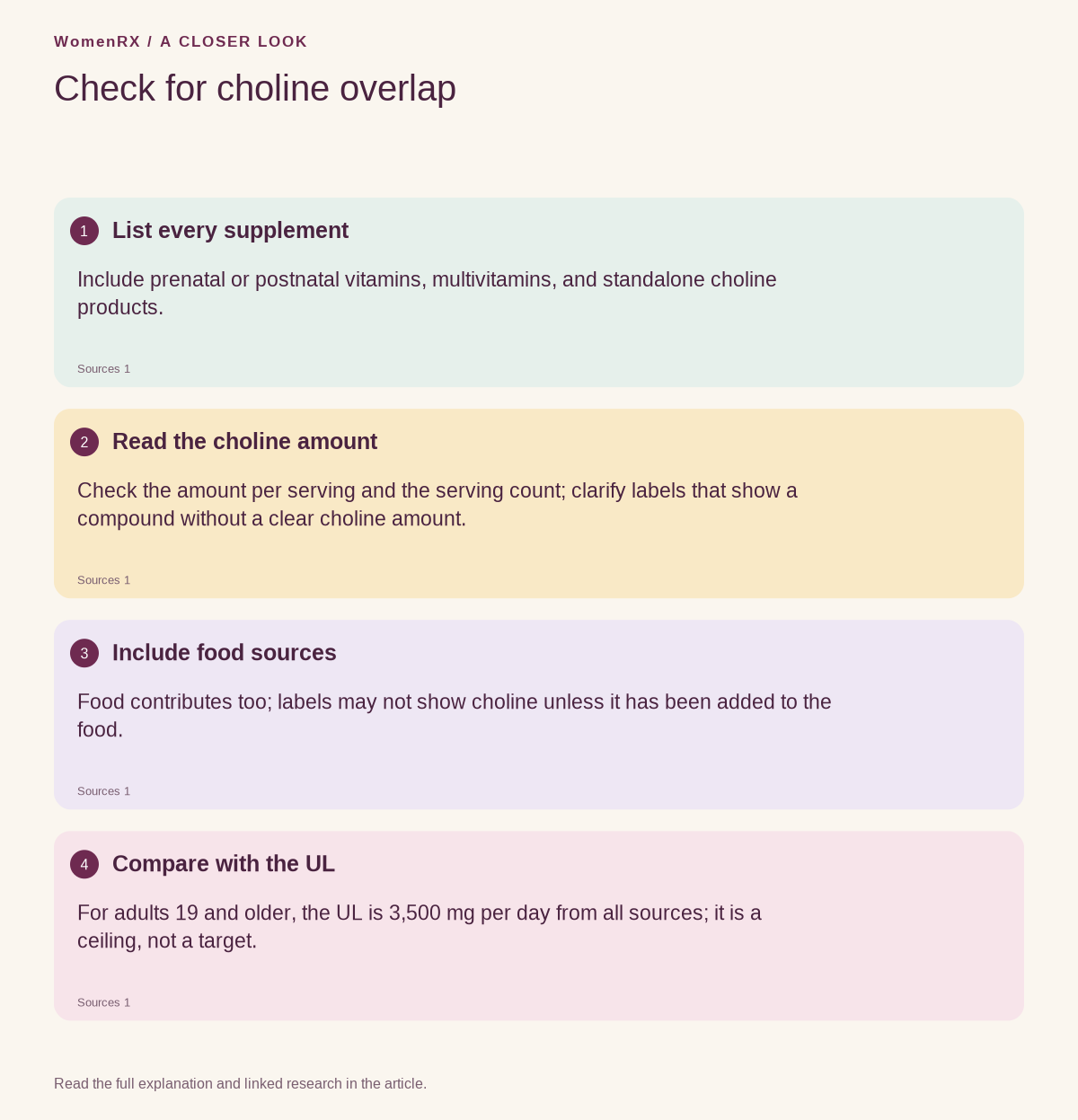
Check for choline overlap
List every supplement: Include prenatal or postnatal vitamins, multivitamins, and standalone choline products.1
Read the choline amount: Check the amount per serving and the serving count; clarify labels that show a compound without a clear choline amount.1
Include food sources: Food contributes too; labels may not show choline unless it has been added to the food.1
Compare with the UL: For adults 19 and older, the UL is 3,500 mg per day from all sources; it is a ceiling, not a target.1
Read the figure as text
Use this quick audit to compare products and foods with the total-intake safety limit, without treating that limit as a goal.- List every supplement: Include prenatal or postnatal vitamins, multivitamins, and standalone choline products.1
- Read the choline amount: Check the amount per serving and the serving count; clarify labels that show a compound without a clear choline amount.1
- Include food sources: Food contributes too; labels may not show choline unless it has been added to the food.1
- Compare with the UL: For adults 19 and older, the UL is 3,500 mg per day from all sources; it is a ceiling, not a target.1
More questions, answered
Does the choline upper limit include food?
Yes. The adult UL includes choline from food and supplements together, not just the dose in a supplement. 1
Is the upper limit the amount I should try to get?
No. It’s a safety ceiling, not a target. The AI is the separate intake reference; for adult women it is 425 mg per day, 450 mg during pregnancy, and 550 mg during lactation. 1
Sources you can check
- Choline - Health Professional Fact SheetAccessed 2026-09-25Return to first citation
- Effects of an 8-week intake of lysolecithin on cognitive function and concentrations of blood choline and lysophosphatidylcholine: a randomized, double-blinded, placebo-controlled trial.Tanaka-Kanegae R, Kimura H, Hamada K. · Journal of clinical biochemistry and nutrition · 2025Return to first citation