How to Count Choline Before Adding a Supplement
Check what you get from food and your prenatal first: pregnancy and breastfeeding have different choline intake targets, but a separate supplement isn’t automatically needed.
For women ages 19 and older, the adequate intake (AI) is 425 mg of choline daily; it’s 450 mg during pregnancy and 550 mg while breastfeeding. These are intake reference points, not proof that you’re deficient or a requirement to take a pill. Add up food and any choline listed in your prenatal or multivitamin before considering another product. 1 2
Start with your life stage, not the supplement aisle
Choline is an essential nutrient, and you get it from food as well as some supplements. For women 19 and older, the U.S. AI is 425 mg a day. It rises to 450 mg during pregnancy and 550 mg while breastfeeding. For ages 14-18, the corresponding figures are 400 mg, 450 mg, and 550 mg. 1
An AI, or adequate intake, is used when there isn’t enough evidence to set a recommended dietary allowance (RDA). It’s a helpful reference for planning, but it isn’t a test of whether an individual is deficient. The AI also doesn’t mean you need to get that amount from a supplement. 1
Make a rough total from food and products
Choline is found in many foods. In the NIH’s examples, one large hard-boiled egg provides 147 mg; 3 ounces of roasted chicken breast provides 72 mg; half a cup of cooked broccoli provides 31 mg; and a cup of quinoa provides 43 mg. These are examples, not a required menu, and amounts vary by food and serving. Meat, poultry, fish, dairy, and eggs are common sources; soybeans, beans, cruciferous vegetables, nuts, seeds, and whole grains contribute too. 1
A practical estimate has three parts:
- Think about your usual foods. Use typical portions and meals, rather than treating one unusual day as your normal intake. FoodData Central can help you look up foods, but food values are estimates.
- Check every relevant label. Look for choline on the Supplement Facts panel of your prenatal, multivitamin, or other supplement. Some products contain little or none. FDA doesn’t require choline to appear on food labels unless it has been added, so a label that omits it doesn’t mean the food contains none. 1 2
- Count each product once. If choline appears in more than one supplement, include each listed amount in your total. Then consider food and supplements together, not just the stand-alone choline bottle.
For example, if you eat eggs regularly and your prenatal lists some choline, both contribute. The useful next question is whether your usual total seems low for your life stage, not whether you can find a product with the largest number on its front label.
Why pregnancy and breastfeeding deserve a closer look
Choline supports cell structure and other functions, and it has roles in fetal growth and nervous-system development. Yet population estimates suggest many people get less than the AI. In U.S. data summarized by NIH, the average from food and beverages was 278 mg a day for adult women; an analysis of pregnant women found an average of 321 mg a day from food, and 7.7% were above the pregnancy AI. These group averages don’t tell you what you personally consume. 1 2
Prenatals aren’t a reliable shortcut to a particular choline total. In one evaluation of U.S. prenatal supplements, 40% contained choline, with a median of 25 mg per serving among those products. Check your own label rather than assuming your prenatal covers the AI. 2
Food patterns can matter. Eggs, meat, fish, and dairy are among the common sources; beans, soy, nuts, seeds, vegetables, and whole grains also contribute. If you avoid several common sources, or you’re pregnant or breastfeeding and unsure how your foods and products add up, bring the labels and a rough account of your usual meals to your prenatal care team. That gives you something concrete to review without assuming a separate supplement is right for everyone. 1 2
Evidence that a supplement improves pregnancy or child outcomes is a separate question from whether choline is an essential nutrient. A 2024 rapid review found mixed evidence for neurocognitive and neurodevelopmental outcomes in healthy pregnant people, with few studies and limitations including low statistical power. So don’t treat a higher supplement intake as a proven way to improve a child’s cognitive outcome. 4
Check the total before adding more
The tolerable upper intake level (UL) for adults 19 and older is 3,500 mg a day from all sources; during pregnancy and breastfeeding, the adult UL is also 3,500 mg. For ages 14-18, it’s 3,000 mg. A UL is a ceiling unlikely to cause adverse effects for most healthy people, not a target or a recommended dose. 1 2
Very high choline intakes have been associated with fishy body odor, vomiting, excessive sweating or salivation, low blood pressure, and liver toxicity. These effects are a reason not to stack products casually or assume that more is better. 1
Supplement forms include choline bitartrate, phosphatidylcholine, and lecithin. NIH reports that studies haven’t compared their relative bioavailability, so the form alone doesn’t establish that a product is better. Choline isn’t known to have clinically relevant medication interactions, but pregnancy is a reason to review a new supplement with your care team before taking it. 1 3
A useful question is: “Here are the choline amounts in my prenatal and other products, and the foods I usually eat. Does adding anything make sense for me?” That keeps the conversation focused on your total intake and life stage, rather than a broad promise about what choline might do.
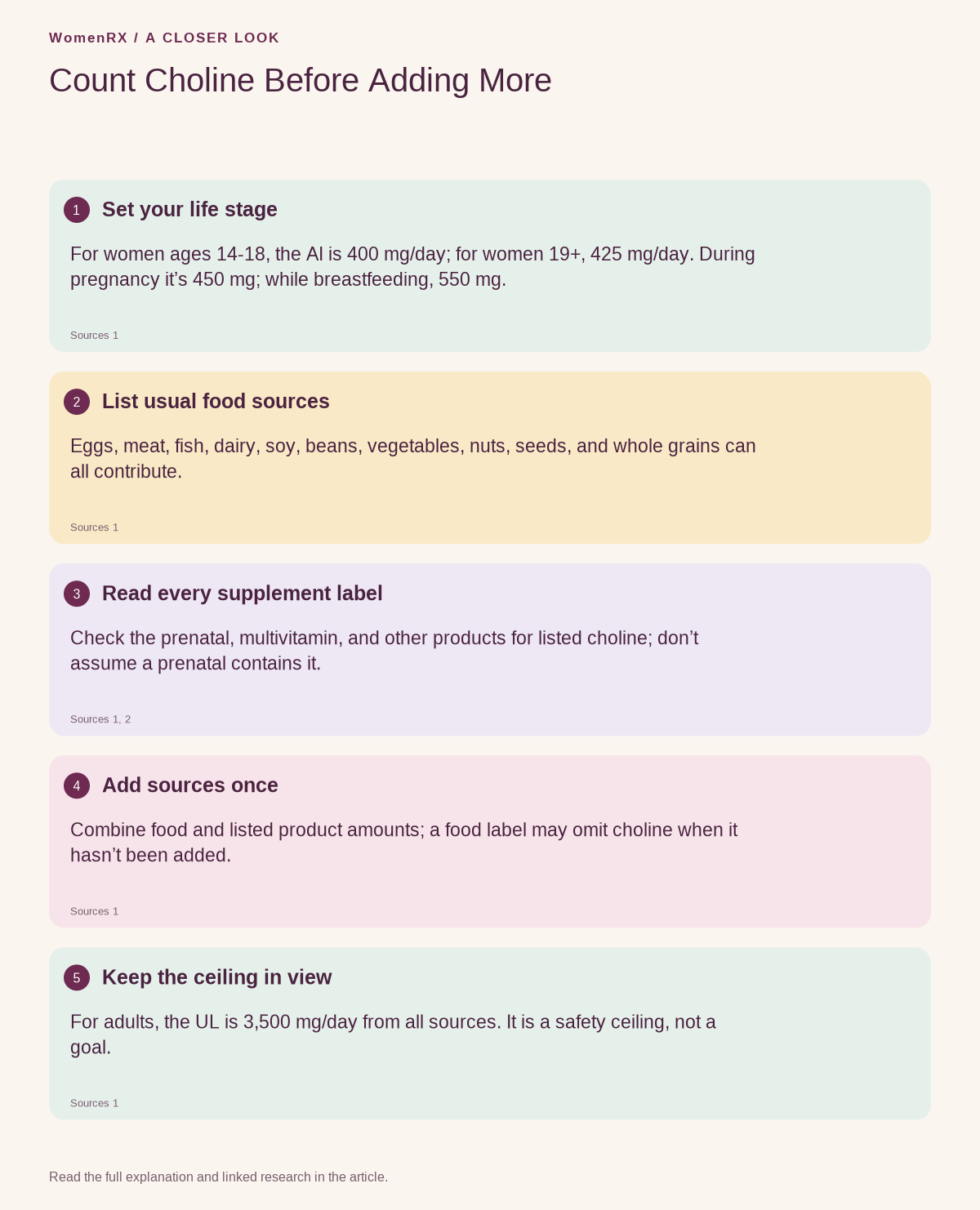
Count Choline Before Adding More
Set your life stage: For women ages 14-18, the AI is 400 mg/day; for women 19+, 425 mg/day. During pregnancy it’s 450 mg; while breastfeeding, 550 mg.1
List usual food sources: Eggs, meat, fish, dairy, soy, beans, vegetables, nuts, seeds, and whole grains can all contribute.1
Read every supplement label: Check the prenatal, multivitamin, and other products for listed choline; don’t assume a prenatal contains it.12
Add sources once: Combine food and listed product amounts; a food label may omit choline when it hasn’t been added.1
Keep the ceiling in view: For adults, the UL is 3,500 mg/day from all sources. It is a safety ceiling, not a goal.1
Read the figure as text
Use this sequence to estimate a total from foods and product labels, then compare it with the right life-stage reference.- Set your life stage: For women ages 14-18, the AI is 400 mg/day; for women 19+, 425 mg/day. During pregnancy it’s 450 mg; while breastfeeding, 550 mg.1
- List usual food sources: Eggs, meat, fish, dairy, soy, beans, vegetables, nuts, seeds, and whole grains can all contribute.1
- Read every supplement label: Check the prenatal, multivitamin, and other products for listed choline; don’t assume a prenatal contains it.12
- Add sources once: Combine food and listed product amounts; a food label may omit choline when it hasn’t been added.1
- Keep the ceiling in view: For adults, the UL is 3,500 mg/day from all sources. It is a safety ceiling, not a goal.1
More questions, answered
Does a prenatal vitamin usually contain enough choline?
Not necessarily. In one evaluation of U.S. prenatal supplements, 40% contained choline, and the median amount among those products was 25 mg per serving. Check your specific Supplement Facts panel. 2
Is the adequate intake the same as a supplement dose?
No. The AI is a reference for total daily intake, including food and supplements. It isn’t a dose recommendation or proof that you need a supplement. 1
Sources you can check
- Choline - Health Professional Fact SheetAccessed 2026-09-25Return to first citation
- Dietary Supplements and Life Stages: Pregnancy - Health Professional Fact SheetAccessed 2026-09-25Return to first citation
- Pregnancy and Medicines | MedlinePlusAccessed 2026-09-25Return to first citation
- Choline Supplementation for Infants, Children, and Pregnant People: Rapid Review2024Return to first citation