Choline in Food: Practical Sources for Pregnancy
Eggs, soybeans, meat, fish, dairy, and several vegetables can all add choline to your day.
During pregnancy, the Adequate Intake (AI) for choline is 450 mg a day. That’s a planning reference, not a test of deficiency. A large hard-boiled egg provides about 147 mg; soybeans, chicken, milk, beans, and vegetables contribute too. Looking at your usual foods and your prenatal label can help you decide what may be missing before assuming you need a supplement. 12
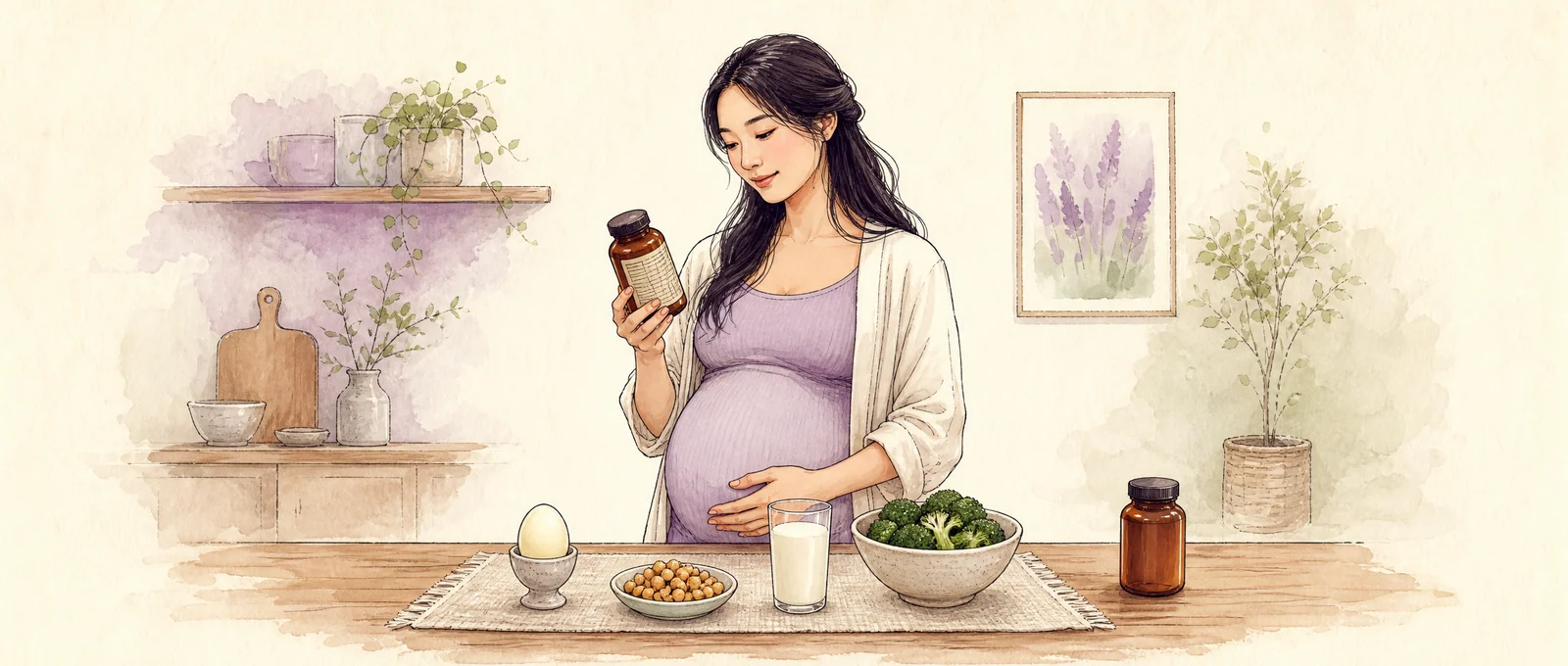
Choline comes from a mix of everyday foods, not just eggs or meat. During pregnancy, the Adequate Intake (AI) is 450 mg a day. You can use that figure to get a rough sense of how your food choices contribute, without treating it as a pass-or-fail target for every day. 1
What a serving can contribute
Meat, poultry, fish, dairy, and eggs are common sources of choline. Soybeans, some other beans, cruciferous vegetables, nuts, seeds, and whole grains contribute too. 1
Here are approximate amounts in selected servings: 1
- One large hard-boiled egg: 147 mg
- Half a cup of roasted soybeans: 107 mg
- Three ounces of roasted chicken breast: 72 mg
- Half a cup of canned kidney beans: 45 mg
- One cup of milk: 43 mg
- Half a cup of cooked broccoli: 31 mg
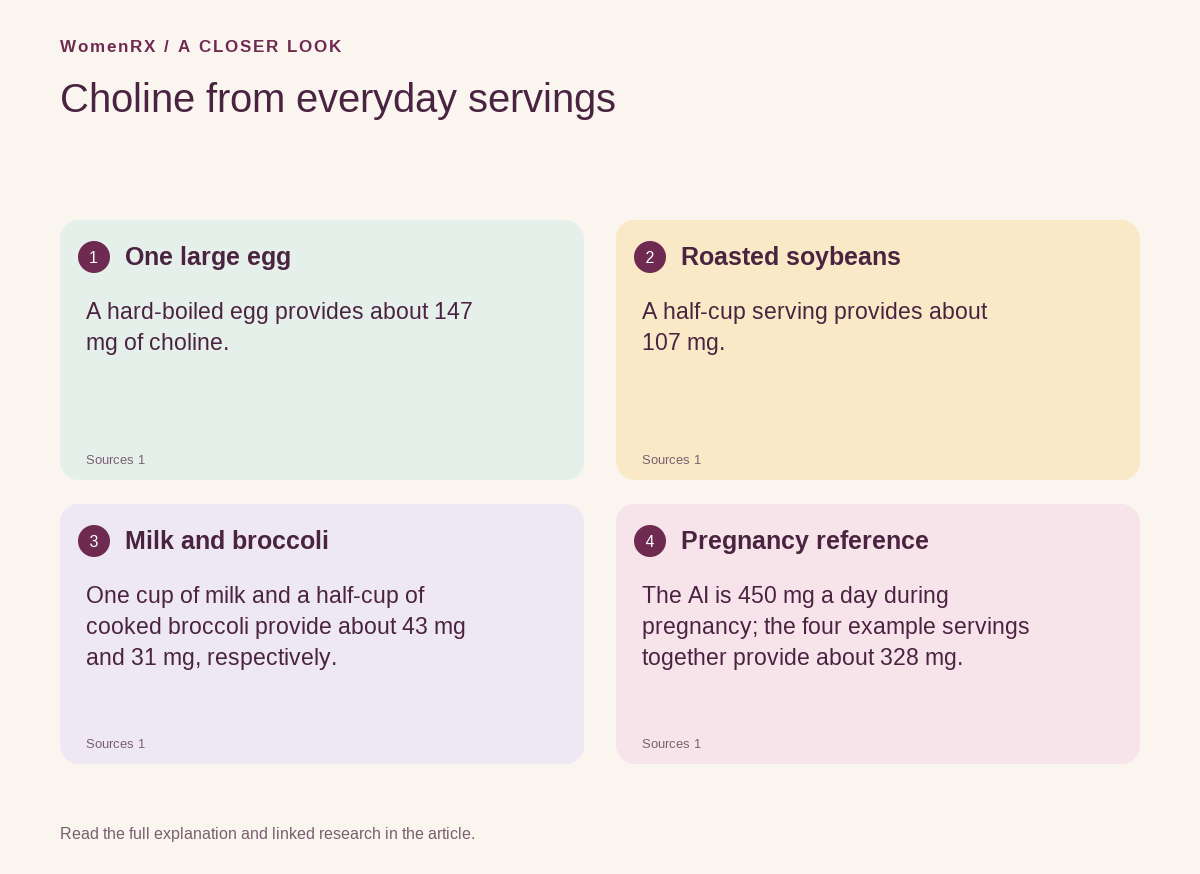
For example, an egg, half a cup of roasted soybeans, a cup of milk, and half a cup of cooked broccoli would provide about 328 mg in total, using these food-composition estimates. This shows how different foods can add up across a day; it isn’t a required menu or a guarantee of your exact intake. 1
Pregnancy and lactation have different reference amounts
For women ages 19 and older, the AI is 425 mg a day; it is 450 mg during pregnancy and 550 mg while lactating. For ages 14 to 18, the corresponding amounts are 400 mg, 450 mg, and 550 mg. These are Adequate Intakes, not Recommended Dietary Allowances: there wasn’t enough evidence to establish an Estimated Average Requirement for choline. So an estimate below the AI doesn’t, by itself, diagnose a deficiency. 1
Choline has roles in cell membranes, nervous-system function, and early development. U.S. pregnancy intake data suggest that reaching the AI through food can be challenging: in an analysis of pregnant women ages 20 to 40, mean food-derived choline intake was 321 mg a day, and 7.7% had an intake above the AI. Those figures describe a group, not your individual diet or health. 2
Estimate from the foods you actually eat
Start with foods that show up regularly in your meals, then use serving sizes as a rough guide. A varied pattern can include animal foods, plant foods, or both. If you avoid eggs or animal products, soybeans and other beans, along with vegetables, nuts, seeds, and whole grains, still contribute choline. The serving examples can help you spot larger contributions and see where smaller ones might add up. 1
Food-composition values are estimates for particular foods and preparations. Choline also may not appear on a Nutrition Facts label: U.S. food labels aren’t required to list it unless it has been added to the food. An absent label value doesn’t mean the food contains none. 1
Check what your prenatal actually contains
A prenatal vitamin doesn’t necessarily provide much choline. In a 2022 evaluation of 188 prenatal supplements on the U.S. market, 40% contained choline, and the median amount among those products was 25 mg per serving. That describes the products evaluated, not every product currently available, so check the label of the prenatal you use. 2
A practical next step is to look at your usual food pattern and the actual label, rather than assume that food alone covers your intake or that every pregnant woman needs extra choline. The AI is a planning reference; the information above supports identifying food sources and checking product content, not a claim that extra choline beyond your needs improves pregnancy outcomes. 12
Choline from everyday servings
One large egg: A hard-boiled egg provides about 147 mg of choline.1
Roasted soybeans: A half-cup serving provides about 107 mg.1
Milk and broccoli: One cup of milk and a half-cup of cooked broccoli provide about 43 mg and 31 mg, respectively.1
Pregnancy reference: The AI is 450 mg a day during pregnancy; the four example servings together provide about 328 mg.1
Read the figure as text
Compare approximate choline amounts in selected portions, then see how several foods can contribute together. The pregnancy AI is a planning reference, not a required menu.- One large egg: A hard-boiled egg provides about 147 mg of choline.1
- Roasted soybeans: A half-cup serving provides about 107 mg.1
- Milk and broccoli: One cup of milk and a half-cup of cooked broccoli provide about 43 mg and 31 mg, respectively.1
- Pregnancy reference: The AI is 450 mg a day during pregnancy; the four example servings together provide about 328 mg.1
More questions, answered
If choline isn’t listed on a food label, does the food contain none?
Not necessarily. U.S. food labels aren’t required to list choline unless it has been added to the food, so a label may not show naturally occurring choline. 1