Can You Get Enough Choline From Food?
A few familiar foods can add up, but your life stage changes the reference point.
Yes, food can contribute meaningful choline, and a mix of animal foods or plant foods can add up across the day. For women ages 19 and older, the Adequate Intake (AI) is 425 mg daily, rising to 450 mg during pregnancy and 550 mg while lactating. A food estimate can help you spot patterns, but one day’s total can’t determine whether your usual intake is adequate. 1
Start with the right reference point
For women ages 19 and older, the choline Adequate Intake is 425 mg a day. It’s 450 mg during pregnancy and 550 mg while lactating. These are AIs, not Recommended Dietary Allowances: an AI is used when there isn’t enough evidence to set an RDA. That difference matters because a total below the AI doesn’t, by itself, establish that an individual is deficient. 1
The body can make some choline, and need can vary with factors including pregnancy, lactation, and the amounts of other nutrients in the diet. The reference is useful for comparing food patterns, not as a pass-or-fail score for a single day. 1
Build a rough estimate from foods you eat
Choline is spread across foods rather than limited to one “must-eat” item. In the NIH’s food examples, one large hard-boiled egg provides 147 mg; a cup of milk, 43 mg; half a cup of kidney beans, 45 mg; a cup of cooked quinoa, 43 mg; and half a cup of broccoli, 31 mg. Meat, fish, soybeans, potatoes, and other foods contribute too. 1
Here’s an illustration using those serving sizes: an egg and a cup of milk at breakfast (190 mg), kidney beans, quinoa, and broccoli at lunch (119 mg), then 3 ounces of chicken and a large baked potato at dinner (129 mg). That adds up to about 438 mg. It’s a worked example, not a recommended menu or proof that someone’s usual intake is adequate. 1
For a plant-focused pattern, roasted soybeans provide 107 mg per half cup in the same reference table. Kidney beans, quinoa, broccoli, wheat germ, and other foods can add to the total. The servings in this list contribute different amounts, so estimating a plant-based pattern means counting several foods rather than assuming one serving of beans or vegetables covers the day. 1
A practical check: jot down several ordinary days, note approximate portions, and add food estimates using USDA FoodData Central. Food labels may not help much because choline generally isn’t required on the Nutrition Facts label unless it has been added to the food. 1
How pregnancy and lactation change the comparison
Use the pregnancy or lactation AI when comparing your intake, rather than the 425 mg reference for other adult women. For perspective, a dietary-assessment study of 103 pregnant women in Australia found eggs, red meat, nuts and legumes, and dairy were major contributors; eggs contributed the most among the reported food groups. Those results describe that study’s participants, not a required food pattern for every pregnant person. 12
Food sources can help you see what might be added or included more often, but an estimate from a few days is still only a rough picture. If you’re pregnant or lactating and your usual foods appear to contribute considerably less than the relevant AI, bring the estimate to a prenatal clinician or registered dietitian to discuss what fits your diet and whether a supplement needs consideration. 1
Read the estimate without overreading it
In a U.S. dietary survey analysis from 2013-2014, average choline intake from foods and beverages was 278 mg a day for adult women. That population average is a reason to look at food sources, not a prediction of any one woman’s intake or a diagnosis of deficiency. 1
The AI also has a limit as an individual assessment tool: there isn’t an Estimated Average Requirement for choline, so the AI can’t be used to estimate the proportion of people with inadequate intake in the way an EAR can. If your estimate is below the AI, look at your usual pattern and life stage rather than treating one day as a clinical result. 1
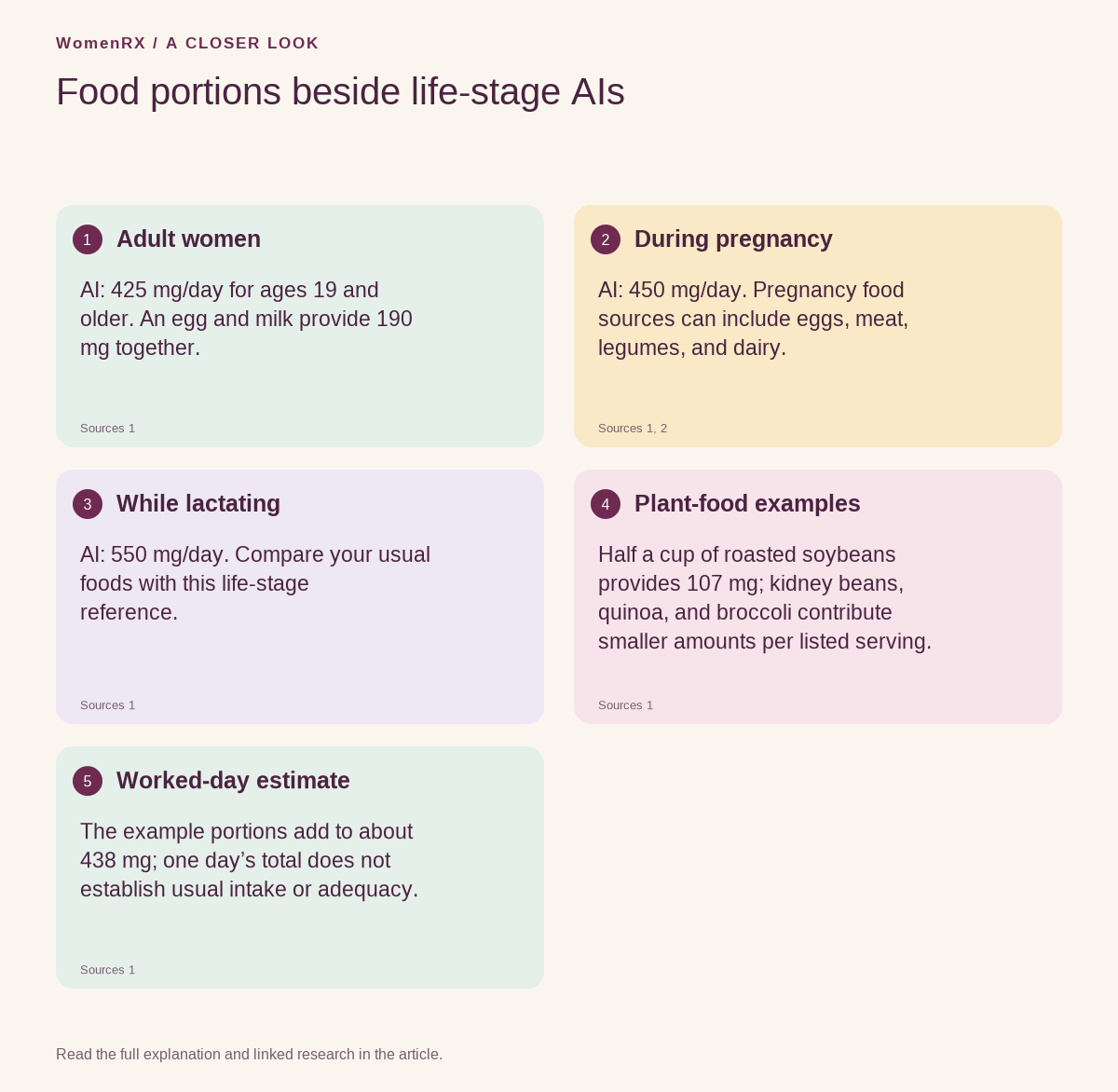
Food portions beside life-stage AIs
Adult women: AI: 425 mg/day for ages 19 and older. An egg and milk provide 190 mg together.1
During pregnancy: AI: 450 mg/day. Pregnancy food sources can include eggs, meat, legumes, and dairy.12
While lactating: AI: 550 mg/day. Compare your usual foods with this life-stage reference.1
Plant-food examples: Half a cup of roasted soybeans provides 107 mg; kidney beans, quinoa, and broccoli contribute smaller amounts per listed serving.1
Worked-day estimate: The example portions add to about 438 mg; one day’s total does not establish usual intake or adequacy.1
Read the figure as text
Compare several listed food portions with the adult, pregnancy, and lactation reference values. The example total is an illustration, not a target menu or assessment of usual intake.- Adult women: AI: 425 mg/day for ages 19 and older. An egg and milk provide 190 mg together.1
- During pregnancy: AI: 450 mg/day. Pregnancy food sources can include eggs, meat, legumes, and dairy.12
- While lactating: AI: 550 mg/day. Compare your usual foods with this life-stage reference.1
- Plant-food examples: Half a cup of roasted soybeans provides 107 mg; kidney beans, quinoa, and broccoli contribute smaller amounts per listed serving.1
- Worked-day estimate: The example portions add to about 438 mg; one day’s total does not establish usual intake or adequacy.1
More questions, answered
If I’m below the AI on one day, does that mean I’m deficient?
No. A one-day estimate describes that day, not your usual intake or choline status. Also, because an EAR hasn’t been established for choline, the AI isn’t a diagnostic cutoff for an individual. 1
Will my food labels show how much choline I’m getting?
Often they won’t. U.S. labels generally aren’t required to list choline unless it has been added to the food, so a food-composition database can be more useful for a rough estimate. 1
Sources you can check
- Choline - Health Professional Fact SheetAccessed 2026-09-25Return to first citation
- Estimated Choline Intakes and Dietary Sources of Choline in Pregnant Australian Women.Probst Y, Sulistyoningrum DC, Netting MJ, Gould JF, Wood S, Makrides M, Best KP, Green TJ. · Nutrients · 2022Return to first citation