Can You Get Enough Vitamin D From Food?
Food can contribute to your vitamin D intake, but fortified products often do more of the work than foods that contain it naturally.
You can get vitamin D from food, especially fatty fish and fortified products, but getting enough from unfortified food alone is difficult. U.S. adult intake guidance ranges from 600 to 800 IU a day, depending on age. Supplements may help some people meet their needs; an identified deficiency calls for a treatment plan rather than a food-only fix. 23
The difference between natural and fortified sources
A salmon dinner, an egg, and a bowl of fortified cereal can all contribute vitamin D, but they don't contribute in the same way. Fatty fish such as salmon, trout, tuna, and mackerel are among the best foods that naturally contain vitamin D. Egg yolks, beef liver, and cheese contain smaller amounts. Mushrooms contain variable amounts, so they aren't a predictable substitute for fish. Few foods naturally contain much vitamin D, which is why relying only on unfortified foods can be difficult. 2
Fortified foods have vitamin D added. Milk, some yogurts, and ready-to-eat cereals are familiar examples; some soy drinks are fortified too. The word some matters: a food isn't necessarily a vitamin D source just because it belongs to one of these categories. Check its label for vitamin D and the amount per serving. 13
Put a serving beside the daily guidance
U.S. recommended amounts for adults range from 600 to 800 international units (IU) a day, depending on age. Pregnancy and breastfeeding guidance is 600 IU a day. These are intake recommendations, not separate targets based simply on being a woman. 21
Here's one useful point of comparison: the NIH Office of Dietary Supplements lists a serving of ready-to-eat cereal fortified with 10% of the vitamin D Daily Value as providing 80 IU. That serving contributes vitamin D, but it's only part of a 600 IU day. Other cereals may differ, so the number on your own box is more useful than assuming every fortified cereal provides the same amount. 2
If you're trying to see what food can do for you, start with what you actually eat. For example, you might check the vitamin D line on the cereal and milk you have at breakfast, then consider whether fish is a regular part of your meals. That gives you a more realistic picture than counting every dairy product or every egg as though it were a major source. The distinction is between foods that contain vitamin D naturally, foods with vitamin D added, and supplements, which may already be included in a multivitamin. 21
For perspective, a U.S. dietary survey from 2015-2016 found that women averaged 168 IU of vitamin D a day from foods and beverages. That's well below the 600-800 IU adult intake guidance, but it isn't a diagnosis of deficiency: sunlight also affects vitamin D status, and an average can't tell you what any one person's blood level is. It does show why food choices, particularly whether fortified foods are in the mix, deserve a closer look. 2
When food isn't the whole answer
Your body can make vitamin D after sunlight reaches your skin, but sun exposure isn't a reliable food-plan replacement or a reason to seek extra sun: too much exposure raises the risk of skin damage and skin cancer. Vitamin D supplements are another source, including as part of some multivitamins. Both D2 and D3 raise blood vitamin D levels, though D3 may raise them higher and for longer. 1
A low dietary intake and a diagnosed vitamin D deficiency are different questions. The first is about what you're consuming; the second is about whether your body has enough. Absorption problems, gastric bypass surgery, and certain medicines can contribute to deficiency even when someone pays attention to food. If you've been told you have a deficiency, MedlinePlus describes supplements as the treatment. Food can remain part of your routine, but it shouldn't be expected to correct an identified deficiency on its own. 3
That leaves a practical choice: look at food labels if you're deciding how much vitamin D your usual meals provide, and account for any multivitamin or vitamin D supplement you already take. If a test has shown a deficiency, the useful question is what treatment and follow-up fit that result, rather than how many vitamin D foods you can add. 13
Where vitamin D comes from
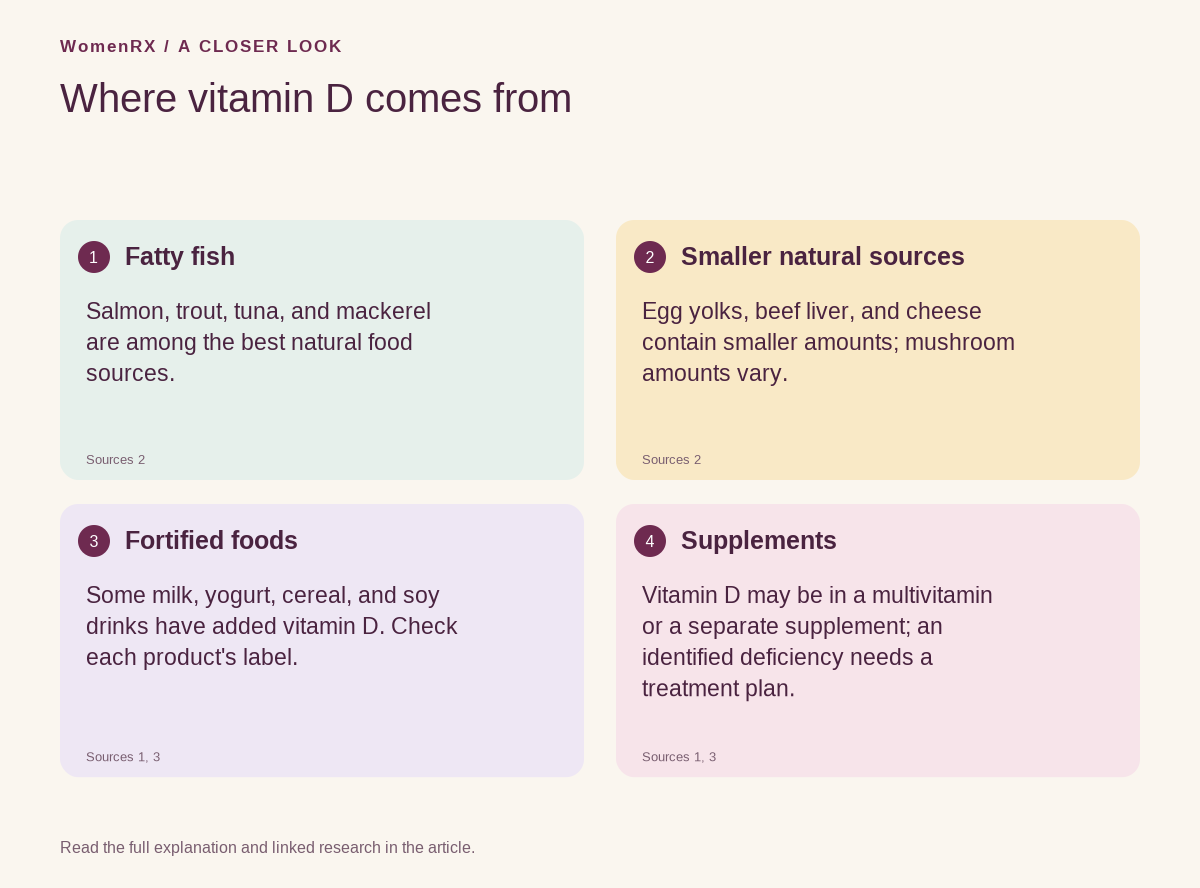
Fatty fish: Salmon, trout, tuna, and mackerel are among the best natural food sources.2
Smaller natural sources: Egg yolks, beef liver, and cheese contain smaller amounts; mushroom amounts vary.2
Fortified foods: Some milk, yogurt, cereal, and soy drinks have added vitamin D. Check each product's label.13
Supplements: Vitamin D may be in a multivitamin or a separate supplement; an identified deficiency needs a treatment plan.13
Read the figure as text
Compare what naturally contains vitamin D, what has it added, and when a supplement is a separate consideration.- Fatty fish: Salmon, trout, tuna, and mackerel are among the best natural food sources.2
- Smaller natural sources: Egg yolks, beef liver, and cheese contain smaller amounts; mushroom amounts vary.2
- Fortified foods: Some milk, yogurt, cereal, and soy drinks have added vitamin D. Check each product's label.13
- Supplements: Vitamin D may be in a multivitamin or a separate supplement; an identified deficiency needs a treatment plan.13
More questions, answered
If I'm breastfeeding, does my baby get enough vitamin D from breast milk?
Human milk is a poor source of vitamin D. MedlinePlus advises a daily 400 IU vitamin D supplement for breastfed infants. That's separate from the 600 IU daily intake guidance for someone who is breastfeeding. 3
Sources you can check
- Vitamin D: MedlinePlusAccessed 2026-09-25Return to first citation
- Vitamin D - Health Professional Fact SheetAccessed 2026-09-25Return to first citation
- Vitamin D Deficiency: MedlinePlusAccessed 2026-09-25Return to first citation