Vitamin D: When Testing and Supplements Make Sense
Vitamin D supports bone health, but whether a test or supplement helps depends on why you’re considering one.
Vitamin D helps your body absorb calcium. You can get it from food, supplements, and sunlight, but routine blood testing isn’t recommended for every healthy adult. Testing is more useful when a risk factor or health condition makes the result likely to change care. A supplement can raise your vitamin D level without necessarily improving other health outcomes. 1 2 4 5
Start with what vitamin D does
Vitamin D helps your body absorb calcium, a building block of bone. It also has roles in muscle, nerve, and immune function. Deficiency can contribute to loss of bone density. Those established roles matter, but they don’t mean that taking extra vitamin D prevents every condition associated with a low blood level. A review of clinical trials found no significant effect on the selected health outcomes it assessed in healthy adults ages 19 to 74. 1 2 5
You have three ways to get vitamin D: sunlight, food, and supplements. Fatty fish and egg yolks are among the few foods that contain it naturally. Some milk, cereals, and yogurt have vitamin D added; check the label rather than assuming every product does. Sunlight helps your skin make vitamin D, but getting more sun has a tradeoff because too much exposure can damage skin. 1 2
Decide whether a blood test would answer a useful question
The blood test used to assess vitamin D status measures 25-hydroxyvitamin D, often written as 25(OH)D. A test may be worth discussing if you have a reason to suspect deficiency, such as a condition that affects nutrient absorption, kidney or liver problems, or a medicine that affects vitamin D levels. Older adults and people with darker skin also have recognized risk factors. 1 3
That’s different from routinely testing everyone who feels well. Guidance summarized in a 2026 review advises against routine vitamin D testing in healthy adults. A systematic review supporting the 2024 Endocrine Society guideline did not identify trials testing whether screening with 25(OH)D improves health outcomes. The useful question before ordering a test is what you and your care team would do differently with the result. 4 5
If you already have a result, don’t read it as a universal pass-or-fail score. Laboratory methods can differ, and experts have not settled on one target that fits every clinical decision. The 2024 Endocrine Society guideline no longer endorses its former 30 ng/mL target or fixed categories for deficiency and sufficiency, according to the 2026 review. The reason for testing and your health history help give the number meaning. 4
Compare food and supplements without expecting a cure-all
If you’re thinking about a supplement, take stock of fortified foods and any multivitamin you already use. Supplements contain vitamin D2 or D3. Both raise blood vitamin D levels; D3 may raise them higher and for longer. Because vitamin D is fat soluble, it may be absorbed better with a meal or snack containing some fat. Raising a blood level, though, isn’t the same as demonstrating a benefit for a particular health outcome. 2 4
Pregnancy and breastfeeding bring different questions. MedlinePlus lists 600 IU per day as the recommended vitamin D amount for pregnant and breastfeeding women. That’s a general intake recommendation, not a treatment plan for someone with a low test result. A systematic review found low-certainty evidence suggesting possible benefits from supplementation for some maternal, fetal, and newborn outcomes, so it would overstate the findings to promise those benefits to every pregnant woman. 1 5
If you’re breastfeeding, your baby’s vitamin D needs are separate from yours: human milk is a poor source of vitamin D, and MedlinePlus recommends a daily vitamin D supplement for breastfed infants. 1
After menopause, bone health may be the reason vitamin D is on your mind. Its role in calcium absorption is well established, and deficiency can contribute to bone-density loss. That doesn’t establish that a vitamin D supplement by itself prevents fractures for every postmenopausal woman. The decision is better tied to your bone-health risks and whether deficiency is suspected than to a goal of pushing one lab number higher. 1 4
Keep the dosing tradeoff in view
More vitamin D isn’t automatically better. The systematic review found that high-dose intermittent supplementation may increase falls compared with lower-dose daily dosing. If you’re considering a supplement for general intake, that finding is a reason not to treat a high-dose schedule as interchangeable with an ordinary daily one. If a test has shown a low level, the approach depends on the result and the reason you were tested. 5
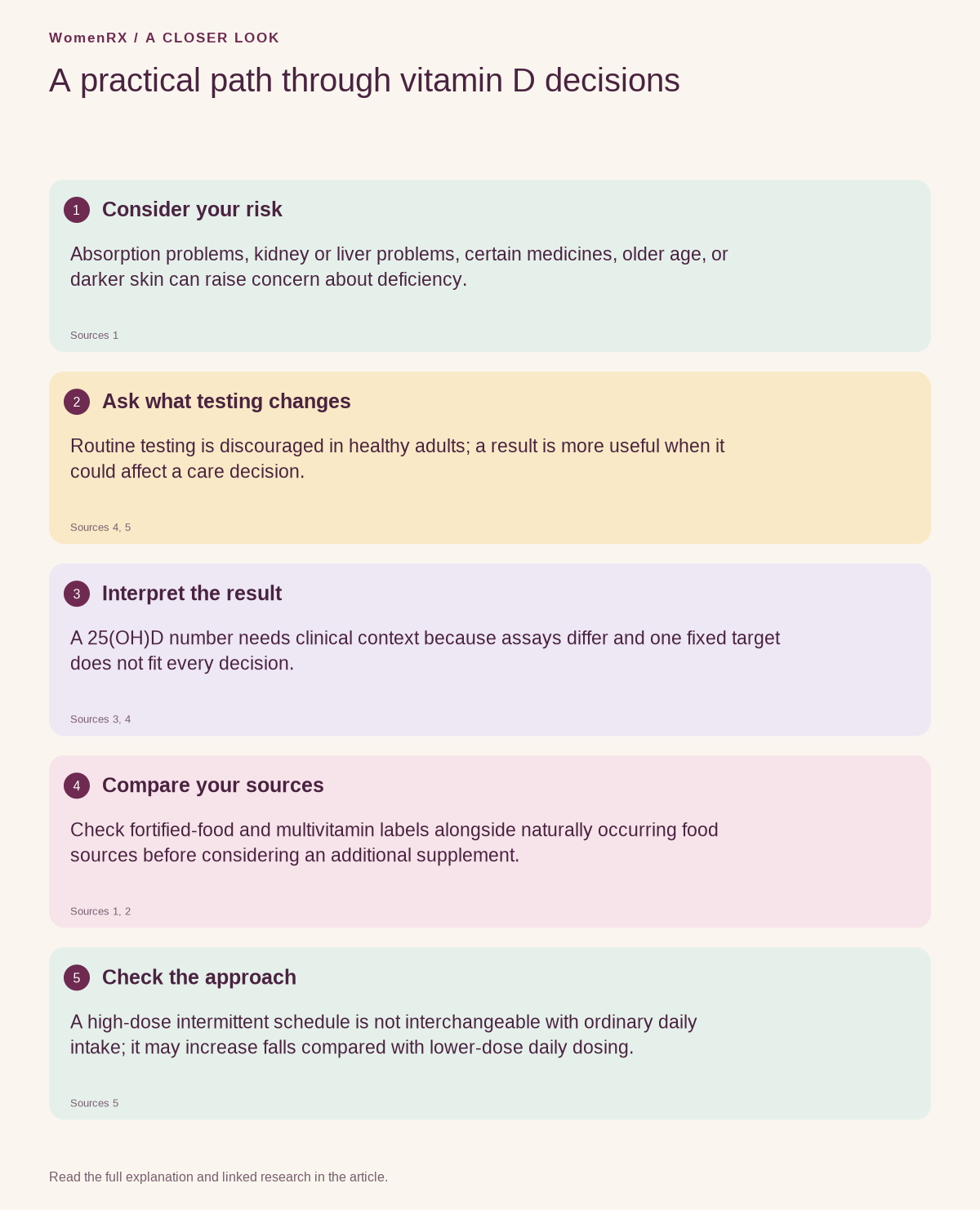
A practical path through vitamin D decisions
Consider your risk: Absorption problems, kidney or liver problems, certain medicines, older age, or darker skin can raise concern about deficiency.1
Ask what testing changes: Routine testing is discouraged in healthy adults; a result is more useful when it could affect a care decision.45
Interpret the result: A 25(OH)D number needs clinical context because assays differ and one fixed target does not fit every decision.34
Compare your sources: Check fortified-food and multivitamin labels alongside naturally occurring food sources before considering an additional supplement.12
Check the approach: A high-dose intermittent schedule is not interchangeable with ordinary daily intake; it may increase falls compared with lower-dose daily dosing.5
Read the figure as text
The questions that help separate a useful test from an unnecessary one, then put sources and supplements in context.- Consider your risk: Absorption problems, kidney or liver problems, certain medicines, older age, or darker skin can raise concern about deficiency.1
- Ask what testing changes: Routine testing is discouraged in healthy adults; a result is more useful when it could affect a care decision.45
- Interpret the result: A 25(OH)D number needs clinical context because assays differ and one fixed target does not fit every decision.34
- Compare your sources: Check fortified-food and multivitamin labels alongside naturally occurring food sources before considering an additional supplement.12
- Check the approach: A high-dose intermittent schedule is not interchangeable with ordinary daily intake; it may increase falls compared with lower-dose daily dosing.5
More questions, answered
Should I get more sun to raise my vitamin D?
Sunlight helps your body make vitamin D, but too much exposure can damage skin. Food and supplements offer other ways to get it. 1 2
Is vitamin D3 better than D2?
Both raise blood vitamin D. D3 may raise it higher and for longer, but that blood-level difference alone doesn’t show that D3 produces better health outcomes. 2
Sources you can check
- Vitamin D Deficiency: MedlinePlusAccessed 2026-09-25Return to first citation
- Vitamin D: MedlinePlusAccessed 2026-09-25Return to first citation
- Vitamin D Status and Test Utilization: A Five-Year Analysis.Al Maqbali S, Al Maharbi H, Al Handhali S, Al Hashimi T, Anwar S, Alswaii T. · Cureus · 2026Return to first citation
- From the Vitamin D Paradox to Precision Nutrition: Targeted Supplementation, Assay Pitfalls, and Clinical Decision-Making.Dalamaga M, Tsilingiris D, Petropoulou D, Emfietzoglou R, Kypraiou M, Kounatidis DC, Vallianou NG, Karras S, Magkos F, Karampela I. · Current nutrition reports · 2026Return to first citation
- A Systematic Review Supporting the Endocrine Society Clinical Practice Guidelines on Vitamin D.Shah VP, Nayfeh T, Alsawaf Y, Saadi S, Farah M, Zhu Y, Firwana M, Seisa M, Wang Z, Scragg R, Kiely ME, Lips P, Mitchell DM, Demay MB, Pittas AG, Murad MH. · The Journal of clinical endocrinology and metabolism · 2024Return to first citation