Calcium Needs: Food, Supplements, and Bone Health
Estimate calcium from your usual food first, then compare the total with the target for your age and life stage.
Calcium targets change with age, but pregnancy and breastfeeding don’t raise them above the target for the same age group. For girls, the target is 700 mg a day at ages 1-3, 1,000 mg at 4-8, and 1,300 mg at 9-18; for women it’s 1,000 mg at 19-50 and 1,200 mg from 51 onward. Count food and supplements together. A supplement may fill a gap, but isn’t automatically needed. 13
Find the target for your age
Calcium targets refer to the total amount you get each day from food, drinks, and supplements combined, not the amount you need to take as a pill. For girls, the recommended amount is 700 mg a day at ages 1-3, 1,000 mg at 4-8, and 1,300 mg at 9-18. For women, it’s 1,000 mg at ages 19-50 and 1,200 mg from age 51 onward. 1
Pregnancy and breastfeeding use the same target as the nonpregnant or nonlactating person of the same age. That means a pregnant teenager ages 14-18 has a 1,300 mg target, while an adult ages 19-50 has a 1,000 mg target. 13
After menopause, lower estrogen levels contribute to changes in calcium absorption and bone loss. The target for women over 50 is 1,200 mg a day, but reaching it doesn’t mean every postmenopausal woman needs a supplement. First estimate what you already get. 1
Estimate a typical day of food
Add the calcium in the servings you usually eat or drink. Food labels can help, especially for fortified plant drinks, juice, cereal, and tofu, since amounts vary by product. Some reference amounts are:
- Plain low-fat yogurt, 8 ounces: 415 mg
- Fortified soy milk, 1 cup: 299 mg
- Milk, 1 cup: about 276-299 mg
- Firm tofu made with calcium sulfate, ½ cup: 253 mg
- Canned sardines with bones, 3 ounces: 325 mg
For example, a day with one cup of fortified soy milk, an 8-ounce serving of plain low-fat yogurt, and a half cup of calcium-set tofu adds up to about 967 mg. That’s an estimate from those foods only; actual portions, brands, and other meals can change the total. 1
Dairy isn’t the only source. Fortified drinks and cereals, tofu made with calcium sulfate, and canned fish with edible bones can contribute. Kale, broccoli, and bok choy also provide calcium. Spinach contains calcium, but compounds in it make that calcium less available for absorption than calcium in milk. 1
Decide whether a supplement fills a gap
Compare your food estimate with your age-based target. If there’s a shortfall, consider whether a realistic food change could help close it. If not, a supplement can add calcium. Check the Supplement Facts panel for elemental calcium. That’s the amount to count toward your daily total, rather than the weight of the whole calcium compound. 1
Look at your multivitamin or prenatal supplement before adding another product. Prenatal supplements can contain relatively little calcium, and amounts vary. Include calcium from any vitamins, supplements, or calcium-containing antacids when estimating your total. 13
Pregnancy involves a separate question: some guidance discusses extra calcium to reduce preeclampsia risk for people with low dietary calcium intake. That’s different from simply meeting the usual age-based target, and it isn’t a reason for everyone who is pregnant to add calcium. Ask about it in the context of your own diet and pregnancy care. 3
If you have kidney disease or a history of kidney stones, don’t use a general food estimate alone to decide on a supplement. These conditions call for added caution in an Indian consensus statement; its specific recommendations shouldn’t automatically be applied to US patients. 4
Compare the forms and how they feel
Calcium carbonate and calcium citrate are the two common supplement forms. Carbonate is absorbed best with food and depends more on stomach acid. Citrate depends less on stomach acid and can be taken with or without food. The elemental calcium listed on the label is the useful figure for comparing how much a product provides. 12
The amount taken at one time also matters: a larger supplemental amount is absorbed less efficiently as a percentage, and absorption is highest with amounts of 500 mg or less at a time. If a proposed supplement plan provides more than that at once, ask whether dividing it makes sense for you rather than taking it all at once. 12
Some people get gas, bloating, or constipation from calcium supplements. Taking calcium with food, dividing the amount, or trying a different form may help; carbonate appears more likely than citrate to cause digestive side effects, particularly in older adults with lower stomach acid. 12
Calcium is one part of bone health, not a guarantee against fractures. A food estimate helps answer the practical first question: is there a likely gap to fill, or are you already close to your target?
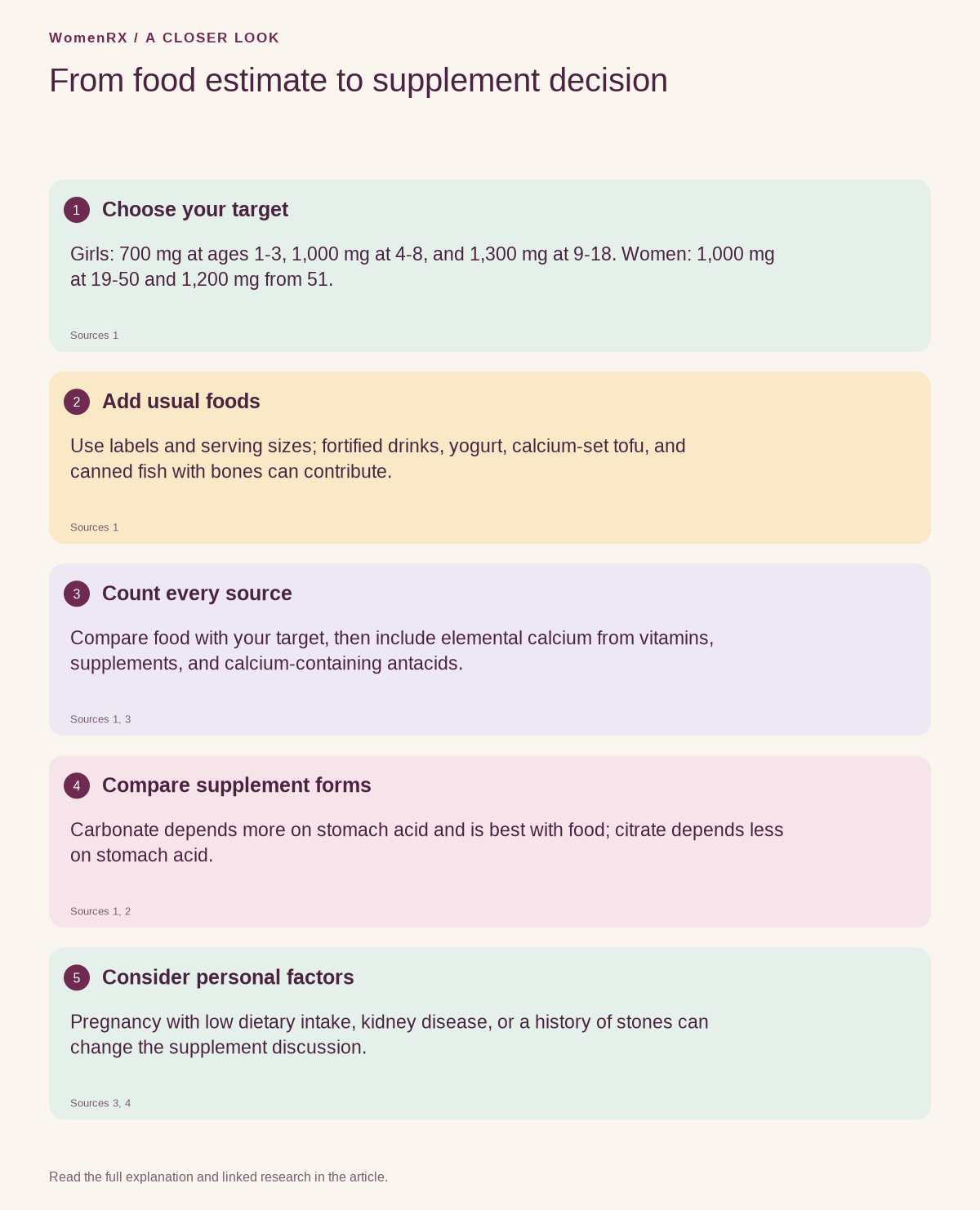
From food estimate to supplement decision
Choose your target: Girls: 700 mg at ages 1-3, 1,000 mg at 4-8, and 1,300 mg at 9-18. Women: 1,000 mg at 19-50 and 1,200 mg from 51.1
Add usual foods: Use labels and serving sizes; fortified drinks, yogurt, calcium-set tofu, and canned fish with bones can contribute.1
Count every source: Compare food with your target, then include elemental calcium from vitamins, supplements, and calcium-containing antacids.13
Compare supplement forms: Carbonate depends more on stomach acid and is best with food; citrate depends less on stomach acid.12
Consider personal factors: Pregnancy with low dietary intake, kidney disease, or a history of stones can change the supplement discussion.34
Read the figure as text
Use the sequence to estimate total calcium, identify a possible gap, and compare supplement details that can affect the choice.- Choose your target: Girls: 700 mg at ages 1-3, 1,000 mg at 4-8, and 1,300 mg at 9-18. Women: 1,000 mg at 19-50 and 1,200 mg from 51.1
- Add usual foods: Use labels and serving sizes; fortified drinks, yogurt, calcium-set tofu, and canned fish with bones can contribute.1
- Count every source: Compare food with your target, then include elemental calcium from vitamins, supplements, and calcium-containing antacids.13
- Compare supplement forms: Carbonate depends more on stomach acid and is best with food; citrate depends less on stomach acid.12
- Consider personal factors: Pregnancy with low dietary intake, kidney disease, or a history of stones can change the supplement discussion.34
Sources you can check
- Calcium - Health Professional Fact SheetAccessed 2026-09-25Return to first citation
- Calcium | MedlinePlusAccessed 2026-09-25Return to first citation
- Dietary Supplements and Life Stages: Pregnancy - Health Professional Fact SheetAccessed 2026-09-25Return to first citation
- Calcium Supplementation in the Indian Context: A Consensus Statement by the Endocrine Society of India Skeletal Health Taskforce.Bhattacharya S, Nagendra L, Agarwal K, Arjunan D, Kapoor N, Kaur P, Cherian KE, Shetty S, Patra S, Monteiro AS, Bhandarkar A, Aggarwal A, Thakur PS, Maldar AM, Mangaraj S, Joseph A... · Indian journal of endocrinology and metabolism · 2026Return to first citation