Can Food Provide Enough Calcium Without Supplements?
Often, yes: a few calcium-rich foods across the day can add up, but your age and the foods you actually eat matter.
Food can meet calcium needs without supplements when your regular meals add up to your age-specific target. For most women ages 19-50, that’s 1,000 mg a day; from age 51 onward, it’s 1,200 mg. Dairy is one option, not the only one: fortified soy milk, calcium-set tofu, some fish, and selected vegetables can contribute too. 1
Start with the target for your age
For women ages 19-50, the recommended daily amount is 1,000 mg. It’s 1,200 mg for women 51 and older. Pregnancy and breastfeeding don’t change those targets for adults ages 19-50; pregnant or breastfeeding teens ages 14-18 need 1,300 mg. These are planning targets for daily intake, not a test of whether one particular day’s menu is adequate. 1
Calcium needs are higher after age 50, but that doesn’t mean every woman over 50 needs a supplement. First, estimate what you regularly get from food. A single day can vary, so look at your usual pattern rather than treating one low day as a verdict.
Add up meals, not just “calcium foods”
Use the serving sizes on food labels or a food reference, then add the calcium across meals and snacks. For a quick label check, calcium’s Daily Value is 1,300 mg. The percent Daily Value helps compare products, but your age-specific target may be lower or higher than that number. 1
Here’s an example, not a prescribed menu: an 8-ounce serving of plain low-fat yogurt (415 mg), a cup of calcium-fortified soy milk (299 mg), half a cup of tofu made with calcium sulfate (253 mg), and a cup of raw shredded bok choy (74 mg) total about 1,041 mg. That combination reaches the 1,000 mg target for many adults under 51, but not the 1,200 mg target for women 51 and older. Food values vary, so check the label, especially for fortified products and tofu. 1
The example also shows why it’s useful to count the whole day. A food doesn’t need to be a standout source to contribute, and a few modest servings can add up.
Choose sources that fit your meals
Milk, yogurt, and cheese are concentrated options, but you don’t need to eat dairy to get calcium. A cup of fortified soy milk provides about 299 mg in the reference serving; half a cup of calcium-set firm tofu provides 253 mg. Canned sardines with bones provide 325 mg per 3 ounces, and canned salmon with bones provides 181 mg per 3 ounces. 1
For plant foods, cooked kale provides 94 mg per cup, and raw bok choy provides 74 mg per cup. These can help fill a gap, although their calcium amounts per serving are generally smaller than those in many fortified foods or dairy servings. Broccoli is nutritious, but the reference serving of half a cup raw contains only 21 mg of calcium, so it’s not a large calcium substitute on its own. 1
Fortified foods can make a particular difference if you avoid dairy. Calcium may be added to some plant-based drinks, tofu, cereals, and juices, but products differ. Check the nutrition label rather than assuming a drink or food is fortified. For tofu, the reference value applies to tofu made with calcium sulfate; tofu made with other salts may contain much less calcium. 12
Calcium content and absorption aren’t the same thing. Dairy and fortified foods have about 30% absorption in the reference, while absorption from some plants is lower because of compounds that bind calcium. Spinach, for example, contains calcium, but only a small fraction is absorbed. Kale, broccoli, and cabbage-family vegetables have better calcium bioavailability than spinach, though their servings may still contain less calcium overall. Eating a varied mix of foods helps avoid relying on one plant source. 1
If your tally is short
Look for the easiest repeatable swap, not a perfect menu. Depending on what you already eat, that might mean choosing a calcium-fortified soy drink, adding calcium-set tofu to a meal, using yogurt as a snack, or including canned fish with edible bones. If you avoid dairy, combine fortified foods with other sources rather than expecting greens alone to supply a full day’s target. 12
If your usual meals still fall short, that’s a useful reason to discuss whether a supplement is appropriate, particularly if you avoid dairy or are postmenopausal. People who avoid dairy are more likely to have inadequate intakes, but nondairy foods can contribute and the right next step depends on your actual intake. A small food tally gives you a clearer starting point than buying a supplement by default. 1
A quick meal-by-meal check
- Breakfast: Check the calcium on plant-based drinks, cereal, or yogurt labels.
- Lunch or dinner: Count calcium-set tofu, dairy, or canned fish with bones if you eat them.
- Vegetables and snacks: Include calcium-containing greens, but don’t overcount low-calcium servings.
- End of day: Add the amounts, then compare your usual intake with your age-specific target.
Food tables give reference amounts, not a guarantee that every brand or serving is identical. Labels are especially helpful for fortified products and foods with different recipes.
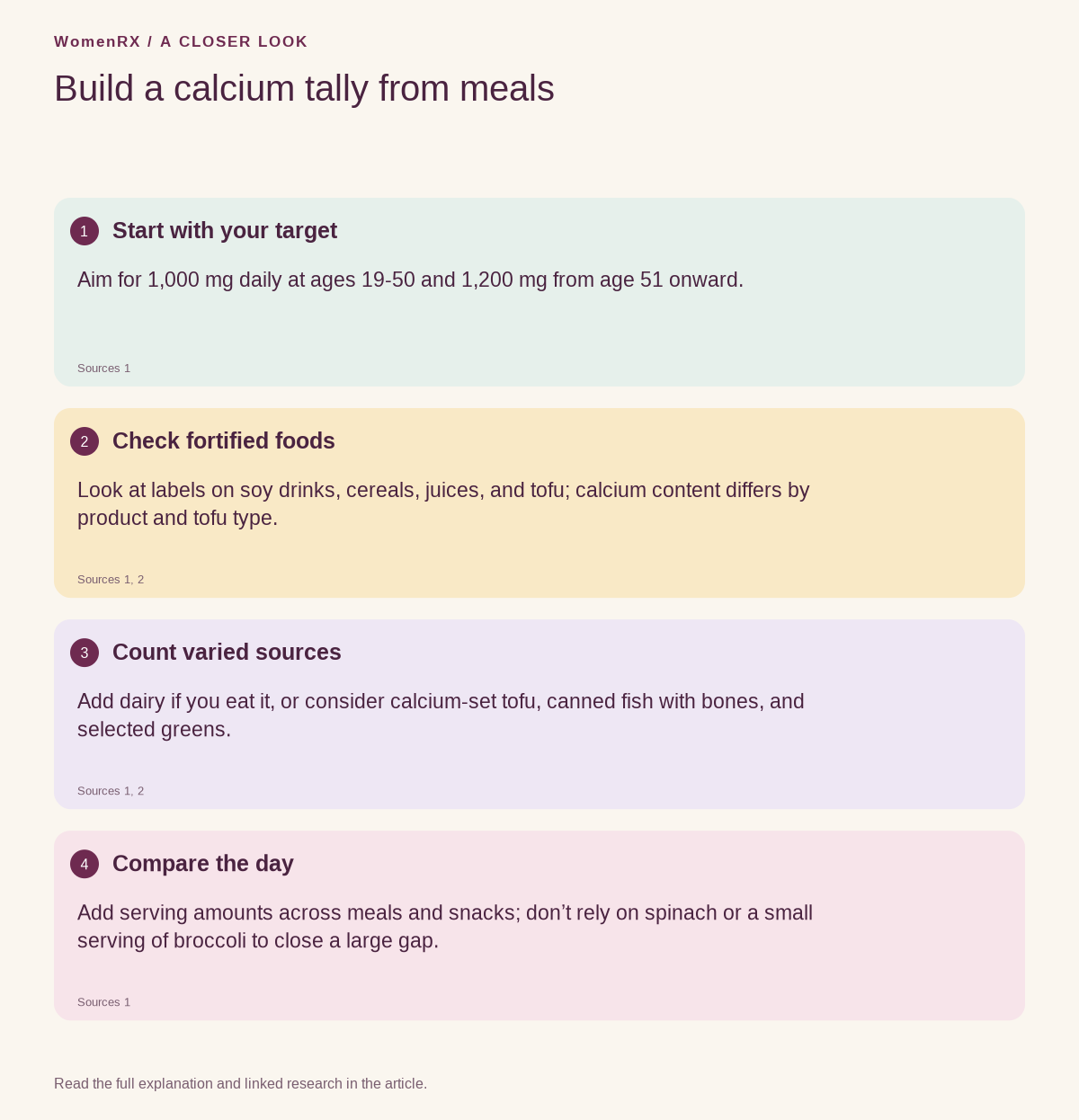
Build a calcium tally from meals
Start with your target: Aim for 1,000 mg daily at ages 19-50 and 1,200 mg from age 51 onward.1
Check fortified foods: Look at labels on soy drinks, cereals, juices, and tofu; calcium content differs by product and tofu type.12
Count varied sources: Add dairy if you eat it, or consider calcium-set tofu, canned fish with bones, and selected greens.12
Compare the day: Add serving amounts across meals and snacks; don’t rely on spinach or a small serving of broccoli to close a large gap.1
Read the figure as text
Check the sources you actually eat, use labels for fortified products, and compare your usual daily total with the target for your age.- Start with your target: Aim for 1,000 mg daily at ages 19-50 and 1,200 mg from age 51 onward.1
- Check fortified foods: Look at labels on soy drinks, cereals, juices, and tofu; calcium content differs by product and tofu type.12
- Count varied sources: Add dairy if you eat it, or consider calcium-set tofu, canned fish with bones, and selected greens.12
- Compare the day: Add serving amounts across meals and snacks; don’t rely on spinach or a small serving of broccoli to close a large gap.1
More questions, answered
Does pregnancy mean I need more calcium?
For adults ages 19-50, the recommended amount stays at 1,000 mg a day during pregnancy and breastfeeding. Pregnant or breastfeeding teens ages 14-18 have a higher target of 1,300 mg. 1
Is spinach a good way to close a calcium gap?
Spinach contains calcium, but its absorption is low because of compounds that bind calcium. Kale, bok choy, and other cabbage-family vegetables are better-absorbed plant sources, though their calcium per serving can still be modest. 1
Sources you can check
- Calcium - Health Professional Fact SheetAccessed 2026-09-25Return to first citation
- Calcium | MedlinePlusAccessed 2026-09-25Return to first citation