Can Food Provide Enough Copper? When Supplements May Be Needed
Most U.S. diets provide enough copper, and foods such as nuts, seeds, chickpeas, potatoes, and whole grains can help meet your needs.
For most adults, food can provide enough copper: the recommended amount is 900 micrograms a day, and average U.S. food intake among adult women is about 1,100 micrograms. Needs rise to 1,000 micrograms during pregnancy and 1,300 while breastfeeding. A higher-risk condition, not the life stage alone, is a reason to ask about clinical assessment before taking copper supplements. 1
Start with food, not a supplement
Copper is an essential mineral, but that doesn’t mean you need a copper pill. In U.S. adults, average copper intake from food is about 1,400 micrograms a day for men and 1,100 for women. Those are population averages, not a guarantee about any one person’s diet or copper status. National intake data also found that some adults consumed less than the Estimated Average Requirement, a measure used to assess intake, not a diagnosis of deficiency. 1
For women age 19 and older, the recommended dietary allowance (RDA) is 900 micrograms a day. It rises to 1,000 micrograms during pregnancy and 1,300 micrograms while breastfeeding. These are total daily intake goals, not instructions to add a copper supplement. 1
Build a mix of copper sources
You don’t need one “superfood” to meet your needs. Copper occurs in a range of foods, including shellfish, nuts and seeds, legumes, potatoes, mushrooms, whole grains, and chocolate. For a sense of scale, a one-ounce serving of cashews has 629 micrograms, a half-cup of chickpeas has 289 micrograms, and a medium potato has 675 micrograms. The amounts vary by food and serving, and a meal pattern can include several sources. 1
A practical example: cashews or sunflower seeds as a snack, chickpeas in a salad, or potatoes alongside a meal all contribute copper. You can also get copper from shellfish or organ meats if you eat them, but they aren’t required to make a copper-containing diet. Food labels often don’t list copper unless it has been added, so the label may not show every source. 1
When food intake and deficiency are different questions
The RDA helps with planning a diet; it doesn’t tell you whether you personally have a deficiency. Intake estimates and symptoms alone can’t settle that question. Copper deficiency is more of a concern when there’s a reason absorption or intake may be affected. Examples include celiac disease, which can interfere with absorption, or regular use of high-dose zinc supplements, which can reduce copper absorption. 1
Some people receiving long-term tube feeding also need closer attention to trace minerals. A pediatric case report and a retrospective study of children receiving tube feeds describe copper depletion concerns, especially with jejunal feeding or complex gastrointestinal conditions. Those findings are specific to medically complex children, so they don’t establish the risk for everyone who uses tube feeding. 23
If one of these situations applies, ask your care team whether your copper intake or status should be assessed. That’s different from taking copper “just in case”: the reason for concern and the right response depend on the person’s health and nutrition. The NIH reference also notes that copper supplements come in varied forms and amounts, and studies have not compared how well those forms are absorbed. 1
Why a copper pill isn’t automatically harmless
Taking more isn’t a reliable way to make up for a suspected shortfall. Excess copper can cause stomach symptoms and, with chronic high exposure, liver damage. People with Wilson’s disease, a rare inherited condition affecting copper handling, are especially vulnerable to copper toxicity. 1
So if your diet is varied and you don’t have a known absorption or nutrition concern, start with food rather than assuming you need a separate supplement. If you have celiac disease, use high-dose zinc, or rely on specialized tube feeding, the useful next step is an individualized assessment, not self-diagnosis or an extra mineral pill.
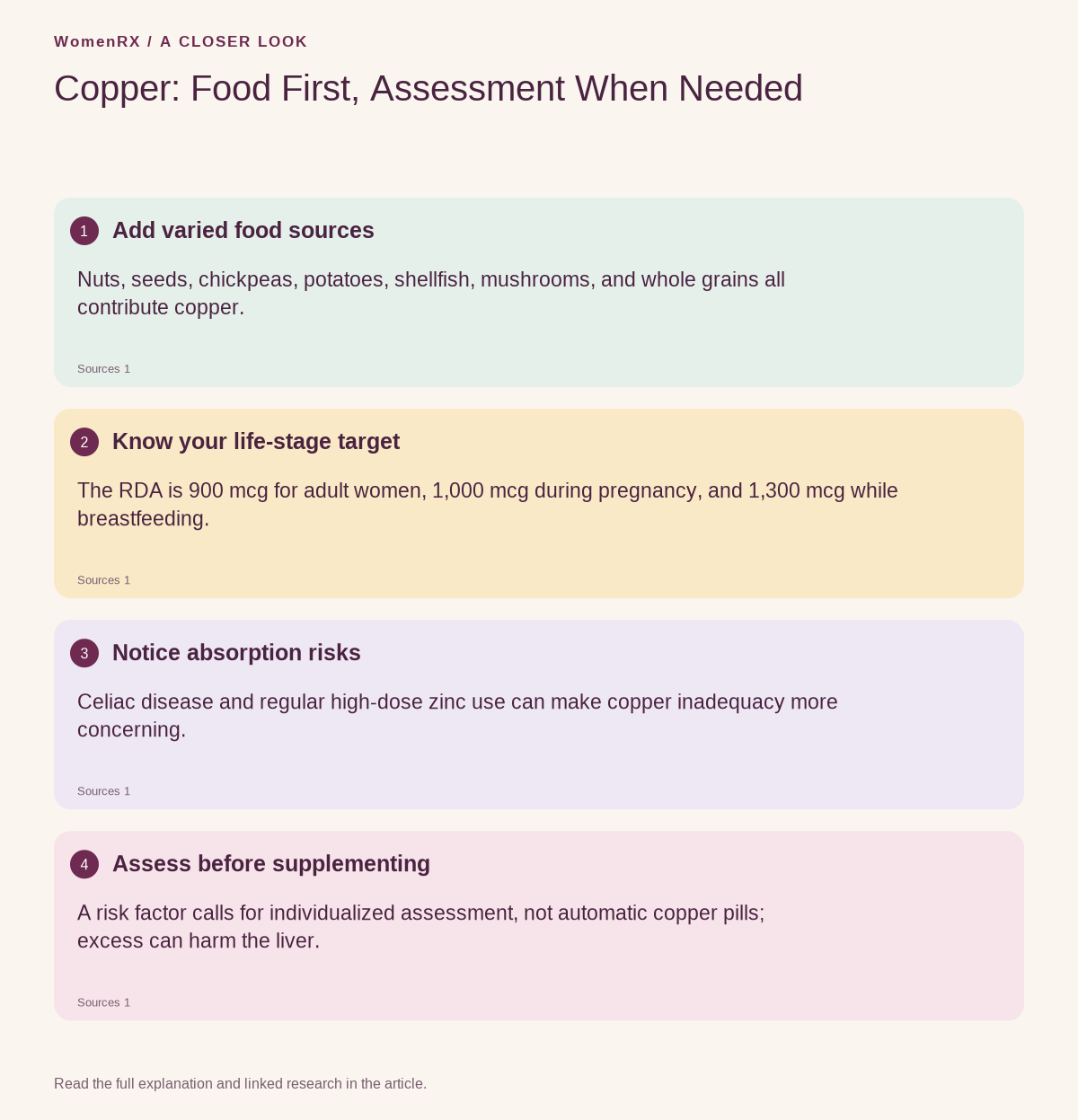
Copper: Food First, Assessment When Needed
Add varied food sources: Nuts, seeds, chickpeas, potatoes, shellfish, mushrooms, and whole grains all contribute copper.1
Know your life-stage target: The RDA is 900 mcg for adult women, 1,000 mcg during pregnancy, and 1,300 mcg while breastfeeding.1
Notice absorption risks: Celiac disease and regular high-dose zinc use can make copper inadequacy more concerning.1
Assess before supplementing: A risk factor calls for individualized assessment, not automatic copper pills; excess can harm the liver.1
Read the figure as text
Use this quick guide to distinguish everyday food sources and life-stage targets from situations that may warrant a closer look at copper status.- Add varied food sources: Nuts, seeds, chickpeas, potatoes, shellfish, mushrooms, and whole grains all contribute copper.1
- Know your life-stage target: The RDA is 900 mcg for adult women, 1,000 mcg during pregnancy, and 1,300 mcg while breastfeeding.1
- Notice absorption risks: Celiac disease and regular high-dose zinc use can make copper inadequacy more concerning.1
- Assess before supplementing: A risk factor calls for individualized assessment, not automatic copper pills; excess can harm the liver.1
More questions, answered
Does pregnancy or breastfeeding automatically mean I need a copper supplement?
No. The recommended daily intake increases to 1,000 micrograms during pregnancy and 1,300 micrograms while breastfeeding, but those targets describe total intake. They don’t by themselves establish a need for a separate copper supplement. 1
Sources you can check
- Copper - Health Professional Fact SheetAccessed 2026-09-25Return to first citation
- Anemia secondary to copper deficiency in a child receiving gastrojejunal feeds: A case report.Sabir S, Jain M, Goyal M, Teitelbaum JE, Guli K. · JPGN reports · 2024Return to first citation
- The hierarchy of copper status in paediatric enteral tube feeding: A comparative retrospective cohort study of jejunal and gastric feeding.Cairney DG, Paxton C, Wilson A, Hamblin R, Grant H, Henderson P, Wilson DC, Merrick V. · Clinical nutrition (Edinburgh, Scotland) · 2026Return to first citation