Copper in Food: What to Eat and When to Pay Attention
Nuts, beans, mushrooms, potatoes, seafood, and whole grains can all provide copper, and most U.S. adults get enough from food.
For women 19 and older, the recommended intake is 900 micrograms (mcg) of copper a day, the same as for men. A serving of cashews, shiitake mushrooms, potatoes, tofu, or chickpeas can contribute meaningfully. Pregnancy raises the recommendation to 1,000 mcg and breastfeeding to 1,300 mcg. Celiac disease, high-dose zinc use, and Wilson’s disease are reasons to discuss copper with a clinician. 1
Copper is found in a mix of everyday foods, not just shellfish or liver. For most women, a varied diet provides it without a copper supplement. The practical question is usually whether your eating pattern, life stage, or health context calls for a closer look, not whether you need to chase a particular food. 1
Useful amounts in familiar servings
The adult recommended dietary allowance (RDA) is 900 mcg per day. Here are selected food amounts, with the serving sizes that go with them:
- Cashews: 629 mcg per ounce
- Cooked shiitake mushrooms: 650 mcg per half cup
- A medium cooked potato, skin and flesh: 675 mcg
- Firm tofu: 476 mcg per half cup
- Chickpeas: 289 mcg per half cup
- Cooked whole-wheat pasta: 263 mcg per cup
These are contributions, not a menu you need to assemble each day. Other notable sources include crab, sunflower seeds, dark chocolate, and whole-grain products. Amounts depend on the specific food and serving; food labels aren’t required to list copper unless it has been added. 1
Liver and oysters are especially concentrated: a 3-ounce serving of pan-fried beef liver contains 12,400 mcg, and 3 ounces of cooked eastern oysters contains 4,850 mcg. Those figures are useful comparisons, not a reason to make either food a routine copper strategy. 1
The target changes with life stage
Women and men have the same copper RDA from age 19 onward: 900 mcg a day. The recommendation increases to 1,000 mcg during pregnancy and 1,300 mcg while breastfeeding. Those life-stage recommendations don’t mean you automatically need a copper supplement; food and any supplements you already take both contribute to total intake. 1
The adult upper intake level (UL) is 10,000 mcg a day, including during pregnancy and lactation. It’s a safety ceiling for total intake, not a target to aim for. A serving of liver contains more than that amount, but the number alone doesn’t establish that a particular meal will cause harm. The UL is intended to describe an intake level unlikely to cause adverse effects, and chronic excess can damage the liver or cause stomach symptoms. 1
When your situation matters more than a food list
Copper from food, copper from a supplement, and copper status in the body are related but not interchangeable. Supplements vary widely in the amount they contain, so check the label on a multivitamin or other product before adding a separate copper supplement. Typical U.S. diets meet or exceed the RDA on average, but a population average can’t tell you whether your own intake or status is adequate. 1
A U.S. analysis of national survey data found that average copper intake from foods, beverages, and supplements declined from 1.79 mg per day in 1999 to 1.38 mg per day in March 2020. Intake also varied across demographic groups. That trend describes a population, not an individual diagnosis or a reason for everyone to supplement. 2
Some health contexts do make assessment more relevant. Celiac disease can interfere with absorption, and the NIH Office of Dietary Supplements identifies it as a group at increased risk of inadequate copper status. High-dose zinc supplements can also interfere with copper absorption. If you have celiac disease or regularly take a high-dose zinc product, bring that context and your supplement labels into a discussion about whether assessment is appropriate. 1
Wilson’s disease is different: it impairs the body’s ability to clear copper and can lead to harmful buildup. If you have this condition, copper intake is a medical issue to manage with your care team, rather than a reason to independently add or cut out particular foods. 1
Copper deficiency can’t be diagnosed from symptoms alone. A clinician can consider your medical history, diet, and supplements when deciding whether copper testing or a change in intake makes sense. For most women without these specific concerns, food sources are the sensible starting point, and the serving comparisons above offer options across plant and animal foods. 1
Copper in a serving
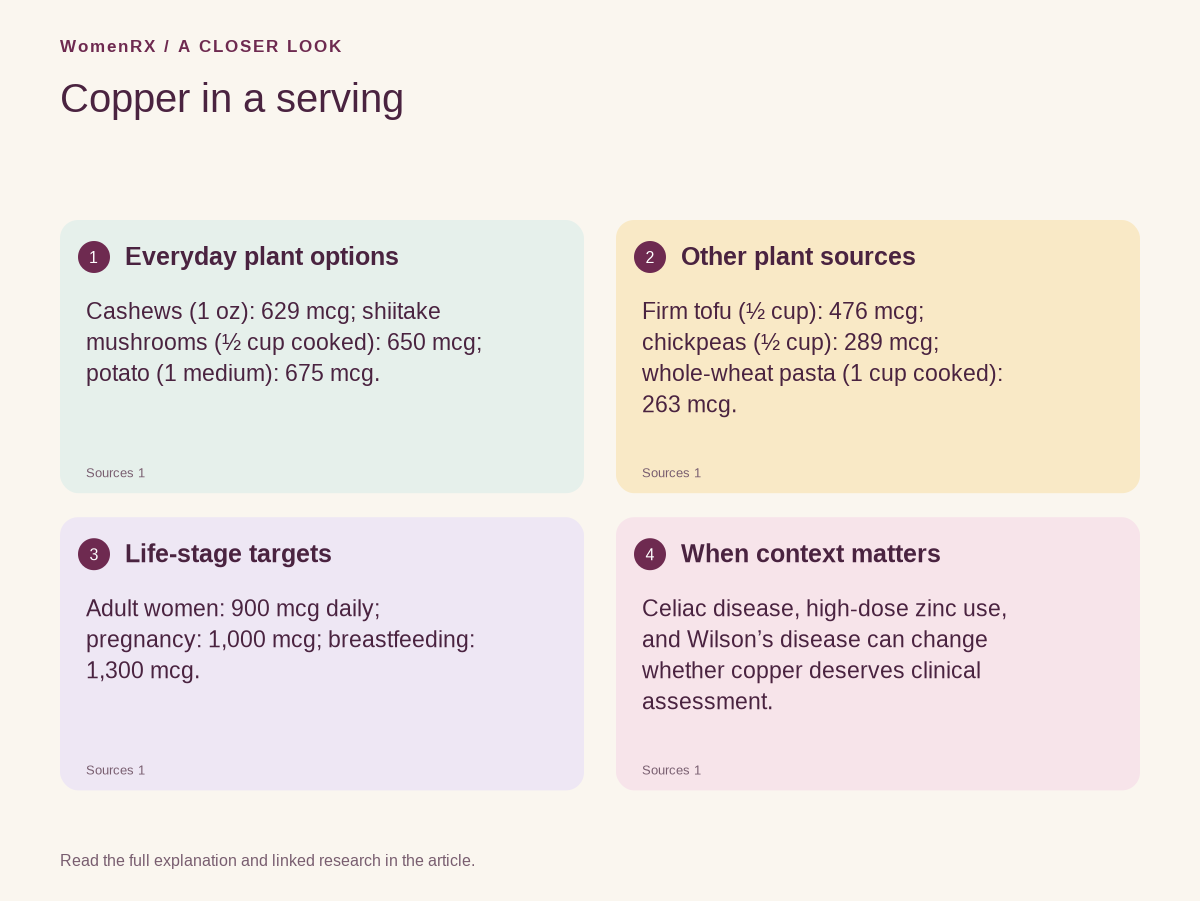
Everyday plant options: Cashews (1 oz): 629 mcg; shiitake mushrooms (½ cup cooked): 650 mcg; potato (1 medium): 675 mcg.1
Other plant sources: Firm tofu (½ cup): 476 mcg; chickpeas (½ cup): 289 mcg; whole-wheat pasta (1 cup cooked): 263 mcg.1
Life-stage targets: Adult women: 900 mcg daily; pregnancy: 1,000 mcg; breastfeeding: 1,300 mcg.1
When context matters: Celiac disease, high-dose zinc use, and Wilson’s disease can change whether copper deserves clinical assessment.1
Read the figure as text
Compare selected food servings, life-stage targets, and health contexts without treating a high food value as a supplement recommendation.- Everyday plant options: Cashews (1 oz): 629 mcg; shiitake mushrooms (½ cup cooked): 650 mcg; potato (1 medium): 675 mcg.1
- Other plant sources: Firm tofu (½ cup): 476 mcg; chickpeas (½ cup): 289 mcg; whole-wheat pasta (1 cup cooked): 263 mcg.1
- Life-stage targets: Adult women: 900 mcg daily; pregnancy: 1,000 mcg; breastfeeding: 1,300 mcg.1
- When context matters: Celiac disease, high-dose zinc use, and Wilson’s disease can change whether copper deserves clinical assessment.1
More questions, answered
Does one serving of liver above the UL mean copper poisoning?
No. The UL is a daily upper intake level for total copper, not a food-specific poisoning threshold. A liver serving’s copper content is a useful comparison, but the amount alone doesn’t establish that one meal will cause harm. 1
Sources you can check
- Copper - Health Professional Fact SheetAccessed 2026-09-25Return to first citation
- National trends in nine key minerals intake (quantity and source) among U.S. adults, 1999 to march 2020.Yan X, Wang X, Zhang J, Ming Z, Zhang C, Ma P, Liu Q, Xu Y, Cheng L, Pang X, Li Y. · Nutrition journal · 2024Return to first citation