Before You Pay for an In-Office Hair Treatment
PRP and other procedures have been studied mainly for patterned hair loss, so the right comparison begins with your diagnosis.
PRP injections, PRP with microneedling, fractional lasers, and exosome-based treatments have different levels of evidence. Most research discussed here concerns androgenetic alopecia, also called patterned hair loss, and does not establish one best procedure for women. Before paying, confirm the diagnosis, ask what results were shown in women, and get the proposed visits, maintenance, provider details, and full fees in writing. 1 2 3

First, find out which hair loss is being treated
“Hair loss” isn’t one diagnosis. Androgenetic alopecia, also called patterned hair loss, involves progressive changes in hair follicles. Alopecia areata involves an autoimmune process and can cause patchy loss. A procedure studied for one condition hasn’t automatically been shown to work for the other. 4 5
That distinction can save you from paying for a treatment on the strength of the wrong study. For example, a small study comparing PRP with topical minoxidil enrolled people with alopecia areata, not patterned hair loss. Only 9 of its 40 participants were women, and the reported comparison did not give a separate result for them. It cannot answer whether PRP is the better choice for a woman with patterned hair loss. 5
Ask the treating clinician to name your diagnosis and explain what supports it before discussing a package of sessions. Then compare each option against research in people with that diagnosis.
How the procedures compare
PRP scalp injections. Platelet-rich plasma, or PRP, is prepared from your own blood and injected into the scalp. Preparation methods vary, so “PRP” does not describe one identical treatment everywhere. In a randomized study of 80 people with patterned hair loss, researchers compared activated with non-activated PRP on opposite sides of the scalp. They gave treatments monthly for three months and followed participants for three more. That study examined differences between PRP preparations, not PRP versus no treatment, and its abstract does not report results separately for women. Its schedule is an example from research, not a standard every clinic should follow. 4
A separate review of trials comparing one-spin with two-spin PRP preparation included one women-only trial and two men-only trials. The pooled comparison did not show a clear difference in hair-density change between the preparation methods, despite the review’s more favorable wording about one-spin PRP. If a clinic says its particular preparation is worth a higher fee, ask for evidence supporting that claim in women with your diagnosis. 6
PRP applied with microneedling. This combines PRP placed on the scalp with microneedling rather than delivering PRP solely by injection. A systematic review found three studies directly comparing these approaches in patterned hair loss. The results suggested PRP with microneedling might do better, but the authors called for higher-quality studies with consistent protocols. That’s a reason to ask what the combination adds, not proof that an add-on fee will buy a better result for you. 1
Fractional lasers. These are a different category of procedure from PRP. A 2026 review pooled studies of several light and energy-based treatments for patterned hair loss and reported improvements in hair measures with fractional lasers. But its abstract combines different devices and, in some analyses, treatments paired with minoxidil, PRP, or growth factors. It does not establish that a particular clinic’s laser protocol outperforms PRP for women, and it does not report a separate women’s result. Ask for the exact device, what else is used with it, and evidence for that specific approach. 3
You may also see low-level light therapy mentioned alongside lasers. The same review reports results for it, but does not establish that the studied light devices were office-based procedures. Don’t assume a quote for clinic laser sessions represents the evidence for every type of light device. 3
Exosome-based treatments. These are sometimes presented as a newer option. A systematic review of microneedling with exosomes describes a 24-week, open-label study of 30 people with patterned hair loss that had no comparison group. That study cannot separate a treatment effect from other reasons hair measurements might change. It also cannot establish how long any benefit lasts. Before considering an exosome add-on, ask what product and delivery method are proposed and whether controlled research supports that combination for your diagnosis. 2
Compare the commitment, not just the session fee
Research schedules vary. One PRP injection study used three monthly treatments, while trials comparing PRP preparation methods used different regimens and follow-up periods. These examples do not establish how many visits you would need or whether continuing sessions would preserve a result. 4 6
For each quote, ask the clinic to put the whole proposed plan on one page: the procedure and any add-ons, number of initial visits, total initial fee, follow-up fees, and the proposed maintenance plan and its cost. Ask which parts of that plan come from research and which are the clinic’s usual practice. A lower per-session price may not be the lower total commitment if the plans include different numbers of visits.
It’s also reasonable to ask who will perform each part of the procedure, their professional role and relevant training, and who will assess whether it is helping. For a combination treatment, find out whether every component is necessary to the proposed plan or offered as an optional extra.
The most useful comparison isn’t a ranking of impressive-sounding techniques. It’s whether the procedure was studied for your kind of hair loss, what the research actually shows for women, and what you’re being asked to commit to before the outcome is known.
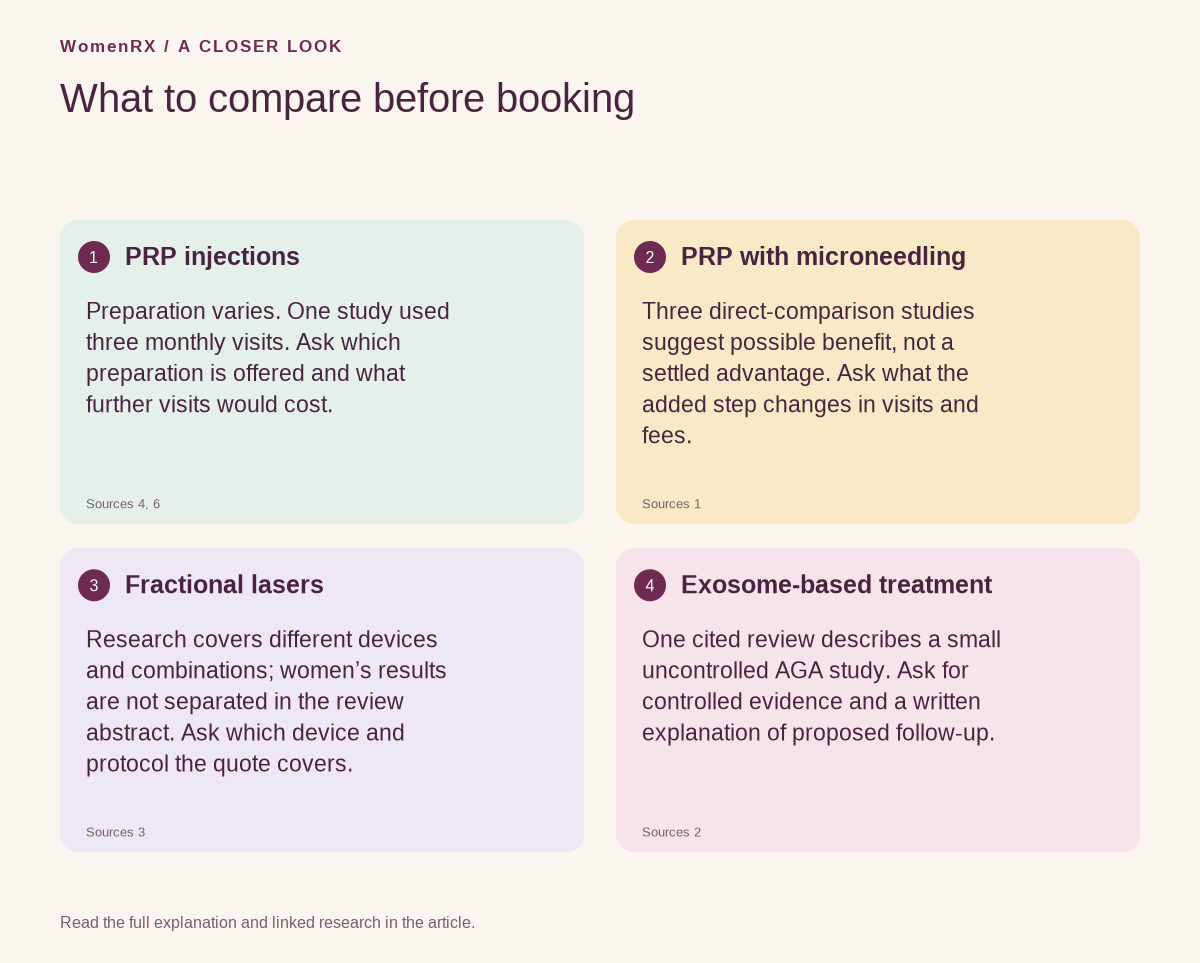
What to compare before booking
PRP injections: Preparation varies. One study used three monthly visits. Ask which preparation is offered and what further visits would cost.46
PRP with microneedling: Three direct-comparison studies suggest possible benefit, not a settled advantage. Ask what the added step changes in visits and fees.1
Fractional lasers: Research covers different devices and combinations; women’s results are not separated in the review abstract. Ask which device and protocol the quote covers.3
Exosome-based treatment: One cited review describes a small uncontrolled AGA study. Ask for controlled evidence and a written explanation of proposed follow-up.2
Read the figure as text
All four options below are proposed as clinic treatments. Study schedules are examples, not established maintenance plans; ask for the complete proposed commitment.- PRP injections: Preparation varies. One study used three monthly visits. Ask which preparation is offered and what further visits would cost.46
- PRP with microneedling: Three direct-comparison studies suggest possible benefit, not a settled advantage. Ask what the added step changes in visits and fees.1
- Fractional lasers: Research covers different devices and combinations; women’s results are not separated in the review abstract. Ask which device and protocol the quote covers.3
- Exosome-based treatment: One cited review describes a small uncontrolled AGA study. Ask for controlled evidence and a written explanation of proposed follow-up.2
More questions, answered
Does a PRP study that includes women show it works specifically for women?
Not necessarily. Check whether it reports women’s outcomes separately and what it compared. One PRP preparation review included a women-only trial, but it compared ways of preparing PRP, not PRP against no treatment. 6
Sources you can check
- Local Injection versus Topical Microneedling of Platelet-Rich Plasma for Androgenetic Alopecia: A Systematic Review.Biben JA, Reinhart R, Karina K, Pamungkas KA, Ekaputri K, Sadikin PM. · Archives of plastic surgery · 2025Return to first citation
- The Use of Microneedling With Exosomes in Dermatology: A Systematic Review.Dhaliwal NK, Moothathamby T, Sokhal BS, Gkini MA. · Journal of cosmetic dermatology · 2026Return to first citation
- Lasers and Energy-Based Devices in the Treatment of Androgenetic Alopecia: A Systematic Review and Meta-Analysis.Alahmadi M, Alghamdi S, Albyali S, Alharbi R, Alanazi D, Altamimi A, Aldahash R, Alharithy R. · Skin appendage disorders · 2026Return to first citation
- Effect of platelet counts and activator in platelet-rich plasma on the treatment of androgenetic alopecia, split-head comparison: A randomised, double-blind study.Singh SK, Singh S. · Indian journal of dermatology, venereology and leprology · 2023Return to first citation
- Comparison of Efficacy of Autologous Platelet Rich Plasma Therapy With 5% Topical Minoxidil Spray in Treating Alopecia Areata: A Head-to-Head Assessment of Novel Approaches.Muhammad A, Saleem S, Khan S, Virdi G, Arshad S, Muhammad S, Younas MT, Saeed A, Khan DS, Ikram A. · Cureus · 2024Return to first citation
- Comparison of single-spin to double-spin platelet-rich plasma centrifugation methods in the treatment of androgenic alopecia: a systematic review and meta-analysis of randomized controlled trials.Ghanem L, Kirmani N, Palacios-Ortiz MP, Cevallos-Cueva M, Mendoza-Millán DL, Almeida Nascimento GV, Velasco-Tamariz V. · Frontiers in medicine · 2025Return to first citation