Microneedling for Hair Loss: What the Studies Show
Studies of microneedling for pattern hair loss mostly test it alongside minoxidil, and a large trial in women found no added benefit.
Microneedling has mainly been studied as an add-on to topical minoxidil for androgenetic alopecia, or pattern hair loss. Reviews found better hair-count results with the combination overall, but a randomized trial in 245 women found no added benefit over minoxidil alone after 24 weeks. Those clinical results don’t establish that microneedling works alone or that a home roller will work the same way. 2 3 5
Start with the kind of hair loss
Most microneedling trials in the major reviews concern androgenetic alopecia, also called pattern hair loss. But thinning or shedding can have other causes, including medical conditions, medicines, stress, and nutrition problems. Treatment depends on the cause, so a result in pattern hair loss may not apply to yours. 1 2 3
The main research comparison is microneedling plus topical minoxidil versus minoxidil alone. It asks whether the procedure adds something to a minoxidil treatment plan. It does not test microneedling as a replacement for minoxidil. 2 3
Why the pooled results and the women’s trial differ
Two systematic reviews of randomized trials found better hair-count outcomes, on average, when microneedling was added to minoxidil. The newer review identified 12 trials involving 631 people with androgenetic alopecia, though fewer contributed to its pooled analyses. Hair-count results varied substantially between trials. The earlier review also found a hair-count advantage, but did not find a statistically significant improvement in hair diameter. The reviews cover overlapping research, not two wholly separate sets of trials. Their reported pooled results do not provide a clear estimate specifically for women. 2 3
A later trial gives a more direct answer for some women. It randomized 245 women with mild-to-moderate androgenetic alopecia to topical 2% minoxidil alone, minoxidil plus monthly microneedling, or minoxidil plus microneedling every two weeks. After 24 weeks, hair counts had risen in all three groups, but there were no significant differences between groups. Other measured hair outcomes were also comparable. In this single-center, open-label study, adding either tested microneedling schedule did not provide an additional clinical benefit. 5
That finding doesn’t erase the pooled results. It does make them a poor basis for promising a woman extra growth from microneedling. Some trials had different participants and procedures. For example, a 12-week randomized trial in 36 Indonesian men found a greater improvement in hair density with microneedling plus minoxidil than with minoxidil alone. Its result cannot establish what will happen for women. 6
A clinical procedure isn’t a home-roller protocol
Microneedling methods varied across studies. The women’s trial used a 36-needle cartridge at a depth of 500-550 micrometers. Those details describe what was tested, not a depth or schedule to copy. The newer review did not find a significant difference between the broad depth, duration, or device categories it analyzed, but that does not prove that every procedure works equally well. 2 5
Nor do these clinical comparisons establish the effectiveness or safety of home dermarolling. If a clinic or device seller points to a study, the useful question is whether it tested the same diagnosis, procedure, and accompanying treatment being proposed to you. 2 5
Ask what will happen to your scalp and what will be applied
In the newer review, adverse events were reported more often with combination treatment than with minoxidil alone; they were generally described as mild or self-limiting. The earlier review reported no scarring or serious adverse events in its included trials. Those reports describe what happened during the studies, not a guarantee against uncommon or longer-term problems. One small trial in men reported itching and temporary redness. 2 3 6
Medication delivery deserves a separate question. A small randomized study of minoxidil microinfusion, which uses needles to deliver medication into the scalp, found a reduction in diastolic blood pressure after the procedure in the minoxidil group. The researchers interpreted this as evidence of systemic absorption. Microinfusion is not interchangeable with every procedure that pairs microneedling and topical minoxidil, but it shows why the method of applying a medicine matters. 4
Before agreeing to treatment, ask what supports your pattern-hair-loss diagnosis; whether microneedling would add to minoxidil or replace it; which device and procedure would be used; whether a medicine would be applied to the scalp or delivered through the needles; and what reactions would lead the clinic to change the plan. The answer should describe the treatment you’re actually considering, not just cite a favorable result from a different approach. 1 2 4 5
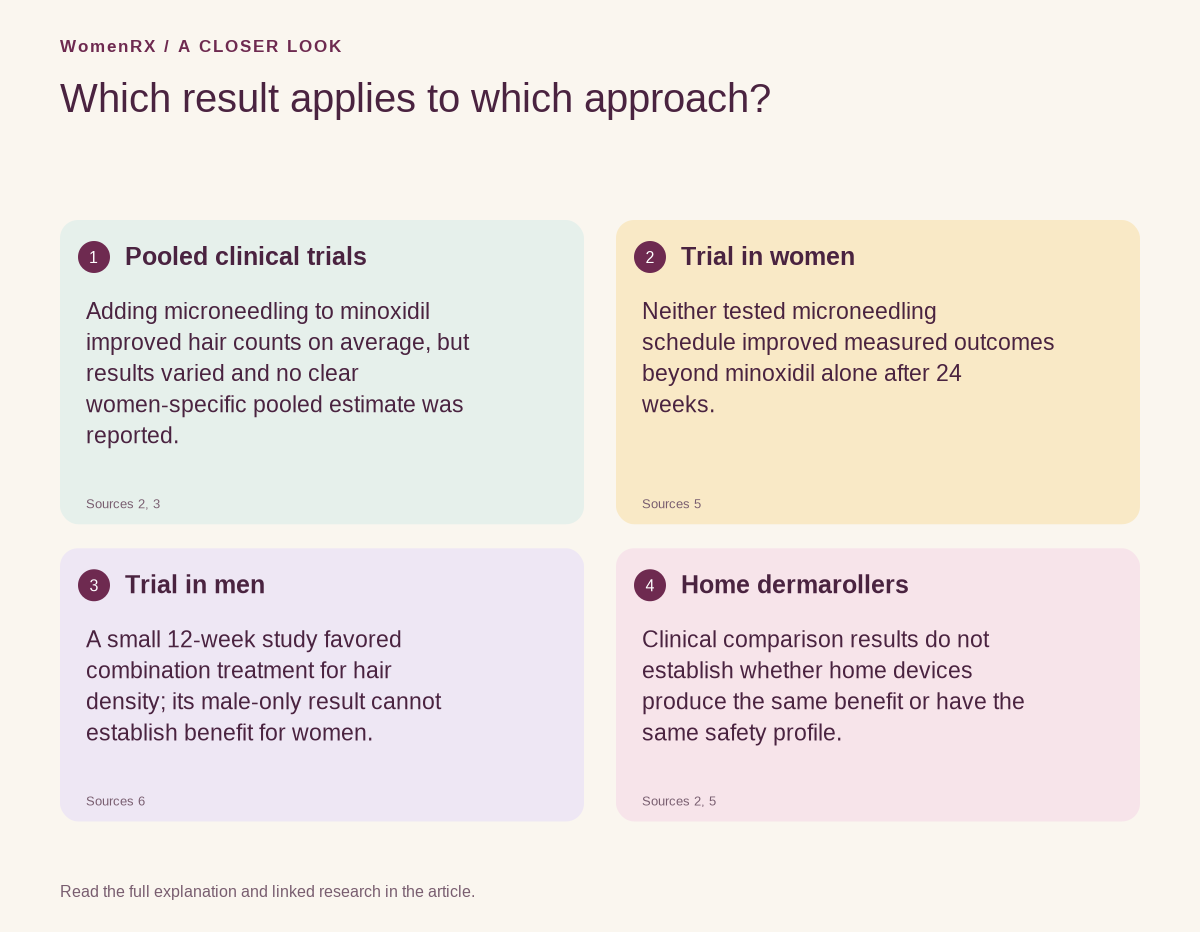
Which result applies to which approach?
Pooled clinical trials: Adding microneedling to minoxidil improved hair counts on average, but results varied and no clear women-specific pooled estimate was reported.23
Trial in women: Neither tested microneedling schedule improved measured outcomes beyond minoxidil alone after 24 weeks.5
Trial in men: A small 12-week study favored combination treatment for hair density; its male-only result cannot establish benefit for women.6
Home dermarollers: Clinical comparison results do not establish whether home devices produce the same benefit or have the same safety profile.25
Read the figure as text
These comparisons keep the treatment, study population, and setting attached to each finding.- Pooled clinical trials: Adding microneedling to minoxidil improved hair counts on average, but results varied and no clear women-specific pooled estimate was reported.23
- Trial in women: Neither tested microneedling schedule improved measured outcomes beyond minoxidil alone after 24 weeks.5
- Trial in men: A small 12-week study favored combination treatment for hair density; its male-only result cannot establish benefit for women.6
- Home dermarollers: Clinical comparison results do not establish whether home devices produce the same benefit or have the same safety profile.25
More questions, answered
Does microneedling work for hair loss without minoxidil?
The principal randomized comparisons summarized here test microneedling added to topical minoxidil. Their results cannot establish that microneedling alone effectively treats pattern hair loss. 2 3
Do these studies show that home dermarolling works?
No. Results from the clinical comparisons should not be treated as proof that a home device has the same benefit or safety profile. 2 5
Sources you can check
- Hair Loss | Alopecia | Alopecia Areata | MedlinePlusAccessed 2026-09-25Return to first citation
- Evaluating the efficacy and safety of combined microneedling therapy versus topical Minoxidil in androgenetic alopecia: a systematic review and meta-analysis.Ahmed KMA, Kozaa YA, Abuawwad MT, Al-Najdawi AI, Mahmoud YW, Ahmed AM, Taha MJJ, Fadhli T, Giannopoulou A. · Archives of dermatological research · 2025Return to first citation
- Efficacy and safety of combinational therapy using topical minoxidil and microneedling for the treatment of androgenetic alopecia: a systematic review and meta-analysis.Abdi P, Awad C, Anthony MR, Farkouh C, Kenny B, Maibach HI, Ogunyemi B. · Archives of dermatological research · 2023Return to first citation
- Blood pressure changes in patients after Minoxidil microinfusion to treat female pattern alopecia: analysis of a randomized, single blinded, placebo controlled clinical trial.Basilio FMA, Mulinari-Brenner F, Werner B, de Macedo NV. · Archives of dermatological research · 2025Return to first citation
- Microneedle frequency adjunct to 2% minoxidil in female androgenetic alopecia: A randomized controlled trial.Liu Y, Luo H, Yang S, Wang Z, Chen Y, Wu F, Xian H, Yang C, Xu DR, Luo Y. · Journal of the American Academy of Dermatology · 2026Return to first citation
- Effectiveness and safety of the combination therapy of micro-needling and minoxidil in androgenetic alopecia of Indonesian men: a randomized controlled trial.Adistri K, Sirait SP, Rihatmadja R, Legiawati L, Indriatmi W, Saldi SRF. · Dermatology reports · 2024Return to first citation