Oral Minoxidil for Hair Loss: Benefits and Tradeoffs
Oral minoxidil may help some types of hair loss, but the diagnosis and whole-body risks matter as much as the convenience of a pill.
Oral minoxidil was developed as a blood-pressure medicine, and its use for hair loss is off-label. It may be worth discussing for pattern hair loss, particularly if a scalp treatment is difficult to use, but it isn’t the right answer to every kind of shedding. First, clarify the likely cause. Then compare oral and topical treatment, including unwanted hair growth, swelling, pregnancy, and heart-related risks. 1 3 4
Start with the kind of hair loss, not the pill
Gradually thinner hair may raise the question of female pattern hair loss. But hair loss can also be associated with illness, thyroid problems, medicines, stress, or poor nutrition. Treatment depends on the cause. Minoxidil shouldn’t stand in for finding out why your hair is changing. 1 3
The timing can help make that first conversation more useful. For example, if shedding began after an illness or medication change, mention that; both can be associated with hair loss. 1 If the change coincided with a recent birth, mention that too. The timing alone doesn’t establish a diagnosis. The question to settle before choosing a treatment is: What are we treating?
Why a tablet comes up at all
Oral minoxidil was developed to treat high blood pressure. Its use for hair loss is off-label. Topical minoxidil is an established treatment for pattern hair loss, but oral and topical treatment are different routes with different tradeoffs. 2 3 4
A pill can sound simpler than putting a product on your scalp regularly, especially if topical treatment causes itching or is hard to fit into your routine. The tradeoff is that oral treatment affects the body beyond the scalp. Unwanted hair growth is a common reported side effect; swelling can occur too. A clinical review describes serious complications, including fluid around the heart, as rare at doses used for hair loss, but they remain part of the safety discussion. 3 4
That doesn’t make topical treatment risk-free or oral treatment automatically a poor choice. It means convenience and possible benefit need to be weighed against different kinds of side effects. 3 4
What the evidence can tell you
A 2025 systematic review combined 27 studies involving 2,933 people with alopecia and found that some participants improved with oral minoxidil. Those pooled findings aren’t a head-to-head estimate of how much better oral treatment works than topical treatment, or a women-specific estimate. The authors called for more research to establish efficacy and safety. 2
The review also describes a randomized oral-versus-topical trial in men with pattern hair loss. Its comparison is useful, but similar results in those men cannot establish that the two routes work equally well for women. 2
For a woman considering treatment for female pattern hair loss, the practical takeaway is narrower than “oral minoxidil works for hair loss.” Ask what benefit is reasonable to expect for your diagnosis, and why the oral route is being considered instead of topical minoxidil. 2 3
Bring pregnancy plans and health history into the decision
Pregnancy changes the discussion: a clinical review lists it as a contraindication to oral minoxidil. If you’re pregnant or might become pregnant, raise that before considering the pill. If you’ve recently given birth or are breastfeeding, mention that too so the timing of your hair change and your circumstances are part of the conversation.
The same review lists uncontrolled high blood pressure and pericardial disease as contraindications. Share any relevant blood-pressure or heart history, and ask what side effects would matter in your case and how you would follow up if you tried treatment. 4
You can keep the conversation focused with three questions: What is the likely cause of my hair loss? Why consider oral rather than topical minoxidil? How would we assess benefit and side effects? Those answers do more work than a general promise that a hair-growth pill might help. 1 3 4
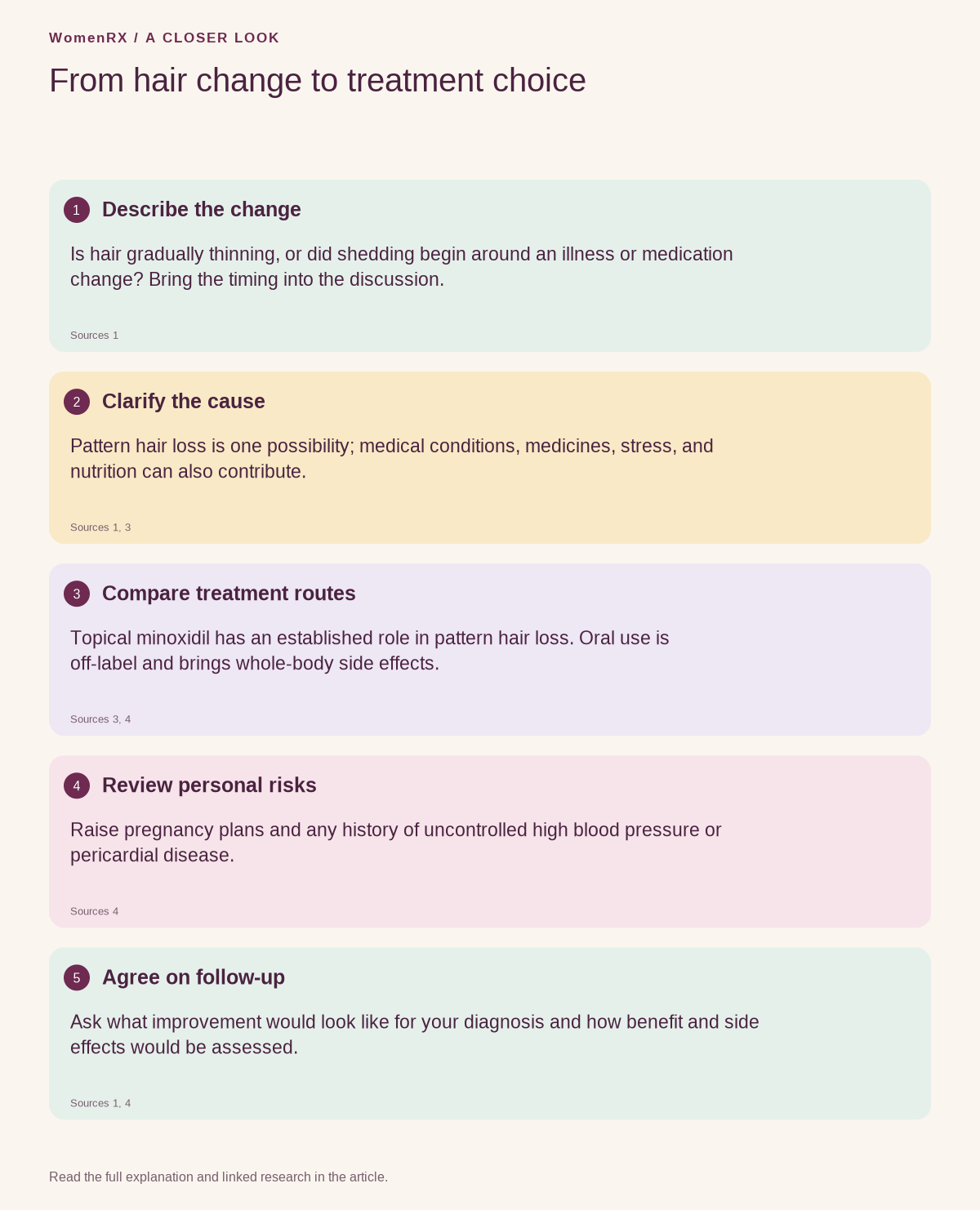
From hair change to treatment choice
Describe the change: Is hair gradually thinning, or did shedding begin around an illness or medication change? Bring the timing into the discussion.1
Clarify the cause: Pattern hair loss is one possibility; medical conditions, medicines, stress, and nutrition can also contribute.13
Compare treatment routes: Topical minoxidil has an established role in pattern hair loss. Oral use is off-label and brings whole-body side effects.34
Review personal risks: Raise pregnancy plans and any history of uncontrolled high blood pressure or pericardial disease.4
Agree on follow-up: Ask what improvement would look like for your diagnosis and how benefit and side effects would be assessed.14
Read the figure as text
A diagnosis-first path for deciding whether oral minoxidil is worth discussing.- Describe the change: Is hair gradually thinning, or did shedding begin around an illness or medication change? Bring the timing into the discussion.1
- Clarify the cause: Pattern hair loss is one possibility; medical conditions, medicines, stress, and nutrition can also contribute.13
- Compare treatment routes: Topical minoxidil has an established role in pattern hair loss. Oral use is off-label and brings whole-body side effects.34
- Review personal risks: Raise pregnancy plans and any history of uncontrolled high blood pressure or pericardial disease.4
- Agree on follow-up: Ask what improvement would look like for your diagnosis and how benefit and side effects would be assessed.14
More questions, answered
Is oral minoxidil used for hair loss?
Yes. Oral minoxidil is used off-label for hair loss, meaning it’s used for a purpose other than its approved use. 4
Does the oral-versus-topical research apply directly to women?
Not the randomized comparison described in the 2025 systematic review: it studied men with pattern hair loss. The review’s pooled improvement findings also don’t provide a women-specific estimate or show how oral treatment compares with topical treatment. 2
Sources you can check
- Hair Loss | Alopecia | Alopecia Areata | MedlinePlusAccessed 2026-09-25Return to first citation
- Efficacy and safety of oral minoxidil in the treatment of alopecia: a single-arm rate meta-analysis and systematic review.Liu C, Liu X, Shi T, Wang Y, Sui C, Zhang W, Wang B. · Frontiers in pharmacology · 2025Return to first citation
- Expanding the therapeutic landscape of minoxidil for androgenetic alopecia: topical, oral and sublingual formulations.Dias FR, Yong SS, FitzGerald H, Sinclair RD, Bhoyrul B. · Frontiers in pharmacology · 2025Return to first citation
- Oral Minoxidil for Alopecia Treatment: Risks, Benefits, and Recommendations.Ong MM, Li Y, Lipner SR. · American journal of clinical dermatology · 2026Return to first citation