Oral Minoxidil for Hair Loss: Dose and Use
Studies have used a range of oral minoxidil doses in women, but those study doses aren’t a personal prescription.
A 2021 review summarized doses of 0.25 to 2.5 mg daily in studies of women with hair loss. That range describes published use, not a recommended dose for you. Oral minoxidil for hair loss is off-label; a 2024 review says the best dose and monitoring guidance still need clarification. Confirm your prescription directions, what symptoms to report, and what to do about a missed dose. 1 3
Study doses are context, not a dosing plan
Oral minoxidil is used off-label for hair loss. The tablet’s use for hair loss is different from following a prescription written for another condition, so don’t borrow someone else’s dose or assume an online study gives you instructions for your own medication. 1 2
A 2021 review summarized doses of 0.25 to 2.5 mg daily in studies of women with hair loss. These are reported study regimens, not a recommendation or a range that fits every woman. The review called for larger comparative studies to clarify the best dose and treatment duration. 3
There’s a reason the proposed dose deserves a clear explanation: a systematic review with meta-regression of six studies found that higher doses were associated with both greater hair-density changes and more hypertrichosis, or excess hair growth, and cardiovascular adverse events over six months. These were associations across studies, not proof of what a dose change will do for one person. The analysis adjusted for sex, but it does not give a personal prediction for women. 4
Ask your prescriber why the proposed dose makes sense for your hair-loss diagnosis and what would lead them to keep or change the plan. Don’t adjust it yourself.
Make the prescription directions unambiguous
Before taking the first dose, check that you and the pharmacist have the same instructions. Your prescription label should make clear what dose you’ve been prescribed and when to take it. If the label doesn’t match what you understood, or you’re unsure how the tablet instructions translate to the amount prescribed, ask the pharmacist or prescriber to clarify before taking it.
Ask for a specific missed-dose answer that matches your directions. If you’ve already missed a dose and can’t find an answer on the label, contact the pharmacist or prescriber rather than guessing. A dose reported in a hair-loss study doesn’t tell you what to do if you miss your prescribed dose.
Make monitoring about real changes
Ask what your prescriber wants you to watch for and how they’d like you to report changes. In a retrospective study of 310 people with androgenetic alopecia taking low-dose oral minoxidil, 14.9% had a recorded adverse effect. Dizziness or lightheadedness, excess hair growth, and swelling in the extremities were among the most common; higher doses were associated with greater likelihood of dizziness or lightheadedness. These chart-based findings describe one group, not your individual odds. 2
You can make the monitoring conversation concrete: “If I feel lightheaded, notice swelling, or have palpitations, how should I contact you, and what should I do next?” The research also identifies cardiovascular effects such as low blood pressure and increased heart rate, but it doesn’t set an individual threshold for when you should seek care. Agree on the response with your prescriber rather than deciding to change the dose on your own. 2 4
Bring up medicines and reproductive context
Tell your prescriber and pharmacist what medicines you take, especially if you take spironolactone or a medicine that affects blood pressure. In a retrospective study of adult women taking spironolactone with low-dose oral minoxidil for hair loss, taking at least one additional blood-pressure-altering medicine was associated with greater odds of orthostatic effects. That finding concerns this specific combination and doesn’t predict the effect of every medicine combination. 5
Also tell your prescriber if you’re pregnant, trying to become pregnant, or breastfeeding. Ask how that applies to the treatment decision for you; this research doesn’t establish individualized pregnancy or breastfeeding advice.
A useful plan is one you can repeat back: the dose and timing on your label, which changes to report and how, who to contact about a missed dose, and how pregnancy or breastfeeding affects the discussion.
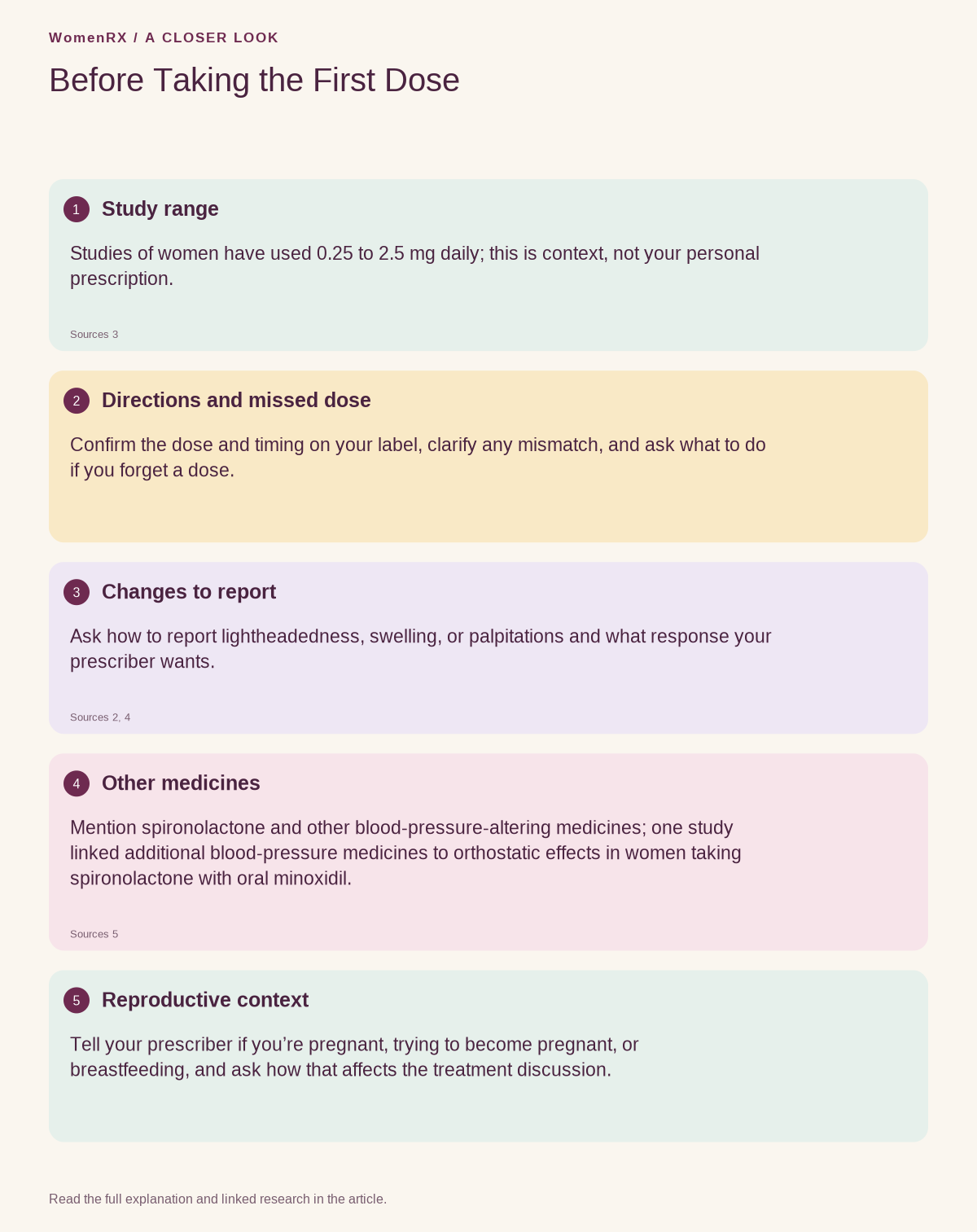
Before Taking the First Dose
Study range: Studies of women have used 0.25 to 2.5 mg daily; this is context, not your personal prescription.3
Directions and missed dose: Confirm the dose and timing on your label, clarify any mismatch, and ask what to do if you forget a dose.
Changes to report: Ask how to report lightheadedness, swelling, or palpitations and what response your prescriber wants.24
Other medicines: Mention spironolactone and other blood-pressure-altering medicines; one study linked additional blood-pressure medicines to orthostatic effects in women taking spironolactone with oral minoxidil.5
Reproductive context: Tell your prescriber if you’re pregnant, trying to become pregnant, or breastfeeding, and ask how that affects the treatment discussion.
Read the figure as text
Use these points to confirm your prescription directions and make the follow-up plan specific to your situation.- Study range: Studies of women have used 0.25 to 2.5 mg daily; this is context, not your personal prescription.3
- Directions and missed dose: Confirm the dose and timing on your label, clarify any mismatch, and ask what to do if you forget a dose.
- Changes to report: Ask how to report lightheadedness, swelling, or palpitations and what response your prescriber wants.24
- Other medicines: Mention spironolactone and other blood-pressure-altering medicines; one study linked additional blood-pressure medicines to orthostatic effects in women taking spironolactone with oral minoxidil.5
- Reproductive context: Tell your prescriber if you’re pregnant, trying to become pregnant, or breastfeeding, and ask how that affects the treatment discussion.
More questions, answered
Is 0.25 to 2.5 mg a recommended dose for women?
No. A review reported that range among doses used in studies of women; it isn’t a personalized recommendation. Ask your prescriber why they chose your proposed dose and how they’ll assess benefits and side effects. 3
Sources you can check
- Efficacy and safety of low-dose oral minoxidil in the management of androgenetic alopecia.Gupta AK, Talukder M, Shemer A. · Expert opinion on pharmacotherapy · 2024Return to first citation
- Gender Differences in Adverse Effects and Dosing Practices of Low-Dose Oral Minoxidil for Androgenetic Alopecia: A Retrospective Analysis of 310 Patients.Ong MM, Do H, Ho B, Lipner SR. · Skin appendage disorders · 2025Return to first citation
- Review of oral minoxidil as treatment of hair disorders: in search of the perfect dose.Villani A, Fabbrocini G, Ocampo-Candiani J, Ruggiero A, Ocampo-Garza SS. · Journal of the European Academy of Dermatology and Venereology : JEADV · 2021Return to first citation
- There Is a Positive Dose-Dependent Association between Low-Dose Oral Minoxidil and Its Efficacy for Androgenetic Alopecia: Findings from a Systematic Review with Meta-Regression Analyses.Gupta AK, Hall DC, Talukder M, Bamimore MA. · Skin appendage disorders · 2022Return to first citation
- Safety and tolerability of combination oral spironolactone and low-dose oral minoxidil for hair loss in adult females: A retrospective cohort study.Dewey E, Salloum L, Gregoire S, McIntosh BA, Zhao V, Mostaghimi A. · Journal of the American Academy of Dermatology · 2026Return to first citation