Oral Minoxidil for Hair Loss: How to Judge Progress
A consistent photo routine can help you notice changes in hair coverage without treating one picture or one day of shedding as a verdict.
Take baseline photos of the areas you want to follow, then repeat them under similar conditions at intervals you can maintain. Compare the same part and scalp areas, and note changes in hair length or styling that could affect how much scalp shows. Oral minoxidil studies have used photos and hair-density measurements, but their assessment schedules don’t predict when you’ll notice a change. 2 3

Make each photo a fair comparison
Your part can look wider in a photo because of the light, camera angle, or the way your hair is lying. A haircut can change how much scalp shows, too. Rather than judging one before-and-after pair, try to keep the setup similar each time: use the same location and lighting, camera distance and angle, and hair condition, such as dry rather than wet.
Choose the areas you want to follow. For example, you might photograph your part and the top of your scalp if that’s where you’ve noticed thinning. Place the part in a similar position each time. A phone photo can help you compare visible coverage, but it can’t give you a precise hair-density measurement.
Keep a record you can actually use
Take a baseline set before or near the start of treatment. Then pick a repeat interval you can maintain. Add a short note with each set: the date, hair length, hairstyle, and anything else that changed about how you took the pictures. If your part looks different later, those details can help you decide whether you’re seeing a change in coverage or simply a different photo setup.
Research assessments show why it helps to look at more than a single image, though they aren’t a home-photo schedule. In a randomized trial of 65 people with androgenetic alopecia, researchers compared oral and topical minoxidil over six months using photographs, hair-diameter measurements, and patient questionnaires. The study abstract doesn’t provide a participant sex breakdown or a women-only result. 2 A separate retrospective study followed 12 women with female androgenetic alopecia, using global photographs and digital scalp measurements at baseline and after 24 weeks. 3
Neither study tells you how often to take pictures at home or when you personally should expect to see a difference. Their methods do support a useful distinction: a change in visible coverage is easier to assess across comparable views than from one photo taken on a particularly good or bad hair day. 2 3
Let shedding be context, not the score
Finding hairs in the shower or brush can be unsettling, but some daily loss is normal. MedlinePlus says people can lose up to 100 scalp hairs a day, and in most people those hairs grow back. 1 One wash day’s loose hairs can’t tell you whether your overall coverage is improving.
If you want to note shedding, keep it simple: record whether it seems different from your usual pattern rather than counting every hair. Look at that note alongside your comparable photos, not in place of them. A part-width comparison may be especially useful if your part is where you first noticed thinning, but it’s a personal reference point, not a test every woman needs to pass.
Don’t borrow someone else’s before-and-after
There’s no single photo result to expect. In the small retrospective study of 12 women, researchers reported improvements in hair density of 38% in the frontal area and 23% at the vertex after 24 weeks. Those figures describe changes reported in that study, not the amount of growth you should expect. Its small size and retrospective design limit how widely the results can be applied. 3
If your photos remain hard to interpret, a few comparable sets and their notes can be useful to show the clinician managing your treatment. Hair loss has different possible causes, and treatment depends on the cause. 1 For your own record, focus on what you can compare fairly: the same areas, photographed in similar ways, across time.
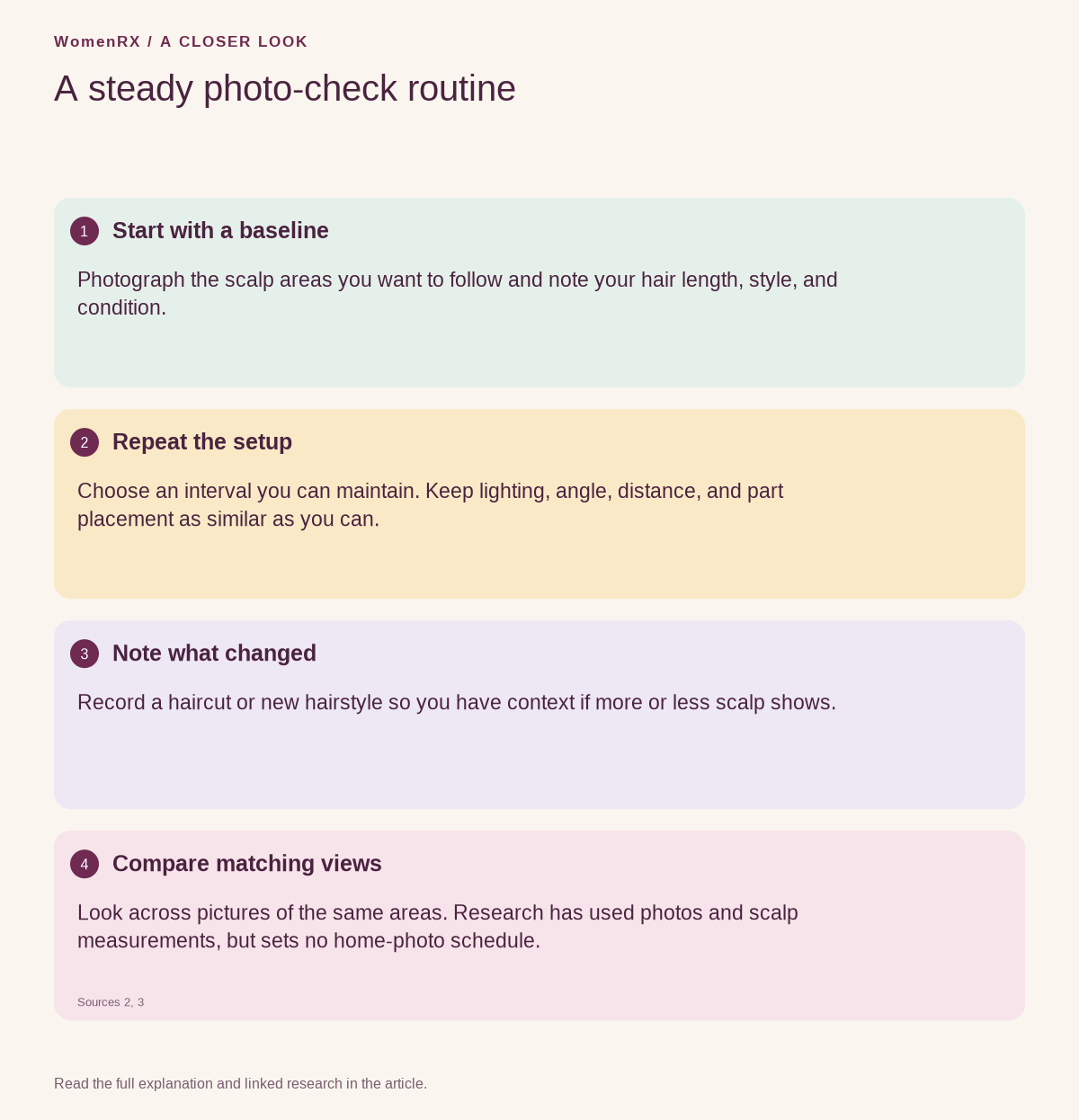
A steady photo-check routine
Start with a baseline: Photograph the scalp areas you want to follow and note your hair length, style, and condition.
Repeat the setup: Choose an interval you can maintain. Keep lighting, angle, distance, and part placement as similar as you can.
Note what changed: Record a haircut or new hairstyle so you have context if more or less scalp shows.
Compare matching views: Look across pictures of the same areas. Research has used photos and scalp measurements, but sets no home-photo schedule.23
Read the figure as text
Use a similar setup each time to compare visible coverage across your own pictures. This is a practical tracking aid, not a validated test or a treatment timetable.- Start with a baseline: Photograph the scalp areas you want to follow and note your hair length, style, and condition.
- Repeat the setup: Choose an interval you can maintain. Keep lighting, angle, distance, and part placement as similar as you can.
- Note what changed: Record a haircut or new hairstyle so you have context if more or less scalp shows.
- Compare matching views: Look across pictures of the same areas. Research has used photos and scalp measurements, but sets no home-photo schedule.23
Sources you can check
- Hair Loss | Alopecia | Alopecia Areata | MedlinePlusAccessed 2026-09-25Return to first citation
- Clinical efficacy and safety of low-dose oral minoxidil versus topical solution in the improvement of androgenetic alopecia: A randomized controlled trial.Asilian A, Farmani A, Saber M. · Journal of cosmetic dermatology · 2024Return to first citation
- Efficacy and safety of oral minoxidil in female androgenetic alopecia.Vastarella M, Cantelli M, Patrì A, Annunziata MC, Nappa P, Fabbrocini G. · Dermatologic therapy · 2020Return to first citation