How to Track Hair Changes on Oral Minoxidil
Shedding, ongoing loss, and visible density are different observations, so track them separately instead of relying on one change to tell the whole story.
There isn’t one response deadline that applies to everyone. A small study of pattern hair loss assessed outcomes after six months, but that doesn’t make six months a promise for an individual. Keep separate notes on shedding and visible coverage, add relevant health or reproductive context, and review the overall pattern with your clinician. 2

Start with the change you’re watching
Hair can seem different in more than one way. You might notice more strands coming out, continued thinning, or a change in how much scalp shows through. These observations can overlap, but they aren’t interchangeable: a week with less shedding doesn’t by itself show that density has improved, and a photo can’t tell you how much hair came out.
Write down your main concern and, if useful, take a baseline photo. For later comparisons, use the same scalp area, part, hairstyle, lighting, and camera distance as much as you can. This makes the comparison more consistent; it isn’t a validated test of whether treatment is working.
Keep three observations distinct
Shedding: Describe whether it seems about the same, noticeably higher, or noticeably lower than usual. If you observe shedding during washing or brushing, use the same personal approach each time. Treat the description as a way to notice a pattern, not as a precise measurement.
Ongoing loss: Note whether thinning seems to be continuing, and where you see it. This is different from how much hair comes out on a particular day. Hair loss has causes beyond pattern hair loss, including illness, stress, some medicines, and poor nutrition, so ongoing change may need to be considered in context. 1
Visible density: Compare the same areas over time. Note changes in coverage or the appearance of your part, and use consistent photos if they help. Gradual changes can be hard to judge from memory, but a short-term fluctuation shouldn’t be treated as proof of regrowth or treatment failure.
Add context without assuming the cause
Alongside your hair observations, note health or life changes that happen around the same time. Depending on what’s relevant to you, that might include an illness, a new medicine, pregnancy, the postpartum period, or menstrual changes. The point isn’t to assume that one of these caused a change; it’s to give your clinician context when considering other explanations. The pattern-hair-loss and COVID-related shedding studies described below don’t establish how menstrual or postpartum changes affect response to oral minoxidil. 2 3
What the study findings can tell you
One small study followed 41 people with androgenetic, or pattern, hair loss during at least six months of low-dose oral minoxidil treatment. It reported clinical improvement in 26 participants after six months. That is a result from one study group, not a forecast for an individual or a universal deadline. The study included 15 women, but the reported sex-specific counts don’t reconcile with the overall total, so they shouldn’t be used to estimate a woman’s chance of improvement. 2
A separate retrospective study looked at 69 people with COVID-related telogen effluvium, including 50 women. It reported lower hair-shedding scores at successive visits after treatment began. Because this was a specific type of shedding, the finding shouldn’t be treated as a schedule for everyone taking oral minoxidil. 3
Together, these studies are a reason to look at more than one kind of change and to interpret it in light of the hair-loss type. They don’t establish one date when everyone should see visible density change. 2 3
Make follow-up about the pattern
At review, bring your separate observations together: what happened to shedding, whether thinning seemed to continue, and what changed in visible coverage. Include any relevant health or reproductive context and the dates or approximate timing. Ask whether the pattern fits the type of hair loss being treated, what else might contribute, and what changes would be useful to compare at the next review.
If you’re still seeing loss, that’s worth discussing as an observation. It doesn’t, by itself, tell you whether oral minoxidil has or hasn’t worked. A consistent record gives you and your clinician a clearer basis for interpreting change over time.
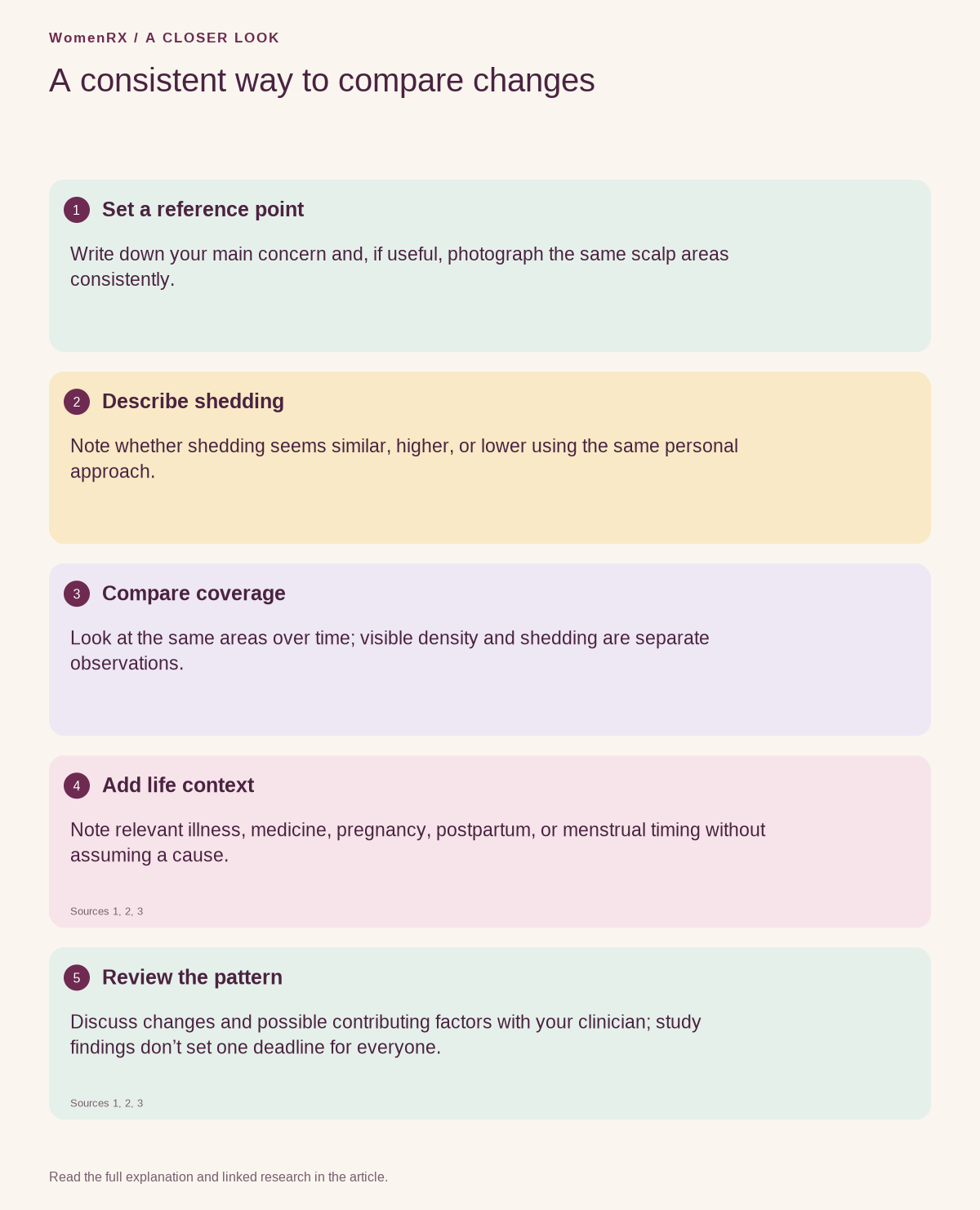
A consistent way to compare changes
Set a reference point: Write down your main concern and, if useful, photograph the same scalp areas consistently.
Describe shedding: Note whether shedding seems similar, higher, or lower using the same personal approach.
Compare coverage: Look at the same areas over time; visible density and shedding are separate observations.
Add life context: Note relevant illness, medicine, pregnancy, postpartum, or menstrual timing without assuming a cause.123
Review the pattern: Discuss changes and possible contributing factors with your clinician; study findings don’t set one deadline for everyone.123
Read the figure as text
A monitoring sequence that separates a starting point, repeated observations, relevant context, and follow-up without assigning a universal date for results.- Set a reference point: Write down your main concern and, if useful, photograph the same scalp areas consistently.
- Describe shedding: Note whether shedding seems similar, higher, or lower using the same personal approach.
- Compare coverage: Look at the same areas over time; visible density and shedding are separate observations.
- Add life context: Note relevant illness, medicine, pregnancy, postpartum, or menstrual timing without assuming a cause.123
- Review the pattern: Discuss changes and possible contributing factors with your clinician; study findings don’t set one deadline for everyone.123
Sources you can check
- Hair Loss | Alopecia | Alopecia Areata | MedlinePlusAccessed 2026-09-25Return to first citation
- Hair follicle sulfotransferase activity and effectiveness of oral minoxidil in androgenetic alopecia.Jimenez-Cauhe J, Vaño-Galvan S, Mehta N, Hermosa-Gelbard A, Ortega-Quijano D, Buendia-Castaño D, Fernández-Nieto D, Porriño-Bustamante M, Saceda-Corralo D, Pindado-Ortega C, Moreno... · Journal of cosmetic dermatology · 2024Return to first citation
- Low-Dose Oral Minoxidil as Treatment for COVID-19-Related Telogen Effluvium: Results From a Retrospective Series of 69 Patients.Villarreal-Villarreal CD, Boland-Rodriguez E, Mares-Custodio D, Asz-Sigall D, Molina-de la Garza JF, Saceda-Corralo D, Vano-Galvan S. · Actas dermo-sifiliograficas · 2026Return to first citation