Minoxidil for Women: What Results Can You Expect?
Topical minoxidil can help with female pattern hair loss, but judging the result takes months and keeping a benefit means continuing treatment.
Topical minoxidil can help women with female pattern hair loss maintain thickness or see some regrowth, though results vary and usually take six to 12 months to become visible. Its benefits fade after you stop using it. Oral minoxidil is a separate, off-label option with less clearly established results for women. If pregnancy or breastfeeding is part of your decision, ask about either formulation before starting. 47
First, make sure pattern thinning is the right question
Female pattern hair loss often develops gradually, but gradual thinning isn’t a diagnosis by itself. Other causes of hair loss include thyroid disease, illness, medication effects, and poor nutrition. A clinician may look at the pattern of thinning and examine the scalp to distinguish female pattern hair loss from other conditions that need a different approach. 14
That distinction matters when you’re weighing minoxidil. A treatment study in women with diagnosed female pattern hair loss can’t tell you what to expect if the main cause of your shedding is something else.
What topical minoxidil may change
Topical minoxidil is the established minoxidil treatment for female pattern hair loss. The goal is improvement or stabilization, not a promise that your hair will return to how it looked years ago. Pattern hair loss can progress over time, and no treatment works for everyone. 234
In a randomized trial involving 60 women with female pattern hair loss, researchers compared topical minoxidil with topical cetirizine, another scalp treatment. After six months, hair diameter and density had improved in both groups, but the improvement reached statistical significance only in the minoxidil group. In an analysis of participants who followed the study protocol, minoxidil performed better for hair density, though not for diameter. That supports a potential benefit over months; it doesn’t tell you how much change you personally will see in the mirror. 5
Another trial followed 48 premenopausal women for 24 weeks while everyone used topical minoxidil. Researchers tested whether adding spironolactone helped. Hair density and diameter increased in both groups, including the group receiving minoxidil without spironolactone. Because there was no group using neither treatment, that trial cannot isolate the size of minoxidil’s effect. It does show why a follow-up assessment needs more than a quick glance: researchers measured individual hairs and also compared scalp photographs. 3
How to tell whether it’s helping you
Studies measure several things that aren’t interchangeable. Hair density means the number of hairs in a measured scalp area. Hair diameter describes the thickness of individual hairs. Standardized photographs can show whether the overall appearance has changed. A treatment might improve one measure more clearly than another, as the six-month comparison of minoxidil and cetirizine illustrates. 35
For your own decision, think about the change you actually want to notice. Is it less visible scalp along your part, or are you hoping for a return to your former volume? A photo of the same part or thinning area in similar lighting can give you a more useful comparison than memory alone. Treat it as a personal reference, not a diagnostic score. The American Academy of Dermatology says visible regrowth with minoxidil usually takes about six to 12 months, so a lack of obvious change after a few weeks isn’t a useful verdict. 7
There’s also the maintenance question. If topical minoxidil helps, continuing it is part of keeping that benefit. The American Academy of Dermatology advises that stopping means losing its benefits: hair may gradually look thinner again, and shedding may increase. It doesn’t give a precise stopping timeline, so think of topical minoxidil as an ongoing scalp treatment rather than a short course that permanently restores hair. Whether regular application fits your life is a real part of the decision. 7
Where oral minoxidil fits
Oral minoxidil isn’t simply topical minoxidil in a more convenient form. A review of treatments for women identifies topical minoxidil as the approved treatment for female pattern hair loss and low-dose oral minoxidil as an off-label option. It also notes a shortage of randomized trials that include women. The topical studies discussed here therefore cannot be used to predict your result with oral treatment or to claim that oral treatment works better. 4
If you’re comparing the two, the useful question is not only which might produce more hair. It’s what evidence supports each option for you, what unwanted effects would change the decision, and how the result would be reassessed. Pregnancy or breastfeeding makes that choice more immediate: the women’s efficacy trials here do not establish safety during either period, and the oral-treatment review does not resolve it. If you’re pregnant, planning pregnancy, or breastfeeding, bring that up before choosing topical or oral minoxidil rather than assuming the two formulations have the same safety considerations. 345
A tradeoff that may be visible somewhere else
Topical treatment can lead to unwanted facial or body hair. An analysis of placebo-controlled topical minoxidil trials involving 1,333 women found spontaneous reports of this effect in 50 women, or about 4%. Reports followed a dose-related pattern across the concentrations studied, and nine women stopped treatment because of it. That figure describes reported events across those trials, not your individual likelihood. 6
If gradual pattern thinning is bothering you, topical minoxidil has evidence worth considering. Give the decision a realistic frame: confirm the cause, decide what visible change would count as worthwhile, allow months to assess it, and weigh unwanted hair growth and ongoing application against the possibility of keeping or improving your hair’s thickness. 1567
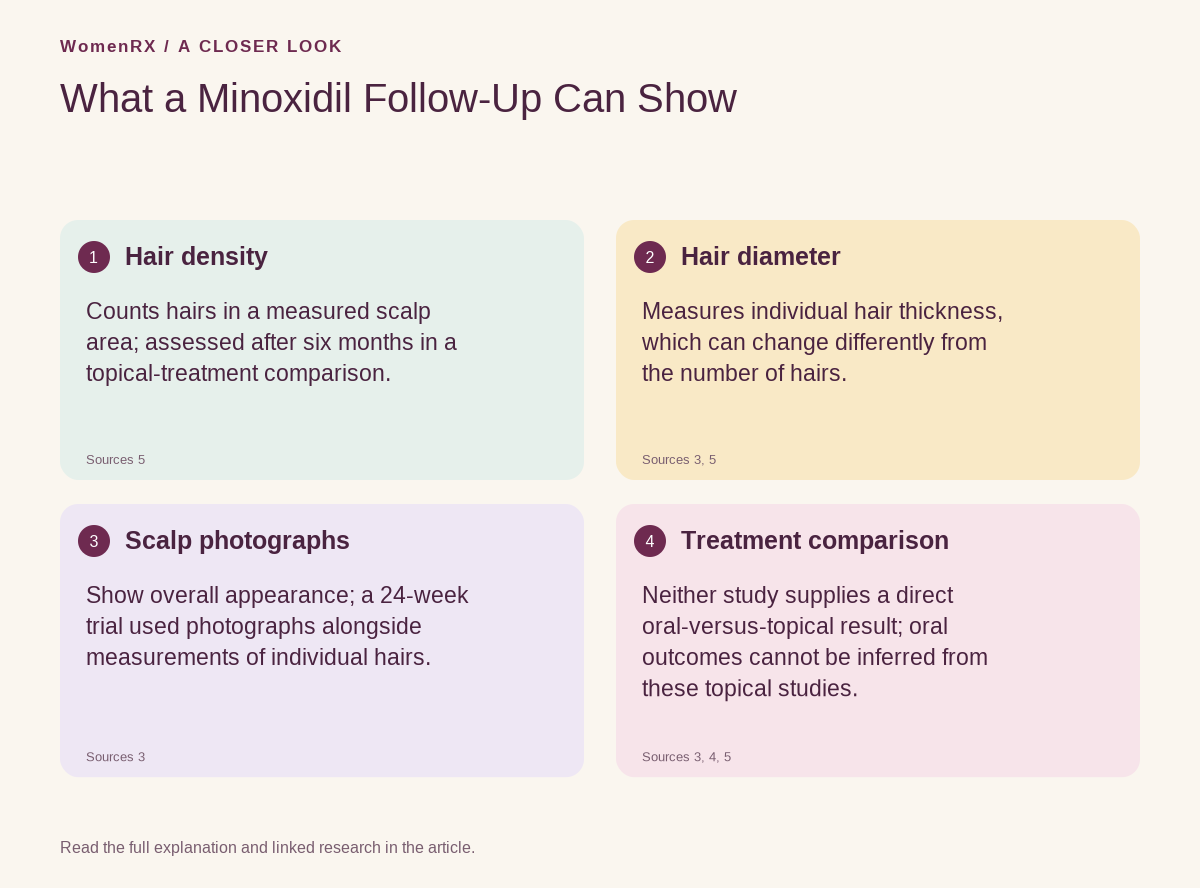
What a Minoxidil Follow-Up Can Show
Hair density: Counts hairs in a measured scalp area; assessed after six months in a topical-treatment comparison.5
Hair diameter: Measures individual hair thickness, which can change differently from the number of hairs.35
Scalp photographs: Show overall appearance; a 24-week trial used photographs alongside measurements of individual hairs.3
Treatment comparison: Neither study supplies a direct oral-versus-topical result; oral outcomes cannot be inferred from these topical studies.345
Read the figure as text
These study measures answer different questions about a change in thinning hair.- Hair density: Counts hairs in a measured scalp area; assessed after six months in a topical-treatment comparison.5
- Hair diameter: Measures individual hair thickness, which can change differently from the number of hairs.35
- Scalp photographs: Show overall appearance; a 24-week trial used photographs alongside measurements of individual hairs.3
- Treatment comparison: Neither study supplies a direct oral-versus-topical result; oral outcomes cannot be inferred from these topical studies.345
More questions, answered
Does a thicker-looking part mean more hairs grew?
Not necessarily. Researchers measure hair density and individual hair diameter separately because both can affect how full an area looks. In one six-month study in women, the treatments differed more clearly on density than on diameter. 5
Sources you can check
- Hair Loss | Alopecia | Alopecia Areata | MedlinePlusAccessed 2026-09-25Return to first citation
- Hair loss - NHSAccessed 2026-09-25Return to first citation
- Efficacy and safety of oral spironolactone for female pattern hair loss in premenopausal women: a randomized, double-blind, placebo-controlled, parallel-group pilot study.Werachattawatchai P, Khunkhet S, Harnchoowong S, Lertphanichkul C. · International journal of women's dermatology · 2025Return to first citation
- Androgenetic Alopecia in Women: A Narrative Review of Pathophysiology, Clinical Evaluation, and Treatments.Kearney CA, Brinks AL, Lawrence CN, Maas DE, Spindler AJ, Coric C, Gener-Pangilinan LA, Lasheras-Pérez MA, Shapiro J, Lo Sicco KI. · American journal of clinical dermatology · 2026Return to first citation
- Therapeutic effects of topical cetirizine in the treatment of female pattern hair loss: a randomized controlled noninferiority trial.Alavi SMK, Layegh P, Vahabi-Amlashi S, Sabeti V, Forouzanfar M, Darchini-Maragheh E. · Expert review of clinical pharmacology · 2023Return to first citation
- Hypertrichosis in females applying minoxidil topical solution and in normal controls.Dawber RP, Rundegren J. · Journal of the European Academy of Dermatology and Venereology : JEADV · 2003Return to first citation
- Hair loss: Diagnosis and treatmentAccessed 2026-09-25Return to first citation