Topical Minoxidil for Female Pattern Hair Loss
Minoxidil solution can improve measured hair growth in women with pattern thinning, but the routine and scalp side effects matter when choosing a formulation.
Topical minoxidil can help with diagnosed female pattern hair loss, though it won’t produce noticeable regrowth for everyone. In a 48-week trial in women, both 2% and 5% solutions improved some measures compared with placebo. The 5% solution did better on more measures, but itching, irritation, and unwanted hair growth were more common. The trial tested twice-daily use, not foam or less frequent application. 3
What improvement meant in the women’s trial
If your part looks wider or your hair seems thinner, the first question is whether you have female pattern hair loss. Other types of hair loss can be temporary or related to a medical condition, and an examination can help clarify the cause before you choose a treatment. Minoxidil is an option for female pattern hair loss, but a trial in women with that diagnosis can’t predict its effect on a different kind of thinning. 13
A randomized trial followed 381 women ages 18 to 49 with female pattern hair loss for 48 weeks. They used either 2% minoxidil solution, 5% minoxidil solution, or a placebo solution twice daily. Researchers counted nonvellus hairs and asked both the women and investigators to assess hair growth and scalp coverage. 3
At week 48, the 5% solution outperformed placebo on all three main measures. The 2% solution outperformed placebo on hair count and the investigators’ assessment, but the women’s own assessment of hair growth was not significantly different from placebo. Women using 5% also rated its treatment benefit more highly than those using 2%. Those distinctions are useful: a change in measured hair count doesn’t always translate into a change you can readily see. 3
A smaller randomized trial of 60 women compared 2% minoxidil with topical cetirizine. After six months, both groups showed improvements in measured hair density and diameter, but those changes were statistically significant only in the minoxidil group. It adds support for minoxidil as a treatment worth considering, without telling you whether 2% or 5% is the better fit. 4
The stronger solution has a comfort trade-off
In the 48-week trial, itching, local irritation, and hypertrichosis, or unwanted hair growth, occurred more often with 5% solution than with 2% solution or placebo. The trial described both strengths as well tolerated overall, but that doesn’t erase a side effect that bothers you. 3
Both strengths in that trial were solutions applied twice daily. So the choice isn’t just about which percentage had the stronger results. It’s also whether regular application feels manageable and whether potential scalp discomfort or unwanted hair growth changes what you’d be willing to continue. The trial did not compare different application routines or measure how changing the routine would affect results. 3
What about foam? The direct 48-week comparison in women tested solutions, not foam. A longer-term study of 5% foam enrolled men, so its findings can’t establish whether foam works better or feels gentler for women with female pattern hair loss. If the feel of a solution is a sticking point, formulation is a reasonable part of the treatment conversation, but there isn’t a women’s foam-versus-solution result here to settle it. 23
Plan for the questions the trial couldn’t answer
The women’s comparison measured outcomes during 48 weeks of application. It doesn’t establish what happens to an individual’s gains after stopping or provide a stopping plan. Before starting, it’s worth asking how you and your clinician would assess whether it’s helping enough to justify continued use, particularly if application or irritation becomes difficult. 3
Pregnancy and breastfeeding call for a separate conversation. The trials described here do not establish safety during pregnancy or while breastfeeding. If you’re pregnant, planning a pregnancy, or breastfeeding, ask for advice tailored to your situation before starting or continuing minoxidil rather than treating results in other women as an answer to that question. 34
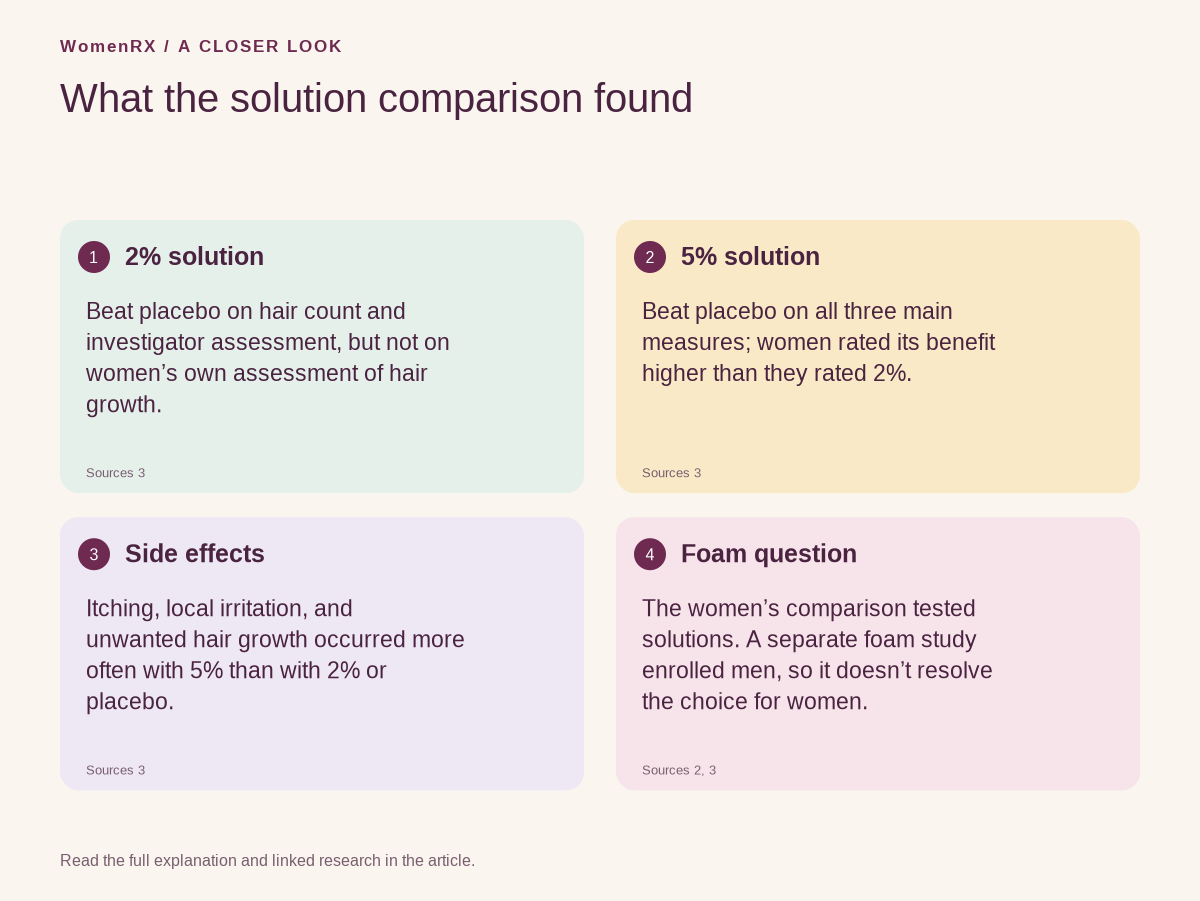
What the solution comparison found
2% solution: Beat placebo on hair count and investigator assessment, but not on women’s own assessment of hair growth.3
5% solution: Beat placebo on all three main measures; women rated its benefit higher than they rated 2%.3
Side effects: Itching, local irritation, and unwanted hair growth occurred more often with 5% than with 2% or placebo.3
Foam question: The women’s comparison tested solutions. A separate foam study enrolled men, so it doesn’t resolve the choice for women.23
Read the figure as text
In a 48-week trial, women used 2% solution, 5% solution, or placebo twice daily. The results differed by outcome and strength.- 2% solution: Beat placebo on hair count and investigator assessment, but not on women’s own assessment of hair growth.3
- 5% solution: Beat placebo on all three main measures; women rated its benefit higher than they rated 2%.3
- Side effects: Itching, local irritation, and unwanted hair growth occurred more often with 5% than with 2% or placebo.3
- Foam question: The women’s comparison tested solutions. A separate foam study enrolled men, so it doesn’t resolve the choice for women.23
Sources you can check
- Hair loss - NHSAccessed 2026-09-25Return to first citation
- Effect of minoxidil topical foam on frontotemporal and vertex androgenetic alopecia in men: a 104-week open-label clinical trial.Kanti V, Hillmann K, Kottner J, Stroux A, Canfield D, Blume-Peytavi U. · Journal of the European Academy of Dermatology and Venereology : JEADV · 2016Return to first citation
- A randomized, placebo-controlled trial of 5% and 2% topical minoxidil solutions in the treatment of female pattern hair loss.Lucky AW, Piacquadio DJ, Ditre CM, Dunlap F, Kantor I, Pandya AG, Savin RC, Tharp MD. · Journal of the American Academy of Dermatology · 2004Return to first citation
- Therapeutic effects of topical cetirizine in the treatment of female pattern hair loss: a randomized controlled noninferiority trial.Alavi SMK, Layegh P, Vahabi-Amlashi S, Sabeti V, Forouzanfar M, Darchini-Maragheh E. · Expert review of clinical pharmacology · 2023Return to first citation