Female Pattern Hair Loss: What the Pattern Means
A widening part can point to female pattern hair loss, but the pattern, timing, and any shedding help determine what to treat.
Female pattern hair loss usually develops gradually, with thinning across the central scalp or crown and often a wider-looking part. A clinician can often assess it from your history and scalp exam, using closer scalp examination or targeted tests when the cause isn’t clear. Topical minoxidil is the established treatment; prescription alternatives involve different evidence, monitoring, and pregnancy considerations. 134
Look at the pattern and the timing
If your part has slowly widened or more scalp shows through at the crown, female pattern hair loss is one possibility. In this condition, affected follicles gradually produce finer hairs, so coverage decreases even though the frontal hairline may remain in place. It can affect women before and after menopause. The pattern alone doesn’t prove that your hormone levels are abnormal. 45
Shedding tells a different part of the story. For example, losing handfuls of hair after an illness or childbirth calls for a look at diffuse shedding, including telogen effluvium, rather than assuming every lost hair is part of a gradual pattern. The two can also occur together: obvious postpartum shedding may reveal an earlier, subtler hereditary loss. A history of when the change began and an examination of where hair density has changed help separate them. 14
What an assessment can establish
A clinician will ask whether thinning developed gradually or shedding began more abruptly, and about recent physical or emotional stressors, childbirth, hair practices, and other symptoms. Examining the scalp and hair distribution may be enough to diagnose female pattern hair loss. Closer examination with a dermoscope can help when the pattern is subtle or the diagnosis is uncertain. 134
Blood tests aren’t automatically needed because you have a widening part. They may be useful when the history or exam suggests another cause, such as a deficiency or hormone-related condition. Acne, increased facial or body hair, and irregular periods are examples of findings that can prompt an assessment for excess androgens or an ovarian disorder. A scalp biopsy is sometimes considered when the diagnosis remains unclear, but it usually isn’t required for a typical pattern. 14
That distinction matters before choosing a treatment. A medicine aimed at pattern loss won’t, by itself, explain substantial new shedding or address hair loss caused by a damaging hairstyle or another scalp condition. 14
Compare treatments by evidence and trade-offs
Topical minoxidil is the established starting point. It’s the FDA-approved drug treatment for female pattern hair loss in the US and can help with early loss, though it cannot restore a full head of hair. Its practical trade-off is regular scalp application over time. Scalp irritation or unwanted hair growth outside the treated area can occur. 135
Spironolactone is a prescription option, not a diagnosis. Dermatologists may consider it for female pattern hair loss, but its use for this condition is off-label; topical minoxidil is the only FDA-endorsed treatment for female pattern hair loss. Unlike a scalp treatment, it is taken by mouth and has whole-body considerations. It can affect potassium, with greater risk of high potassium in people with impaired kidney function. Pregnancy plans matter: US prescribing information advises avoiding spironolactone during pregnancy because its antiandrogenic action may pose a risk to a male fetus. Whether it fits depends on your health, other medicines, and reproductive plans. 136
Oral minoxidil is another prescription approach, but this evidence is less decisive. In an uncontrolled study, 100 women took oral minoxidil with spironolactone and had improved hair-loss and shedding scores over 12 months. Because there was no comparison group and both medicines were given together, the study cannot show how much either medicine contributed. The researchers also recorded blood-pressure changes and side effects. Oral minoxidil is not the FDA-approved female-pattern-hair-loss treatment; its whole-body effects and the limits of combination-study evidence make it a different decision from choosing the scalp product. 23
Finasteride has a particularly narrow place in this conversation. It is approved in the US for male pattern hair loss, not female pattern hair loss. A study discussed in a clinical review found no benefit from one studied regimen in postmenopausal women, while reports of benefit in some other women are less conclusive. Menopause does not, by itself, make finasteride an established choice. US prescribing information says it is contraindicated during pregnancy and when pregnancy may be possible because of potential harm to a male fetus. 147
The useful next move is to establish whether you have pattern loss, shedding, or both. Then the comparison becomes more personal: Is a regular scalp application workable for you? Is there a reason to consider an oral prescription and its monitoring? Could pregnancy be part of your near-term plans? Those answers can change which trade-offs are reasonable without assuming your thinning is simply “hormonal.” 1467
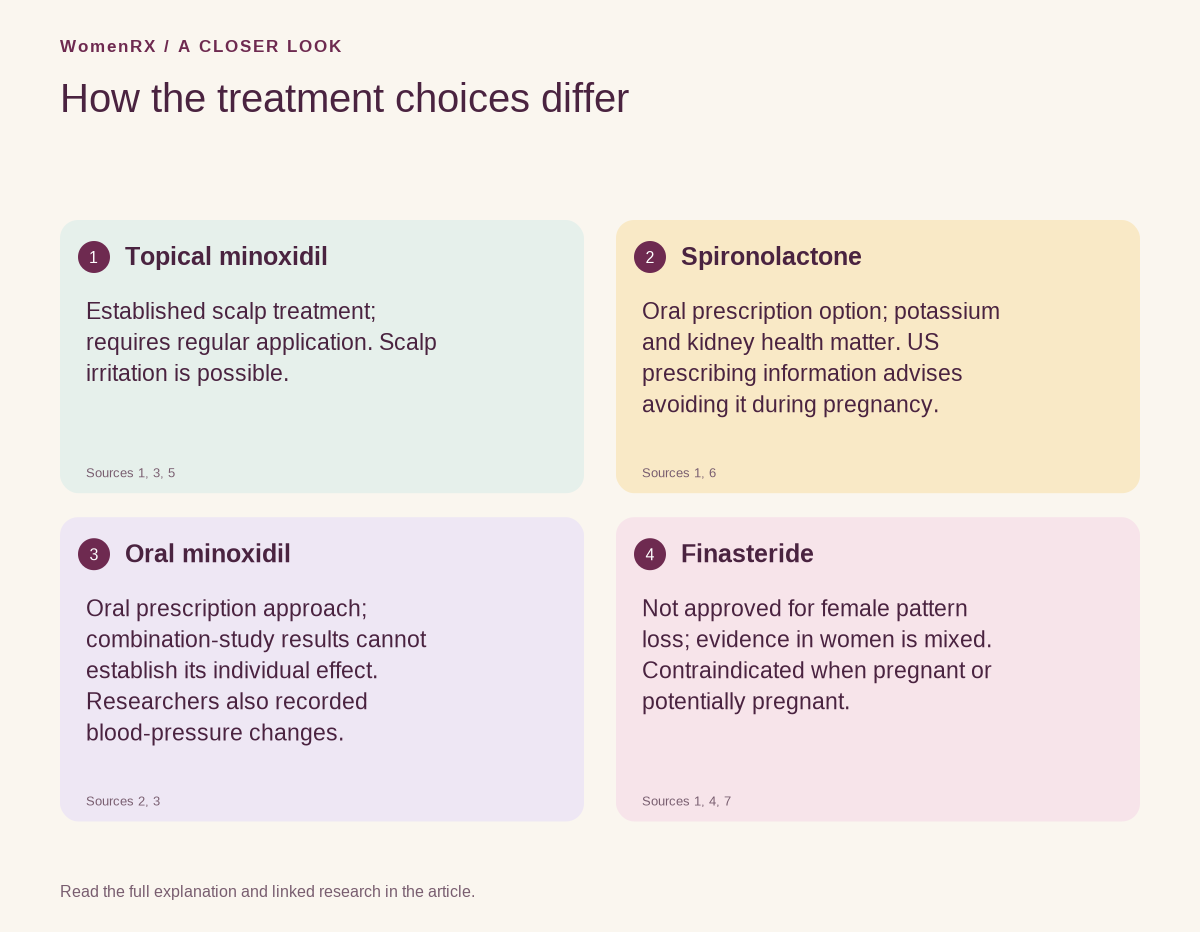
How the treatment choices differ
Topical minoxidil: Established scalp treatment; requires regular application. Scalp irritation is possible.135
Spironolactone: Oral prescription option; potassium and kidney health matter. US prescribing information advises avoiding it during pregnancy.16
Oral minoxidil: Oral prescription approach; combination-study results cannot establish its individual effect. Researchers also recorded blood-pressure changes.23
Finasteride: Not approved for female pattern loss; evidence in women is mixed. Contraindicated when pregnant or potentially pregnant.147
Read the figure as text
The route and evidence matter, and some prescriptions carry specific pregnancy warnings.- Topical minoxidil: Established scalp treatment; requires regular application. Scalp irritation is possible.135
- Spironolactone: Oral prescription option; potassium and kidney health matter. US prescribing information advises avoiding it during pregnancy.16
- Oral minoxidil: Oral prescription approach; combination-study results cannot establish its individual effect. Researchers also recorded blood-pressure changes.23
- Finasteride: Not approved for female pattern loss; evidence in women is mixed. Contraindicated when pregnant or potentially pregnant.147
Sources you can check
- Hair loss: Diagnosis and treatmentAccessed 2026-09-25Return to first citation
- Female pattern hair loss: a pilot study investigating combination therapy with low-dose oral minoxidil and spironolactone.Sinclair RD. · International journal of dermatology · 2018Return to first citation
- Efficacy and safety of botulinum toxin A in the treatment of female pattern hair loss.Hu L, Dai Y, Zhang H, Wu Y, Wang T, Song X. · Skin research and technology : official journal of International Society for Bioengineering and the Skin (ISBS) [and] International Society for Digital Imaging of Skin (ISDIS) [and] International Society for Skin Imaging (ISSI) · 2024Return to first citation
- Female pattern hair loss: A clinical, pathophysiologic, and therapeutic review.Fabbrocini G, Cantelli M, Masarà A, Annunziata MC, Marasca C, Cacciapuoti S. · International journal of women's dermatology · 2018Return to first citation
- Female pattern hair loss.Herskovitz I, Tosti A. · International journal of endocrinology and metabolism · 2013Return to first citation
- SPIRONOLACTONE TABLET, FILM COATED [REMEDYREPACK INC.] | US prescribing information and patient instructionsAccessed 2026-09-25Return to first citation
- FINASTERIDE TABLET, FILM COATED [ACCORD HEALTHCARE, INC.] | US prescribing information and patient instructionsAccessed 2026-09-25Return to first citation