Minoxidil or Spironolactone for Female Pattern Hair Loss
Topical minoxidil treats the scalp directly; oral spironolactone raises different questions about pregnancy, periods, kidney function, and potassium.
For gradual female pattern hair loss, topical minoxidil is an approved scalp treatment. Oral spironolactone is used off-label, but the small placebo-controlled trial in women tested it alongside minoxidil, not instead of it. Minoxidil can irritate the scalp; spironolactone brings pregnancy precautions and questions about potassium and kidney function. First, make sure the thinning fits the condition these treatments were studied for. 3 4 5 2
Does the thinning fit female pattern hair loss?
Female pattern hair loss tends to develop gradually as follicles produce finer hairs. It has several possible contributing factors, and its relationship with androgens is less clear than it is in male pattern hair loss. A widening area of thinning doesn’t, by itself, tell you that your androgen levels are high or that an antiandrogen medicine will help. 3 4 5
A different story may call for a different discussion. For example, hair loss that began around an illness may be temporary rather than pattern hair loss. If you’ve noticed a sudden change in shedding instead of gradual thinning, identifying the likely cause matters more than choosing between these two treatments right away. 1
What each treatment asks of you
Topical minoxidil goes on the scalp. It is an FDA-approved treatment option for female pattern hair loss. Its route avoids taking a tablet, but applying something to your scalp is a routine you need to be willing to follow. In a six-month study comparing topical minoxidil with topical spironolactone, scalp irritation, contact dermatitis, and headache were reported and were more evident in the minoxidil group. That study does not tell us how often you, personally, would have a side effect. 3 4
Oral spironolactone is a tablet used off-label for hair loss. The best direct controlled evidence here addresses whether it adds something to topical minoxidil. In a 24-week trial, 48 premenopausal women with mild-to-moderate female pattern hair loss all used topical minoxidil; half also received spironolactone and half received placebo. Moderate-to-marked improvement was reported in 38% of the spironolactone group versus 9% of the placebo group. The difference in average terminal hair-count change, however, did not reach the study’s usual threshold for statistical significance. This is a possible added benefit in a small study, not proof that spironolactone alone is a better replacement. 5
These are not necessarily either-or choices. They also aren’t short-course treatments with an established stopping point in these studies. Researchers assessed topical treatments over 16 weeks or six months and the oral add-on over 24 weeks; those periods don’t show what happens after treatment stops. Before starting a scalp routine or a tablet, ask what period of use is being proposed, when you would assess whether it’s worthwhile, and what is known about stopping. 3 4 5
Where the safety comparison changes
If pregnancy is possible, say so before considering spironolactone. US prescribing information advises avoiding it during pregnancy because its antiandrogenic action and animal findings raise a potential risk to a male fetus. That warning is not a finding that the small hair-loss trial measured pregnancy outcomes; the trial excluded pregnant participants. 2 5
Spironolactone can raise blood potassium. The hair-loss trial excluded women with abnormal kidney function, electrolyte imbalances, or low blood pressure. Those exclusions make a practical question worth asking before treatment: Do my kidney function and potassium need checking before I start, and would either need monitoring while I take it? Mention relevant health conditions and medicines so that decision reflects your situation, rather than assuming the trial’s safety findings apply to everyone. 2 5
Periods matter, too. Menstrual irregularities were reported in 37.5% of the women assigned spironolactone in the 24-week trial. That figure describes this small premenopausal study, not an expected rate for every woman. 5
Finally, menopause stage changes how directly the evidence applies. The controlled oral add-on trial enrolled premenopausal women; it did not establish the same benefit or side-effect pattern during perimenopause or after menopause. Thinning at either stage still deserves a look at its pattern and possible cause, rather than an assumption that it calls for an antiandrogen. 5 4
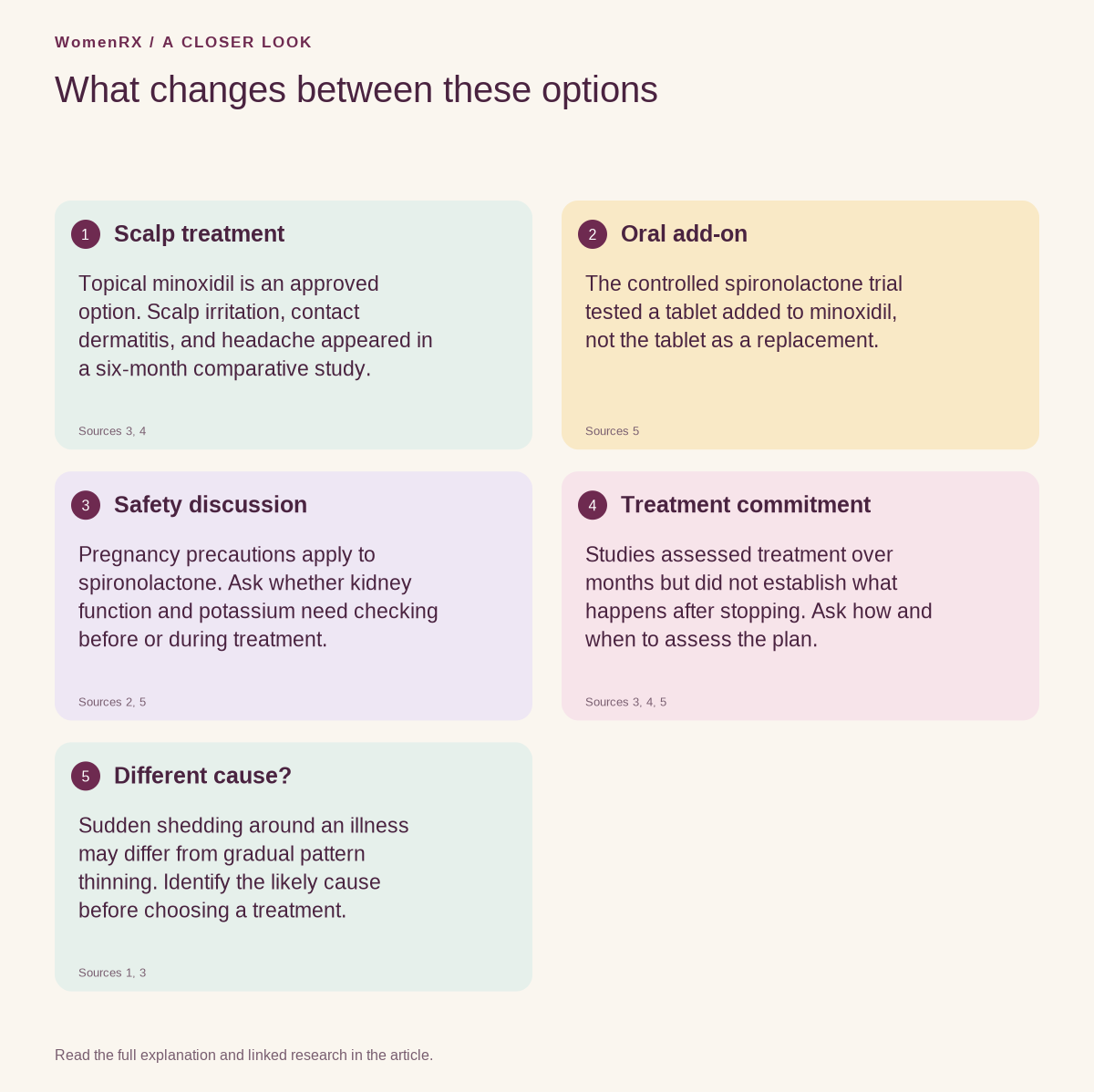
What changes between these options
Scalp treatment: Topical minoxidil is an approved option. Scalp irritation, contact dermatitis, and headache appeared in a six-month comparative study.34
Oral add-on: The controlled spironolactone trial tested a tablet added to minoxidil, not the tablet as a replacement.5
Safety discussion: Pregnancy precautions apply to spironolactone. Ask whether kidney function and potassium need checking before or during treatment.25
Treatment commitment: Studies assessed treatment over months but did not establish what happens after stopping. Ask how and when to assess the plan.345
Different cause?: Sudden shedding around an illness may differ from gradual pattern thinning. Identify the likely cause before choosing a treatment.13
Read the figure as text
Use these distinctions to compare the daily routine, evidence, and safety questions, after checking that gradual pattern thinning is the likely cause.- Scalp treatment: Topical minoxidil is an approved option. Scalp irritation, contact dermatitis, and headache appeared in a six-month comparative study.34
- Oral add-on: The controlled spironolactone trial tested a tablet added to minoxidil, not the tablet as a replacement.5
- Safety discussion: Pregnancy precautions apply to spironolactone. Ask whether kidney function and potassium need checking before or during treatment.25
- Treatment commitment: Studies assessed treatment over months but did not establish what happens after stopping. Ask how and when to assess the plan.345
- Different cause?: Sudden shedding around an illness may differ from gradual pattern thinning. Identify the likely cause before choosing a treatment.13
More questions, answered
Is topical spironolactone the same option as the spironolactone tablet?
No. Small studies have compared topical spironolactone with topical minoxidil, but results from a scalp-applied preparation cannot establish the benefits or safety of an oral tablet. The controlled oral trial tested the tablet only as an addition to topical minoxidil. 3 4 5
Sources you can check
- Hair loss - NHSAccessed 2026-09-25Return to first citation
- SPIRONOLACTONE TABLET, FILM COATED [REMEDYREPACK INC.] | US prescribing information and patient instructionsAccessed 2026-09-25Return to first citation
- Clinical and Trichoscopic Evaluations of Topical Finasteride 1%, Topical Spironolactone 5%, and Minoxidil 5% in Female Pattern Hair Loss Treatment.Al Sayed NM, El Morsy EH, Hussein TM, Hassan EM. · Dermatology practical & conceptual · 2025Return to first citation
- Evaluation of the Efficacy and Safety of Topical Spironolactone versus Topical Minoxidil in the Treatment of Female Pattern Hair Loss: A Comparative, Clinical, and Trichoscopic Study.Hassan GFR, Elsaftawy RE, Mady OY, Gheida SF. · International journal of trichology · 2025Return to first citation
- Efficacy and safety of oral spironolactone for female pattern hair loss in premenopausal women: a randomized, double-blind, placebo-controlled, parallel-group pilot study.Werachattawatchai P, Khunkhet S, Harnchoowong S, Lertphanichkul C. · International journal of women's dermatology · 2025Return to first citation