Spironolactone for Hair Loss: What to Review
Spironolactone may be discussed for diagnosed female pattern hair loss, but the decision depends on the cause of thinning, pregnancy plans, and safety monitoring.
Spironolactone is sometimes prescribed off-label for female pattern hair loss because it can block androgen activity at hair follicles. It isn’t a treatment for every kind of shedding, and evidence is still limited. A useful discussion starts with confirming the hair-loss pattern, reviewing kidney function and potassium-related risks, and talking about pregnancy before deciding how to assess a response. 4 5

First, match the treatment to the type of hair loss
Spironolactone is most often considered for female pattern hair loss, a gradual thinning pattern that can affect the top and front of the scalp. Hair loss has other possible causes too, including thyroid disease, nutritional problems, illness, stress, and medicines. The right treatment depends on the cause, so a hair-loss discussion should begin with the pattern and history, not with an assumption that hormones are responsible. 1 3 5
Androgen-related symptoms alone don’t establish female pattern hair loss or prove that androgen levels are high. The biology is more complicated: a review reports that most women with female pattern hair loss do not have excessive androgen levels or signs of abnormal androgen levels, and that the role of androgens is still debated. 3
Why spironolactone may come up
Spironolactone is a potassium-sparing diuretic used for other medical conditions. It also has antiandrogen activity: it can block androgen receptors and may reduce androgen synthesis. Those actions are the proposed reason it may help limit follicle miniaturization in female pattern hair loss. This is a proposed fit for a particular diagnosis, not proof that the medicine will help every person with thinning hair. 2 4 5
In the United States, use for hair loss is off-label. A small randomized trial in 48 premenopausal women tested spironolactone alongside topical minoxidil, so it assessed an added effect rather than spironolactone on its own. At 24 weeks, the spironolactone group had a greater improvement in some hair measures, but the difference in terminal hair-count change narrowly missed conventional statistical significance. The small study size limits how confidently its results can be applied more broadly. 4 5
Safety is a real part of the decision
Because spironolactone can raise potassium, kidney function and potassium-related risks matter before and during treatment. The US prescribing information warns that the risk of high potassium is greater with impaired kidney function, potassium supplements, potassium-containing salt substitutes, and medicines such as ACE inhibitors or ARBs. It recommends checking potassium within a week after starting or changing the medicine and regularly afterward; monitoring needs can depend on kidney function and other medicines. 2
Bring a complete list of medicines and supplements to the discussion. In particular, mention potassium products, salt substitutes, and blood-pressure medicines, including ACE inhibitors or ARBs. The goal is to identify relevant risks and decide what checks are appropriate, not to stop a prescribed medicine on your own. 2
Menstrual changes are another possible tradeoff. In the small randomized trial, menstrual irregularities were reported in 37.5% of women assigned spironolactone, and adverse events were more frequent in that group than in the placebo group. That finding comes from a small study in premenopausal women taking minoxidil too, so it shouldn’t be treated as a precise rate for everyone. 5
Pregnancy plans should be discussed before treatment. The US prescribing information advises avoiding spironolactone during pregnancy because of a potential risk to a male fetus based on its antiandrogen effects and animal findings. The information also describes limited human pregnancy data. If pregnancy is possible or planned, make that part of the treatment decision rather than an afterthought. 2
Agree on what a review will measure
Hair changes can be hard to judge from memory. In the randomized trial, researchers used scalp imaging to measure hair density and diameter, along with global photographs. A separate comparative study assessed hair loss with the Sinclair scale, a clinical grading measure. These are examples of ways studies tracked change, not a single required monitoring protocol for every patient. 4 5
Before starting, ask what improvement would look like in your case and when the plan will be reviewed. For example, you could discuss whether comparison photos, a scalp examination, or a clinical scale will be used, and what would prompt a change in approach. The study evidence includes short-term results at 24 weeks, but it does not establish one response timetable for everyone. 4 5
The practical decision is a balance: a plausible antiandrogen mechanism and some encouraging study findings, weighed against uncertainty about benefit, possible menstrual effects, pregnancy considerations, and potassium and kidney monitoring. That balance makes sense only after the type of hair loss and your individual safety factors are part of the conversation.
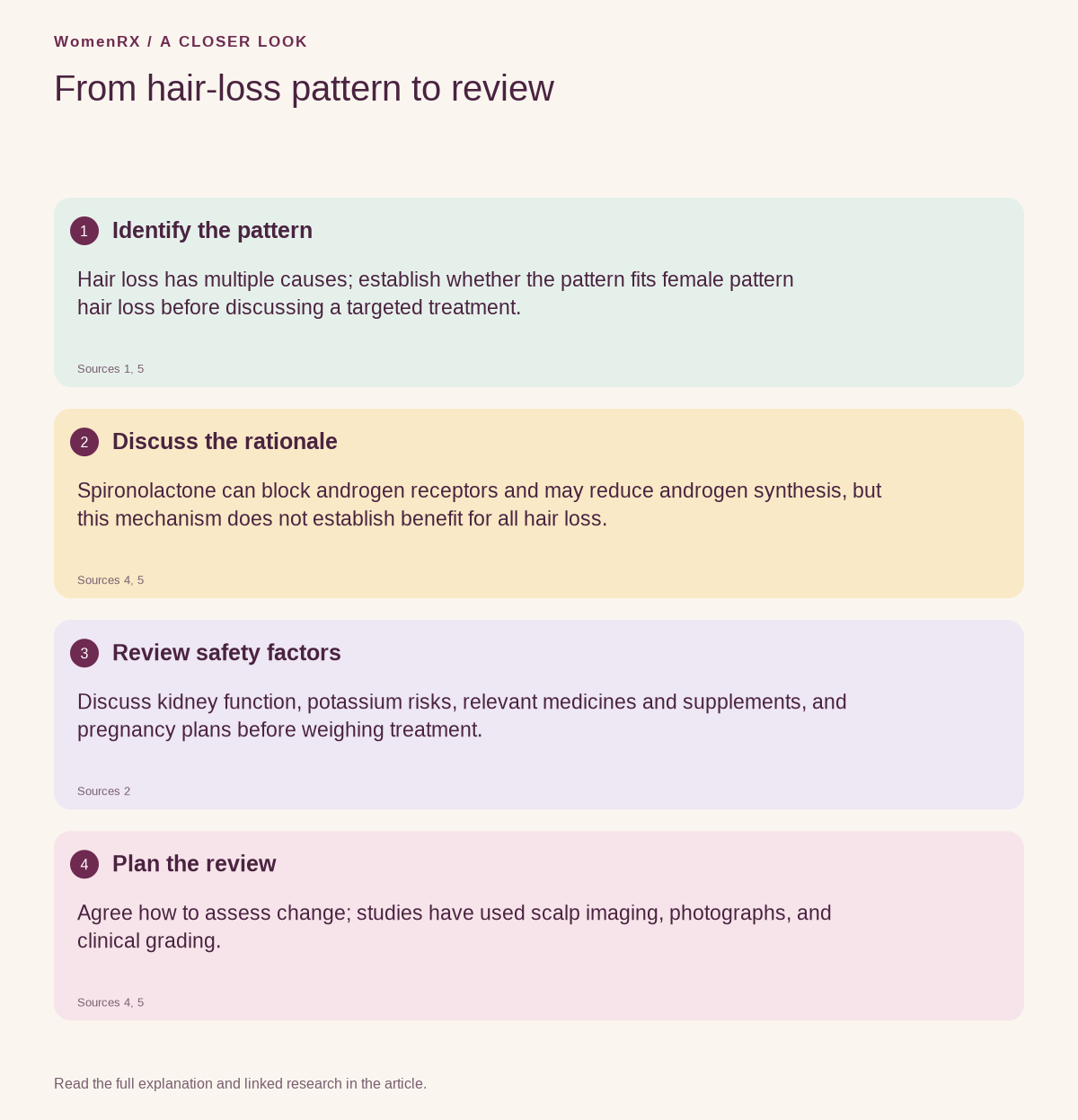
From hair-loss pattern to review
Identify the pattern: Hair loss has multiple causes; establish whether the pattern fits female pattern hair loss before discussing a targeted treatment.15
Discuss the rationale: Spironolactone can block androgen receptors and may reduce androgen synthesis, but this mechanism does not establish benefit for all hair loss.45
Review safety factors: Discuss kidney function, potassium risks, relevant medicines and supplements, and pregnancy plans before weighing treatment.2
Plan the review: Agree how to assess change; studies have used scalp imaging, photographs, and clinical grading.45
Read the figure as text
A practical sequence for connecting the diagnosis, safety discussion, and later assessment without assuming spironolactone fits every kind of hair loss.- Identify the pattern: Hair loss has multiple causes; establish whether the pattern fits female pattern hair loss before discussing a targeted treatment.15
- Discuss the rationale: Spironolactone can block androgen receptors and may reduce androgen synthesis, but this mechanism does not establish benefit for all hair loss.45
- Review safety factors: Discuss kidney function, potassium risks, relevant medicines and supplements, and pregnancy plans before weighing treatment.2
- Plan the review: Agree how to assess change; studies have used scalp imaging, photographs, and clinical grading.45
More questions, answered
Does normal androgen testing rule out female pattern hair loss?
No. A review reports that most women with female pattern hair loss do not have excessive androgen levels or other signs of abnormal androgen levels. The diagnosis depends on the hair-loss pattern and clinical assessment, not on assuming that a blood test must show high androgens. 3
Can spironolactone treat any kind of hair shedding?
It is discussed as a treatment for female pattern hair loss, not as a general treatment for every cause of shedding. Hair loss can also be related to medical conditions, medicines, stress, or nutrition, and treatment depends on the cause. 1 5
Sources you can check
- Hair Loss | Alopecia | Alopecia Areata | MedlinePlusAccessed 2026-09-25Return to first citation
- SPIRONOLACTONE TABLET, FILM COATED [REMEDYREPACK INC.] | US prescribing information and patient instructionsAccessed 2026-09-25Return to first citation
- Safety of Antiandrogens for the Treatment of Female Androgenetic Alopecia with Respect to Gynecologic Malignancies.Seyed Jafari SM, Heidemeyer K, Hunger RE, de Viragh PA. · Journal of clinical medicine · 2024Return to first citation
- Spironolactone versus Bicalutamide for Female Pattern Hair Loss: A 24-Month Unicenter Retrospective Comparative Study of Effectiveness and Safety.Gil-Redondo R, Jimenez-Cauhe J, Imbernon-Moya A, Buendía-Castaño D, Burgos Blasco P, Díaz-Guimaraens B, Domínguez-Santas M, Hermosa-Gelbard Á, Saceda-Corralo D, Vañó-Galván S. · Dermatology and therapy · 2026Return to first citation
- Efficacy and safety of oral spironolactone for female pattern hair loss in premenopausal women: a randomized, double-blind, placebo-controlled, parallel-group pilot study.Werachattawatchai P, Khunkhet S, Harnchoowong S, Lertphanichkul C. · International journal of women's dermatology · 2025Return to first citation