Spironolactone for Acne: What to Review First
Kidney problems, certain medicines, and pregnancy plans can change whether spironolactone is a safe fit.
Before starting spironolactone for acne, tell the prescriber about kidney or urination problems, Addison’s disease, pregnancy or plans to become pregnant, breastfeeding, and every medicine or supplement you take. Some situations may make spironolactone unsuitable; others raise risks such as high potassium and call for individualized review and monitoring. Don’t assume that every listed medicine automatically rules it out. 1 2

Start with the conditions that can change the decision
A safety review isn’t the same as a blanket “no.” Spironolactone may be unsuitable for some people, while other health factors mean the prescriber needs to weigh risks and plan monitoring.
Tell the prescriber if you have kidney problems, trouble passing urine, or Addison’s disease. NHS guidance lists severe kidney problems, inability to urinate properly, and Addison’s disease among situations in which spironolactone may not be suitable. The US prescribing information also warns that impaired kidney function raises the risk of high potassium, or hyperkalemia. These details deserve review before treatment begins; don’t treat this list as a complete set of US prescribing rules. 1 2
If you’ve ever been told your potassium is high, or you have a kidney condition, mention that too. Spironolactone can raise potassium, and the risk increases with impaired kidney function and with some medicines and supplements. 2
Bring the full medicine and supplement list
The most useful list includes prescriptions, over-the-counter medicines, vitamins, herbal products, and supplements. A few combinations are especially worth flagging:
- ACE inhibitors and ARBs, medicines often used for blood pressure or heart conditions, can add to the risk of high potassium. 2
- Potassium supplements and potassium-containing salt substitutes can also raise that risk. A salt substitute may contain potassium even if you don’t think of it as a supplement. 2
- NSAID pain relievers, including ibuprofen, are listed as relevant medicines. The prescribing information says NSAIDs can contribute to the risk of severe hyperkalemia when taken with spironolactone. 1 2
- Heparin and low-molecular-weight heparin are also named in US prescribing information as medicines that can raise potassium risk. 2
- Lithium needs a separate interaction check: spironolactone can reduce the kidneys’ clearance of lithium, which can raise the risk of lithium toxicity. 2
These are reasons to review a combination, not instructions to stop a medicine on your own. If you take more than one item on the list, make sure the prescriber sees the complete picture.
Pregnancy, planning, and breastfeeding are different questions
If you’re pregnant, think you might be pregnant, or are planning a pregnancy, say so before starting. Spironolactone is not usually recommended during pregnancy because it may affect a baby’s development. The right discussion is about your circumstances and treatment plan, not an assumption that every woman has the same pregnancy risk. 1
If you’re breastfeeding, ask specifically whether spironolactone is appropriate for you and your baby. NHS guidance says it may be possible to take it while breastfeeding, but recommends checking with a clinician first. That is a reason for an individual review, not a reason to assume breastfeeding automatically rules it out. 1
Ask what monitoring fits your situation
For its labeled uses, US prescribing information calls for checking blood potassium within a week after starting or changing spironolactone and regularly afterward. It says more frequent checks may be needed with impaired kidney function or other medicines that raise potassium. The prescriber can explain what monitoring is appropriate for your acne treatment and personal risk factors; don’t assume one schedule fits everyone. 2
A focused conversation can be as simple as: “Given my kidney health, other medicines, and pregnancy or breastfeeding plans, what needs to be checked before I start, and what follow-up will I need?” That keeps the discussion centered on the factors that can actually change the decision.
What to raise before starting
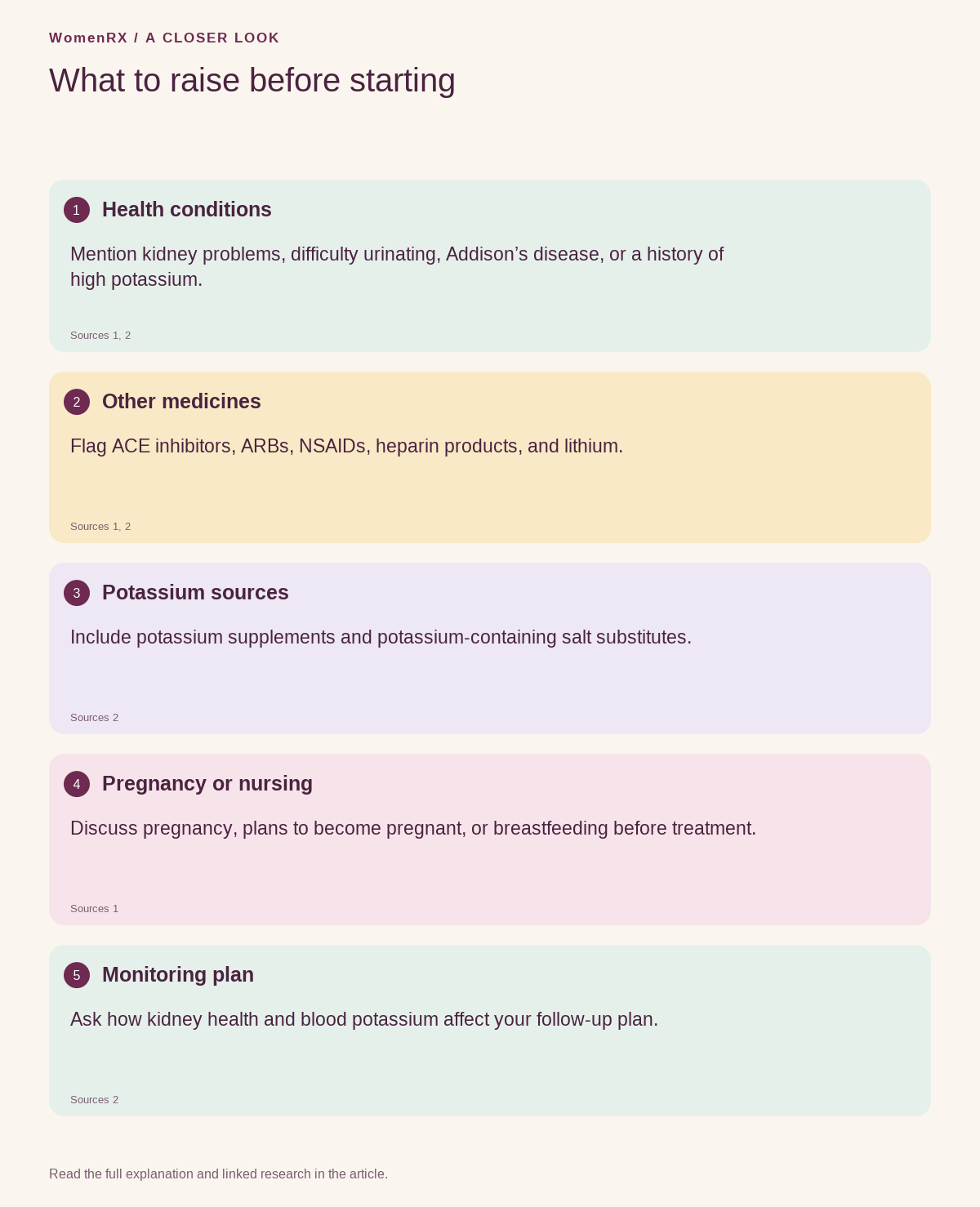
Health conditions: Mention kidney problems, difficulty urinating, Addison’s disease, or a history of high potassium.12
Other medicines: Flag ACE inhibitors, ARBs, NSAIDs, heparin products, and lithium.12
Potassium sources: Include potassium supplements and potassium-containing salt substitutes.2
Pregnancy or nursing: Discuss pregnancy, plans to become pregnant, or breastfeeding before treatment.1
Monitoring plan: Ask how kidney health and blood potassium affect your follow-up plan.2
Read the figure as text
Use these four prompts to organize a safety review. They identify topics to discuss, not a self-screening rule for who can take spironolactone.- Health conditions: Mention kidney problems, difficulty urinating, Addison’s disease, or a history of high potassium.12
- Other medicines: Flag ACE inhibitors, ARBs, NSAIDs, heparin products, and lithium.12
- Potassium sources: Include potassium supplements and potassium-containing salt substitutes.2
- Pregnancy or nursing: Discuss pregnancy, plans to become pregnant, or breastfeeding before treatment.1
- Monitoring plan: Ask how kidney health and blood potassium affect your follow-up plan.2