How Long Can Spironolactone Take to Improve Acne?
In a trial of adult women, spironolactone’s advantage over placebo was clearer at 24 weeks than at 12, but neither is a promised response date.
In a trial of adult women with persistent facial acne, some outcomes favored spironolactone at 12 weeks, with larger differences from placebo at 24 weeks. That doesn’t tell you when your own acne will improve or reach its best result. Track new inflamed spots, deeper painful bumps, and side effects, then use your planned follow-up to discuss the pattern with your prescriber. 3
Look for a pattern, not a dramatic reveal
Spironolactone doesn’t come with a guaranteed “clear skin by” date. In a randomized trial, 410 adult women with facial acne that had lasted at least six months were assigned spironolactone or placebo. They could continue their usual topical treatment, so the findings reflect spironolactone alongside that care, not necessarily spironolactone on its own. 3
The trial checked outcomes at 12 and 24 weeks. At 12 weeks, 72% of participants taking spironolactone said their acne had improved, compared with 68% taking placebo. That difference wasn’t statistically significant. At 24 weeks, the difference was clearer: 82% versus 63%. Acne-related quality-of-life scores also showed a larger advantage for spironolactone at 24 weeks than at 12 weeks. These are results for groups of women, not a timetable or a point of “full benefit” for any one person. 3
If you see little change at an early follow-up, that’s worth discussing, but a single look in the mirror won’t tell the whole story. Whether you’re still getting new breakouts, developing deeper lesions, or finding the treatment hard to tolerate gives your prescriber more to work with.
What’s worth recording
You don’t need to count every spot each morning. A brief, consistent note can help you see whether the pattern is changing. For example, once a week you might record:
- New inflamed spots: tender red bumps or spots with a white, pus-filled tip.
- Deeper bumps: painful lumps beneath the skin, rather than only surface-level spots.
- Breakout areas: whether you’re seeing changes across your face or in another area you’re treating.
- Treatment tolerance: side effects, when they occur, and whether they interfere with your day.
Acne includes blackheads and whiteheads as well as inflamed papules, pustules, nodules, and cysts. Deeper nodules and cysts deserve particular attention because severe lesions can leave permanent scars. If you’re developing them, bring that up rather than waiting to judge treatment by an overall spot count. 2
If you notice flares around your period, add that context. Hormonal changes during the menstrual cycle can be associated with acne episodes, so a recurring flare may make week-to-week comparisons less straightforward. 2 If you use photos, similar lighting and distance can make them easier to compare. They’re a record of your skin, not proof that a treatment has succeeded or failed.
Side effects belong in the same conversation
Clearer skin isn’t the only outcome that matters. In the trial, headaches were reported by 20% of participants taking spironolactone and 12% taking placebo. Overall adverse reactions were similar between groups, and no serious adverse reactions were reported. Those findings can’t predict what you personally will experience. 3
Lightheadedness and menstrual irregularities are also described as common adverse effects in a clinical review of spironolactone for acne. 4 Tell your prescriber about effects that bother you or make it difficult to keep taking the medicine as agreed. You can discuss limited improvement and tolerability together rather than treating them as separate decisions.
If pregnancy is possible, raise it early
The acne trial studied adult women, but its reported results don’t show whether outcomes differed by pregnancy plans or reproductive stage. 3 US prescribing information advises avoiding spironolactone during pregnancy because its antiandrogenic effects and animal findings raise a potential risk to male fetal development. Limited published human case reports and case series did not show an association with major malformations or other adverse pregnancy outcomes, but they don’t settle that potential risk. If you’re pregnant, planning a pregnancy, or think you might be pregnant, tell your prescriber so it can be part of the treatment discussion. 1
A selected before-and-after photo may show what happened for someone else. Your more useful comparison is the pattern of your own breakouts and how you feel on treatment, considered alongside the follow-up plan you made with your prescriber.
Track the pattern, not a deadline
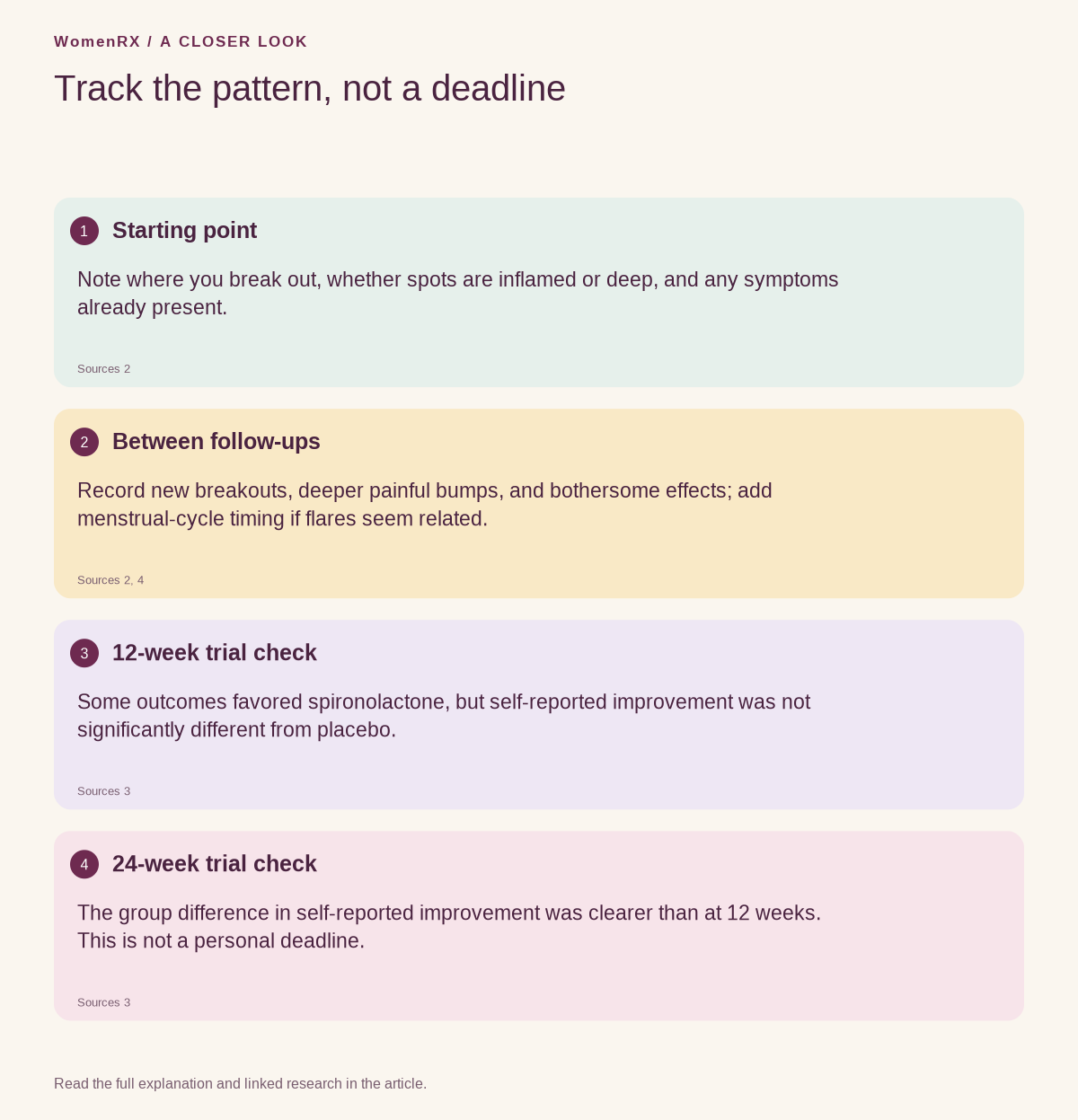
Starting point: Note where you break out, whether spots are inflamed or deep, and any symptoms already present.2
Between follow-ups: Record new breakouts, deeper painful bumps, and bothersome effects; add menstrual-cycle timing if flares seem related.24
12-week trial check: Some outcomes favored spironolactone, but self-reported improvement was not significantly different from placebo.3
24-week trial check: The group difference in self-reported improvement was clearer than at 12 weeks. This is not a personal deadline.3
Read the figure as text
Use the trial’s assessment points as context while recording your own skin changes and treatment tolerance.- Starting point: Note where you break out, whether spots are inflamed or deep, and any symptoms already present.2
- Between follow-ups: Record new breakouts, deeper painful bumps, and bothersome effects; add menstrual-cycle timing if flares seem related.24
- 12-week trial check: Some outcomes favored spironolactone, but self-reported improvement was not significantly different from placebo.3
- 24-week trial check: The group difference in self-reported improvement was clearer than at 12 weeks. This is not a personal deadline.3
More questions, answered
Does spironolactone replace topical acne treatment?
Not necessarily. Participants in the SAFA trial could continue their usual topical treatment, so the trial doesn’t establish what would happen if you stopped yours. Discuss how the treatments fit together before changing your routine. 3
Sources you can check
- SPIRONOLACTONE TABLET, FILM COATED [REMEDYREPACK INC.] | US prescribing information and patient instructionsAccessed 2026-09-25Return to first citation
- Acne - NHSAccessed 2026-09-25Return to first citation
- Effectiveness of spironolactone for women with acne vulgaris (SAFA) in England and Wales: pragmatic, multicentre, phase 3, double blind, randomised controlled trial.Santer M, Lawrence M, Renz S, Eminton Z, Stuart B, Sach TH, Pyne S, Ridd MJ, Francis N, Soulsby I, Thomas K, Permyakova N, Little P, Muller I, Nuttall J, Griffiths G, Thomas KS, La... · BMJ (Clinical research ed.) · 2023Return to first citation
- Spironolactone for Acne: Practical Strategies for Optimal Clinical Outcomes.Ershadi S, Barbieri JS. · Cutis · 2025Return to first citation