When Spironolactone May Make Sense for Acne
Spironolactone can help some women with persistent acne, but the choice depends on prior treatment, safety factors, and pregnancy plans.
Spironolactone may be considered when a woman’s acne persists despite appropriate topical treatment, or as an addition to standard care for more severe acne. Trials show it can improve acne, but it isn’t a cure or the right next step for everyone. Before deciding, compare other treatments, review potassium-related risks and side effects, and make a clear plan to avoid pregnancy during treatment. 2 3
Where spironolactone fits
Spironolactone is an off-label acne treatment that reduces androgen-driven oil production. A jawline pattern or breakouts that flare around your period may make it worth discussing, but neither pattern proves that all your acne is “hormonal.” Randomized trials have found that spironolactone improves acne outcomes in women, and guidance describes it as an option alongside standard treatment rather than a replacement for it. 2 3
The first comparison is often with the treatment you’re already using. A combination of topical treatments, such as benzoyl peroxide and a topical retinoid, is an initial and maintenance approach for most people. If moderate acne continues despite appropriate topical treatment, an oral option may be considered. Improvement takes weeks to months, so whether a treatment has had a fair trial matters. 2
Other options answer different needs. A combined oral contraceptive may appeal if you also want contraception and it’s suitable for you. An oral antibiotic may be used for a limited period with a non-antibiotic topical treatment, rather than repeated indefinitely. Severe, scarring, or treatment-resistant acne calls for a discussion of isotretinoin, which has its own substantial safety requirements. Spironolactone offers another way to treat persistent acne without relying on prolonged antibiotic courses. There aren’t enough direct comparisons to say it’s the best choice over every alternative. 2 3
What could change the treatment choice?
Acne that’s leaving scars or includes deep nodules deserves timely assessment. A prescriber will also want to know what you’ve tried, whether you could use it consistently, and how much the acne is affecting you. If acne began later in life or worsened rapidly, especially alongside irregular periods, increased facial or body hair, or fertility concerns, an assessment for an underlying hormone-related condition may be warranted. Acne on its own doesn’t establish that diagnosis. 2
Your health and medication list matter because spironolactone can raise blood potassium. US prescribing information identifies impaired kidney function, potassium supplements or potassium-containing salt substitutes, and medicines such as ACE inhibitors and angiotensin receptor blockers as factors that increase this risk. It calls for potassium monitoring when spironolactone is started or adjusted for its labeled uses, and more frequent checks in some higher-risk situations. Ask what blood tests and follow-up make sense for your health and other medicines; that labeling does not establish a separate acne-specific testing schedule. 1
The everyday tradeoffs count, too. Possible side effects include menstrual changes, breast tenderness, fatigue, and more frequent urination. If avoiding another course of antibiotics is a priority, spironolactone may be appealing. If those side effects would be particularly disruptive, that may shift the balance toward a different option. 2
Make pregnancy plans part of the decision
Spironolactone should not be used during pregnancy because of concern about its effects on the development of a male fetus. Effective contraception is recommended for patients who could become pregnant while taking it. If you’re planning a pregnancy, raise that before choosing an acne treatment. If pregnancy occurs or you think it might have, stop spironolactone immediately and promptly contact your prescriber. 2
A useful decision is therefore more specific than “Is my acne hormonal?” It’s whether spironolactone fits the acne you have, what has or hasn’t worked so far, the monitoring you may need, and your reproductive plans. Agree on what improvement you’re looking for and when to review both results and side effects, since acne treatment works gradually. 2
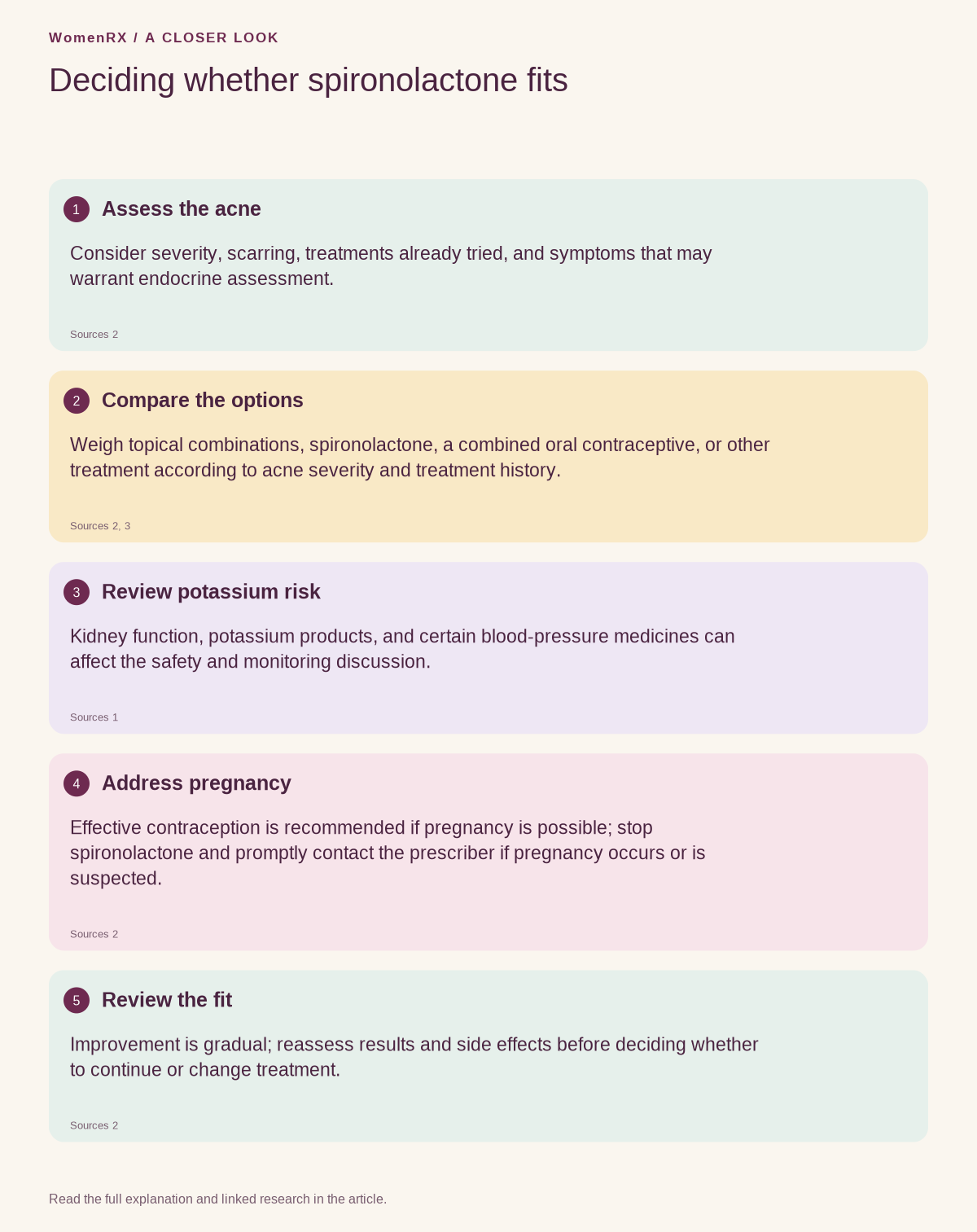
Deciding whether spironolactone fits
Assess the acne: Consider severity, scarring, treatments already tried, and symptoms that may warrant endocrine assessment.2
Compare the options: Weigh topical combinations, spironolactone, a combined oral contraceptive, or other treatment according to acne severity and treatment history.23
Review potassium risk: Kidney function, potassium products, and certain blood-pressure medicines can affect the safety and monitoring discussion.1
Address pregnancy: Effective contraception is recommended if pregnancy is possible; stop spironolactone and promptly contact the prescriber if pregnancy occurs or is suspected.2
Review the fit: Improvement is gradual; reassess results and side effects before deciding whether to continue or change treatment.2
Read the figure as text
A treatment decision moves from the acne itself to available options, safety, and a plan to review the result.- Assess the acne: Consider severity, scarring, treatments already tried, and symptoms that may warrant endocrine assessment.2
- Compare the options: Weigh topical combinations, spironolactone, a combined oral contraceptive, or other treatment according to acne severity and treatment history.23
- Review potassium risk: Kidney function, potassium products, and certain blood-pressure medicines can affect the safety and monitoring discussion.1
- Address pregnancy: Effective contraception is recommended if pregnancy is possible; stop spironolactone and promptly contact the prescriber if pregnancy occurs or is suspected.2
- Review the fit: Improvement is gradual; reassess results and side effects before deciding whether to continue or change treatment.2
More questions, answered
Does my acne have to flare before my period?
No. Period-related flares can be a clue when considering spironolactone, but persistent acne without a clear monthly pattern may also warrant a discussion. Severity, previous treatment, and safety factors matter more than any single breakout pattern. 2 3
Would spironolactone replace my topical treatment?
Not necessarily. It’s commonly used alongside topical therapy, which may remain part of both initial treatment and maintenance care. 2 3
Sources you can check
- SPIRONOLACTONE TABLET, FILM COATED [REMEDYREPACK INC.] | US prescribing information and patient instructionsAccessed 2026-09-25Return to first citation
- Acne vulgaris: a clinical update.Iyengar L, Welsh B. · Australian prescriber · 2026Return to first citation
- Update of the EuroGuiDerm evidence-based guideline for the treatment of acne-Short version.Nast A, Al Wattar BH, Beylot Barry M, Brüggemann H, Bukvić Mokos Z, Caruana DM, Degitz K, Dessinioti C, Dréno B, Driessen RJB, Gollnick H, Hædersdal M, Katoulis A, Läuchli S, Lambe... · Journal of the European Academy of Dermatology and Venereology : JEADV · 2026Return to first citation