How to Make Sense of Pelvic and Reproductive Symptoms
Start with what has changed, then check whether pain, bleeding, urinary symptoms, or pregnancy possibility makes the next step more urgent.
Start with the symptom that’s most disruptive: a cycle change, unusual bleeding, pelvic pain, urinary changes, or pain during sex. Notice what happens alongside it, because pelvic symptoms can involve reproductive organs, the bladder, or the bowel. Seek emergency care for severe or worsening pelvic pain, particularly with faintness or heavy bleeding. Possible pregnancy with pelvic pain needs prompt attention. 1
Pelvic and reproductive symptoms don’t always stay in one lane. Pain can show up with a period, sex, or urination, and similar symptoms can have different causes, including bowel conditions. Use the section closest to your main symptom as a reading route, not a way to identify a condition on your own. 1
This guide is for anyone with the relevant organs or symptoms. Period pain, for example, can affect anyone who has periods, including trans and nonbinary people. 2
Choose a starting point, then check for overlap
- Cycle changes or period pain: Is a period late or absent? Do cramps follow a familiar pattern, or are they newly severe? Start with the cycle section below. 25
- Bleeding outside your usual pattern: Is it between periods, after sex, or occurring when pregnancy may be possible? Start with the bleeding section below. 4
- Pelvic pain: Is it sudden, recurring, or linked to urination or sex? Start with the pelvic-pain section below. 1
- Urinary changes: Is there burning, urgency, frequent urination, or difficulty passing urine? Start with the urinary section below. 16
- Pain during sex: Does it feel like pain deep in the pelvis, or burning or soreness at the vulva? Start with the sex-pain section below. 17
More than one route may fit. For example, urinary frequency with pelvic pain can occur with fibroids, but urinary frequency can also be a UTI symptom. The combination is worth describing; it doesn’t settle the cause. 36
Cycle changes and period pain
Cramping around the start of a period is common. The uterus tightens during menstruation, and cramps can spread to the back or thighs. Period pain usually lasts up to three days, though it can affect daily activities. A warm bath or shower may help. If pelvic or period pain is severe or worse than usual and pain relief hasn’t helped, seek prompt care rather than assuming it’s your usual cramps. 2
A missing period raises a different question. If pregnancy is possible, consider that first, even if your cycles are usually regular. If previously regular periods have stopped for more than three months, or previously irregular periods for six months, the American Society for Reproductive Medicine recommends evaluation. These are thresholds for investigation, not reasons to wait if pregnancy or another concerning symptom is possible. 5
Bleeding outside your usual pattern
Bleeding between periods or after sex has several possible causes. Hormonal contraception, polyps, fibroids, and sexually transmitted infections can be involved; bleeding after sex can also relate to vaginal dryness or changes on the cervix. These possibilities can’t be distinguished from the bleeding pattern alone, so arrange a medical evaluation even if the bleeding is light. 4
Heavy or otherwise abnormal bleeding can occur with fibroids, sometimes alongside pelvic pain or urinary frequency. That overlap makes fibroids one possibility, not a conclusion. 3 If you’ve recently missed a period and have unusual bleeding with abdominal or pelvic pain, seek urgent care because an ectopic pregnancy is possible. Heavy vaginal bleeding with pelvic pain, especially if you feel faint or dizzy, calls for emergency care. 14
Pelvic pain
Pelvic pain is felt in the lower abdomen and may be sharp, crampy, or a heavy pressure. It can appear suddenly, come and go, or persist. Period pain and conditions affecting reproductive organs are possibilities, but so are bladder or bowel problems and infections. Pain that keeps returning or does not go away deserves medical evaluation. 1
The change in pain matters. Seek emergency care for pelvic pain that is severe or getting worse, or pain accompanied by fainting, marked dizziness, shoulder-tip pain, or heavy vaginal bleeding. If you’re pregnant or may be pregnant and develop pelvic pain, seek prompt care instead of treating it as ordinary cycle pain. 1
Urinary changes
Burning when you pee, needing to go more often or more urgently, and lower abdominal pain can occur with a UTI. Fever or chills and pain in the back below the ribs can be signs of a more serious urinary infection and warrant urgent care. Blood in your urine or difficulty passing urine also needs prompt assessment, particularly with pelvic pain. 16
Not every urinary change is an infection. For example, fibroids can be associated with urinary frequency or urgency as well as pelvic pain and abnormal bleeding. If urinary symptoms persist after treatment for a presumed UTI, they deserve another look rather than an automatic assumption that the same cause remains. 36
Pain during sex
Where the pain occurs offers a useful distinction. Pain felt in the lower pelvis during sex can be part of a broader pelvic-pain pattern. Burning, stabbing, or soreness at the vulva, including pain with touch or tampon insertion, points to a different starting place. Persistent or recurring vulval pain is worth having assessed; infections and other causes may need to be ruled out before it can be called vulvodynia. 17
If pain during sex comes with bleeding afterward, follow the bleeding route too. Bleeding after sex should be checked, even when you think dryness might explain it. 4
Keep the details that distinguish your pattern
You don’t need a perfect diary. A short note about when a symptom began, whether it relates to a period, sex, or urination, and what changed alongside it can make the pattern easier to explain. For pelvic pain in particular, the timing and triggers help because different causes can feel similar. Let the urgent signs above guide the timing of care; don’t wait to collect more notes first. 1
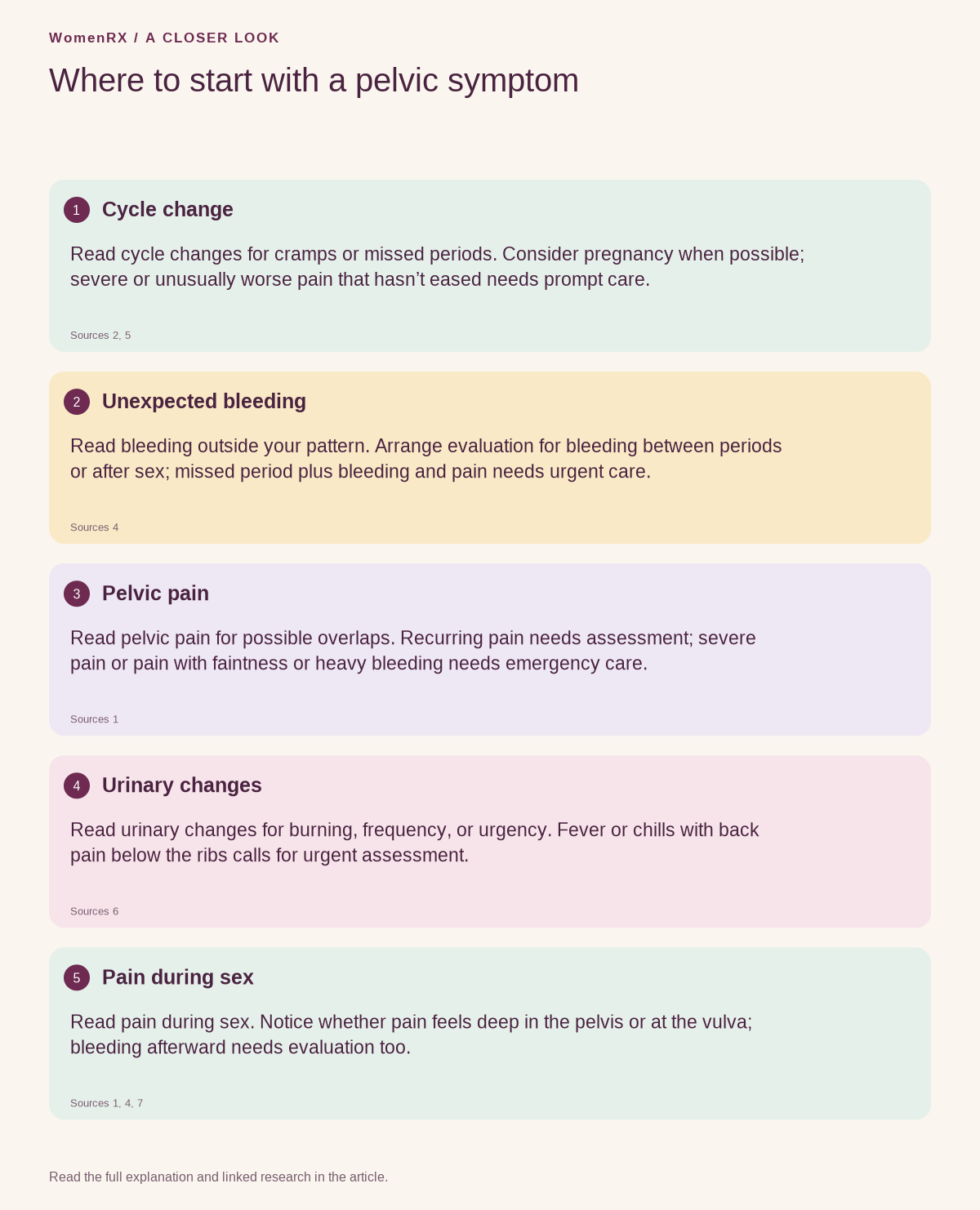
Where to start with a pelvic symptom
Cycle change: Read cycle changes for cramps or missed periods. Consider pregnancy when possible; severe or unusually worse pain that hasn’t eased needs prompt care.25
Unexpected bleeding: Read bleeding outside your pattern. Arrange evaluation for bleeding between periods or after sex; missed period plus bleeding and pain needs urgent care.4
Pelvic pain: Read pelvic pain for possible overlaps. Recurring pain needs assessment; severe pain or pain with faintness or heavy bleeding needs emergency care.1
Urinary changes: Read urinary changes for burning, frequency, or urgency. Fever or chills with back pain below the ribs calls for urgent assessment.6
Pain during sex: Read pain during sex. Notice whether pain feels deep in the pelvis or at the vulva; bleeding afterward needs evaluation too.147
Read the figure as text
Follow your main symptom to the matching section, then check for overlapping symptoms and warning signs. This is a reading route, not a diagnosis.- Cycle change: Read cycle changes for cramps or missed periods. Consider pregnancy when possible; severe or unusually worse pain that hasn’t eased needs prompt care.25
- Unexpected bleeding: Read bleeding outside your pattern. Arrange evaluation for bleeding between periods or after sex; missed period plus bleeding and pain needs urgent care.4
- Pelvic pain: Read pelvic pain for possible overlaps. Recurring pain needs assessment; severe pain or pain with faintness or heavy bleeding needs emergency care.1
- Urinary changes: Read urinary changes for burning, frequency, or urgency. Fever or chills with back pain below the ribs calls for urgent assessment.6
- Pain during sex: Read pain during sex. Notice whether pain feels deep in the pelvis or at the vulva; bleeding afterward needs evaluation too.147
More questions, answered
Can urinary symptoms be related to fibroids?
Yes. Fibroids can be associated with urinary frequency or urgency. But a UTI and other conditions can also cause urinary changes, so the symptom alone can’t identify fibroids. 36
Does every kind of pelvic pain point to a reproductive condition?
No. Pelvic pain can involve reproductive organs, but bowel and bladder conditions and infections are also possible causes. Where and when it hurts can help describe the pattern, but cannot establish the cause. 1
Sources you can check
- Pelvic pain - NHSAccessed 2026-09-25Return to first citation
- Period pain - NHSAccessed 2026-09-25Return to first citation
- Uterine Fibroids: Rapid Evidence Review.Keating MK, Jones KB, Hansell MW. · American family physician · 2025Return to first citation
- Vaginal bleeding between periods or after sex - NHSAccessed 2026-09-25Return to first citation
- Current evaluation of amenorrhea: a committee opinion (2024) | American Society for Reproductive Medicine | ASRMAccessed 2026-09-25Return to first citation
- Urinary tract infections (UTIs) - NHSAccessed 2026-09-25Return to first citation
- Vulvodynia (vulval pain) - NHSAccessed 2026-09-25Return to first citation