When Does Selenium Supplementation Make Sense?
Selenium supplements are most useful when they address a real shortfall, not simply because selenium plays a role in thyroid function.
For most U.S. adults, food provides enough selenium, so a supplement usually isn’t needed just to support thyroid health. It may make sense when a clinician identifies a likely or confirmed shortfall, or recommends it for a specific situation. Before adding one, check your age- and life-stage needs, the selenium in any multivitamin or prenatal, and your total intake. More isn’t automatically better, and excess can cause harm. 1
Start with need, not the thyroid-health claim
Selenium helps make proteins involved in thyroid hormone metabolism, reproduction, and protection from oxidative damage. That role is real, but it doesn’t mean extra selenium will improve thyroid function if you already get enough. Most people in the United States consume adequate amounts, and a trial in healthy adults found no change in thyroid function after supplementation, even though blood selenium levels rose. 1
A practical starting point is to ask whether there’s a reason to suspect your intake is low. A highly restricted diet, a vegetarian or vegan eating pattern, kidney dialysis, or a known medical concern may make a closer review worthwhile. These circumstances don’t prove a deficiency; they help identify when food intake or selenium status may deserve attention. 1
Check your life-stage target and food pattern
The recommended daily intake is 55 micrograms (mcg) for adults, including women age 51 and older. It’s 60 mcg during pregnancy and 70 mcg while breastfeeding. These are total-intake targets from food and supplements combined, not automatic supplement doses. 1
Seafood, meat, poultry, eggs, grains, and dairy can all contribute. Plant foods vary more because selenium content depends partly on the soil where they grew. Brazil nuts are exceptionally concentrated: the NIH Office of Dietary Supplements lists an average of 544 mcg in an ounce, with amounts varying widely. They’re not a dependable way to fine-tune intake, and eating them regularly alongside a supplement could add up quickly. 1
For example, if you eat little or no animal food, look at your usual grains, fortified foods, and other sources before deciding that a pill is needed. A few foods can contribute meaningful amounts without requiring a special selenium product. 1
What thyroid studies do, and don’t, show
In Hashimoto’s thyroiditis, trials have found that selenium can lower thyroid peroxidase antibodies in some groups. But a review of controlled trials, whose participants were predominantly women, found no improvement from selenium alone in thyroid-stimulating hormone (TSH), thyroid ultrasound findings, or health-related quality of life. Many participants in trials that reported selenium status had deficient or marginal levels, so the findings don’t establish a benefit for women whose intake is already adequate. 1
Pregnancy calls for a specific distinction. Trials in pregnant women with thyroid antibodies had mixed results, and some enrolled women who were positive for TPOAb, TgAb, or both. The American Thyroid Association recommendation reported here is specifically against selenium supplementation for pregnant women who are TPOAb-positive. Pregnancy is a reason to review your prenatal label and care plan, not to add selenium on your own. 1
Graves’ orbitopathy, an eye condition associated with Graves’ disease, has also been studied. A 2026 meta-analysis of five trials found a reduction in the clinical activity score, but not consistent improvement in quality of life or visual function; the trials were small and differed in important ways. In a separate randomized trial in a selenium-sufficient area, selenium was combined with vitamin B, and the primary quality-of-life outcome did not improve compared with control at six months. These findings don’t support routine supplementation for everyone with thyroid disease. 23
Read the whole label before adding a pill
Check the amount of selenium in every supplement you take, including a multivitamin, prenatal, or combination product. Add those amounts together before considering a separate selenium supplement. The label amount is only part of the picture because food contributes too, and products can vary substantially in dose. 1
For adults, the U.S. tolerable upper intake level is 400 mcg per day from food and supplements combined. That’s a safety ceiling, not a goal. Long-term excess can cause hair loss and brittle or lost nails; other signs can include a metallic taste, garlic-smelling breath, nausea, diarrhea, fatigue, or a rash. 1
A simple decision path
- Estimate your usual food sources. Consider your overall eating pattern rather than one “high-selenium” food.
- Check every supplement label. Include prenatal vitamins and products with multiple ingredients.
- Consider your context. Pregnancy, breastfeeding, a restrictive diet, dialysis, or another medical concern can change what deserves review.
- Get help interpreting a suspected shortfall. A clinician can weigh your diet, health conditions, and any test results. Blood selenium measures recent intake, while some other measures reflect longer-term status; results and functional markers have limits. 1
- Use a supplement only for a clear reason. If one is recommended, make sure the plan accounts for your food and other supplements so your total intake doesn’t climb unnecessarily. 1
The useful question isn’t simply “Does selenium support the thyroid?” It’s “Is there a reason I need more, and how much am I already getting?” For many women in the United States, checking the diet and supplement labels answers that question more safely than adding another pill.
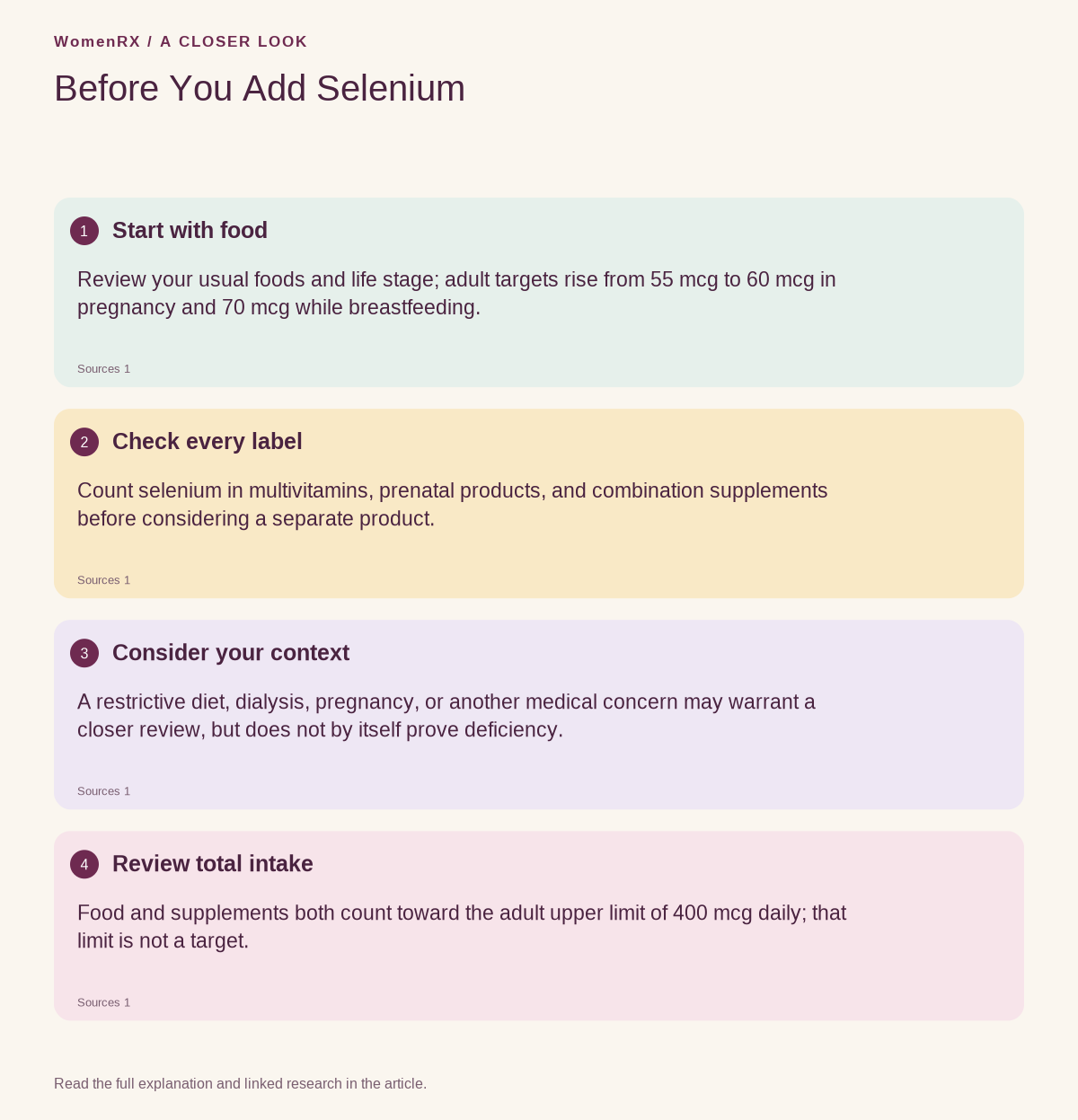
Before You Add Selenium
Start with food: Review your usual foods and life stage; adult targets rise from 55 mcg to 60 mcg in pregnancy and 70 mcg while breastfeeding.1
Check every label: Count selenium in multivitamins, prenatal products, and combination supplements before considering a separate product.1
Consider your context: A restrictive diet, dialysis, pregnancy, or another medical concern may warrant a closer review, but does not by itself prove deficiency.1
Review total intake: Food and supplements both count toward the adult upper limit of 400 mcg daily; that limit is not a target.1
Read the figure as text
Follow the decision from likely intake through product-label checks and clinical context to a more informed choice.- Start with food: Review your usual foods and life stage; adult targets rise from 55 mcg to 60 mcg in pregnancy and 70 mcg while breastfeeding.1
- Check every label: Count selenium in multivitamins, prenatal products, and combination supplements before considering a separate product.1
- Consider your context: A restrictive diet, dialysis, pregnancy, or another medical concern may warrant a closer review, but does not by itself prove deficiency.1
- Review total intake: Food and supplements both count toward the adult upper limit of 400 mcg daily; that limit is not a target.1
More questions, answered
Can selenium supplements treat Hashimoto’s?
Some trials found lower thyroid peroxidase antibody levels, but reviews did not find improvements in TSH, ultrasound findings, or quality of life from selenium alone. Lower antibody levels aren’t the same as proof that the condition or symptoms improve. 1
Should I take selenium during pregnancy if I have thyroid antibodies?
Not automatically. Pregnancy trial results were mixed, and some trials included women who were TPOAb-positive, TgAb-positive, or positive for both. The American Thyroid Association recommendation reported here is specifically against selenium supplementation for pregnant women who are TPOAb-positive. Review your prenatal supplement and care plan rather than adding a separate product. 1
Sources you can check
- Selenium - Health Professional Fact SheetAccessed 2026-09-25Return to first citation
- Efficacy of Selenium Supplementation in Graves' Orbitopathy: A Systematic Review and Meta-Analysis of Randomized Controlled Trials with Trial Sequential Analysis.Kostadinov N, Kirovakov Z, Penchev P. · Journal of clinical medicine · 2026Return to first citation
- Selenium vs Control for Graves Ophthalmopathy in a Selenium-Sufficient Area: A Randomized Clinical Trial.Ahn HY, Lee MJ, Jung KY, Kim HJ, Jung EH, Chung CW, Kim K, Jang J, Park YJ, Lee JK, Cho SW. · JAMA ophthalmology · 2025Return to first citation