How Long Does Selenium Take to Work?
There’s no single timeline: changing a selenium level, easing a symptom, and preventing disease are different outcomes.
A selenium supplement has no dependable, general “time to work.” Correcting low intake is different from treating a symptom or preventing disease, and a change in a blood measure doesn’t prove a health benefit. In one trial of people with selenium-deficient peripartum cardiomyopathy, supplementation lasted three months, but the trial did not establish a general recovery timeline. 2
First ask what “working” means
Selenium is an essential nutrient, but taking more isn’t automatically useful. A supplement might raise a selenium measure without improving how you feel or changing a health outcome. In a cardiac-surgery study, selenium treatment raised blood selenium-related measures in the overall group, but clinical outcomes didn’t differ between treatment and placebo in the analyzed subgroups. That’s a useful distinction: a lab change is not the same as a proven benefit. 3
So the answer to “How long?” depends on the goal. If a low intake or low level has been identified, the relevant question is whether it improves as intake is corrected. If you’re hoping for a change in hair, thyroid symptoms, energy, fertility, or disease risk, the evidence for that specific outcome matters more than a generic supplement timetable.
What a treatment trial can, and can’t, tell you
A randomized trial in 100 patients with selenium-deficient peripartum cardiomyopathy compared three months of selenium supplementation plus recommended treatment with recommended treatment alone. The study did not find a significant reduction in its primary combined outcome of ongoing heart-failure symptoms, incomplete recovery of heart function, or death. Although heart-failure symptoms were less frequent in the selenium group, this was a small, open-label proof-of-concept trial in people with a serious condition, not a guide to how quickly supplementation works for other concerns. 2
That’s why a trial lasting weeks or months shouldn’t be translated into a promise that you’ll feel better by a particular date. The amount taken, starting selenium status, health condition, and outcome being measured all differ across studies. Research on a particular group or medical condition also doesn’t automatically apply to someone taking selenium without a confirmed deficiency.
For many claimed benefits, longer use doesn’t guarantee a payoff. A review summarized by the NIH found that randomized trials of selenium supplements, usually at 200 to 500 micrograms daily for 2 to 10.3 years, had little to no effect on cancer incidence or mortality. The trials included 27,232 participants, 94% of them men, so they do not settle every question about women or every possible health outcome. But they do show why a supplement’s proposed benefit shouldn’t be assumed just because selenium has an essential role in the body. 1
Check the total before adding a supplement
For adult women, the recommended intake is 55 micrograms a day. It’s 60 micrograms during pregnancy and 70 micrograms while breastfeeding. These are intake targets from all sources, not instructions to take that amount as a supplement and not amounts to aim above. 1
Selenium comes from foods as well as pills. Seafood, meat, poultry, eggs, grains, and dairy can contribute. Brazil nuts are especially concentrated, but their selenium content varies; the NIH fact sheet reports an average of 544 micrograms per ounce in one analysis. 1
Supplements can add up, too. Many multivitamins contain 55 micrograms, while selenium-only products commonly contain 100 to 400 micrograms. Check the selenium amount in each product rather than looking only at the name on the front, and count a multivitamin alongside any separate selenium supplement. The upper intake limit is a separate safety benchmark, not a target; excess selenium can be harmful. 14
A practical next step is to write down the selenium amounts on your supplements and multivitamins, then consider the food sources you regularly eat. If a low level has been measured, ask what result is being followed and when it makes sense to check it again. If you’re considering selenium for a symptom or a general wellness claim, first ask whether there’s evidence for that specific outcome and whether your current intake is already adequate.
Pregnancy and breastfeeding change the target, not the rule
Pregnancy and breastfeeding have higher recommended selenium intakes than other adult life stages, but that alone doesn’t show that you need a selenium pill. Food and supplements both count toward intake. If you’re pregnant or nursing and considering adding selenium, check what’s already in your prenatal or other supplements so you don’t accidentally stack products. 1
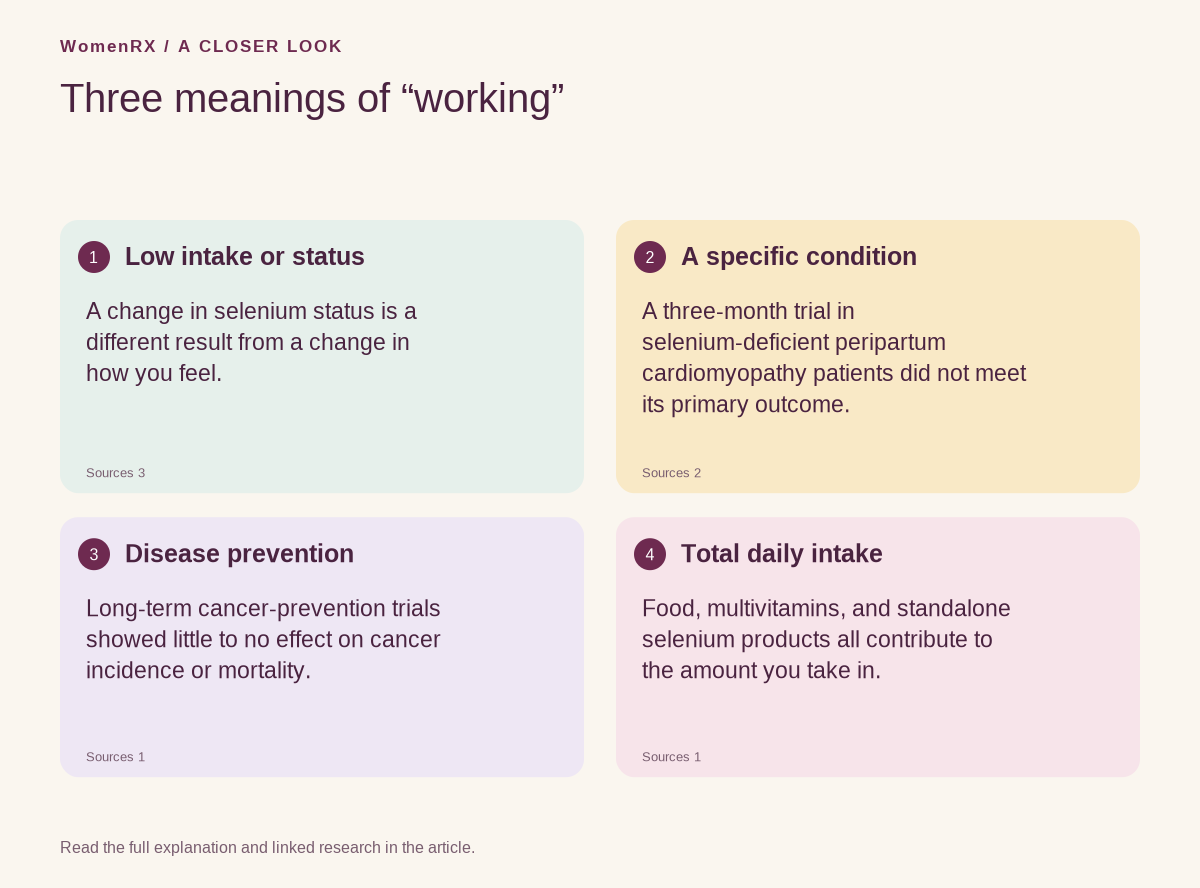
Three meanings of “working”
Low intake or status: A change in selenium status is a different result from a change in how you feel.3
A specific condition: A three-month trial in selenium-deficient peripartum cardiomyopathy patients did not meet its primary outcome.2
Disease prevention: Long-term cancer-prevention trials showed little to no effect on cancer incidence or mortality.1
Total daily intake: Food, multivitamins, and standalone selenium products all contribute to the amount you take in.1
Read the figure as text
A supplement can affect a nutrient measure without proving symptom relief or disease prevention. The goal changes what a result can tell you.- Low intake or status: A change in selenium status is a different result from a change in how you feel.3
- A specific condition: A three-month trial in selenium-deficient peripartum cardiomyopathy patients did not meet its primary outcome.2
- Disease prevention: Long-term cancer-prevention trials showed little to no effect on cancer incidence or mortality.1
- Total daily intake: Food, multivitamins, and standalone selenium products all contribute to the amount you take in.1
Sources you can check
- Selenium - Health Professional Fact SheetAccessed 2026-09-25Return to first citation
- Selenium supplementation in patients with peripartum cardiomyopathy: a proof-of-concept trial.Karaye KM, Sa'idu H, Balarabe SA, Ishaq NA, Sanni B, Abubakar H, Mohammed BL, Abdulsalam T, Tukur J, Mohammed IY. · BMC cardiovascular disorders · 2020Return to first citation
- Identifying a target group for selenium supplementation in high-risk cardiac surgery: a secondary analysis of the SUSTAIN CSX trial.Notz Q, Heyland DK, Lee ZY, Menger J, Herrmann J, Chillon TS, Fremes S, Mohammadi S, Elke G, Mazer CD, Hill A, Velten M, Ott S, Kleine-Brueggeney M, Meybohm P, Schomburg L, Stoppe ... · Intensive care medicine experimental · 2023Return to first citation
- Current Insights and Research Gaps in Selenium Supplementation for Metabolic Health: A Scoping Review.Morales-Juárez L, Domínguez-Uscanga A, Gutiérrez-Uribe JA, Luna-Vital DA, Escalante-Aburto A. · Nutrition reviews · 2026Return to first citation