When to Take Selenium: Does Timing Matter?
There’s no established morning-or-night schedule for selenium; checking the label and your total daily intake matters more.
Selenium guidance doesn’t set a preferred time of day or require taking a supplement with food. Selenium from common supplement forms is generally well absorbed, but research summarized in human guidance doesn’t establish that morning, night, or meal timing improves results. Follow your product’s directions, and check whether a multivitamin, prenatal, or other product already contains selenium. 1
Morning or night? Choose a time you can follow
For most people, the clock isn’t the main consideration. US nutrient guidance describes selenium as readily absorbed from food and reports that the body can absorb up to about 90% from several common supplement forms. It doesn’t give a morning-versus-evening schedule or say that selenium must be taken with food. 1
A small study measured blood selenium after single doses and after 14 days of selenomethionine use in 30 healthy volunteers. It found that blood levels rose, but it wasn’t a comparison of morning versus night or taking a supplement with versus without food. So it doesn’t establish a timing advantage. 2
Check the directions on your own product. If they specify a way to take it, follow those directions. Otherwise, a consistent time that fits your routine may be easiest to remember. There’s no supported reason here to move selenium to bedtime or take it at a particular meal to improve its effect.
Add up selenium across your products
Selenium can appear in a standalone supplement, a multivitamin, a prenatal, or a formula that combines several nutrients. Read the amount per serving on each label and check how many servings you take. For example, if a multivitamin and a separate selenium product both list selenium, count both amounts rather than treating the standalone product as your only source. 1
Food counts too. Seafood, meat, poultry, eggs, grains, and other foods contribute selenium; Brazil nuts can contain particularly high amounts, though their selenium content varies. 1 For adults, the US tolerable upper intake level is 400 micrograms a day from food and supplements combined. That’s an upper limit, not a goal, and a clinician-directed plan may differ. 1
Pregnancy and breastfeeding: review the prenatal label
The recommended intake is 55 micrograms a day for adult women, 60 micrograms during pregnancy, and 70 micrograms while breastfeeding. 1 Those figures refer to total recommended intake, not an instruction to add a separate supplement on top of a prenatal. Check the prenatal label before adding standalone selenium, and use any individualized directions you’ve been given.
When specific instructions matter
If a clinician has given you a selenium plan, follow that rather than a general timing suggestion. If you’re receiving cisplatin, discuss selenium supplements with your oncology team: cisplatin can reduce selenium levels measured in hair and serum, but the clinical significance of those changes is not known. 1
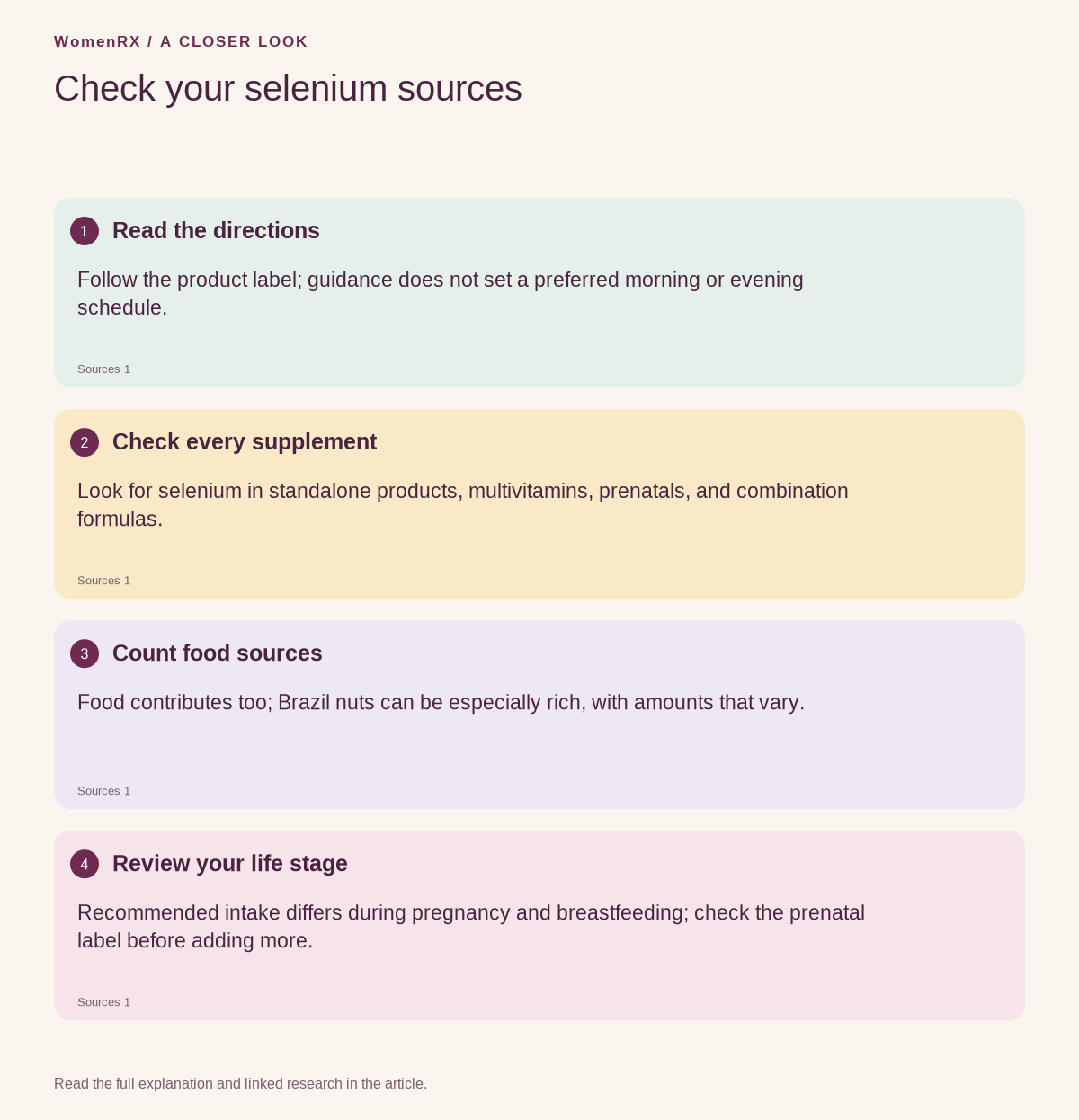
Check your selenium sources
Read the directions: Follow the product label; guidance does not set a preferred morning or evening schedule.1
Check every supplement: Look for selenium in standalone products, multivitamins, prenatals, and combination formulas.1
Count food sources: Food contributes too; Brazil nuts can be especially rich, with amounts that vary.1
Review your life stage: Recommended intake differs during pregnancy and breastfeeding; check the prenatal label before adding more.1
Read the figure as text
Use this label-and-instructions check before adding a selenium product; it does not prescribe a time of day.- Read the directions: Follow the product label; guidance does not set a preferred morning or evening schedule.1
- Check every supplement: Look for selenium in standalone products, multivitamins, prenatals, and combination formulas.1
- Count food sources: Food contributes too; Brazil nuts can be especially rich, with amounts that vary.1
- Review your life stage: Recommended intake differs during pregnancy and breastfeeding; check the prenatal label before adding more.1
More questions, answered
Should I take selenium with food?
US nutrient guidance doesn’t specify that selenium must be taken with food. Follow the directions on your product label; if it gives no meal instruction, there’s no established food-timing advantage in the guidance discussed here. 1
Can I take selenium with my prenatal?
Check whether the prenatal already contains selenium before adding another product. During pregnancy, the recommended total intake is 60 micrograms a day; during breastfeeding, it’s 70 micrograms. 1
Sources you can check
- Selenium - Health Professional Fact SheetAccessed 2026-09-25Return to first citation
- Profiling of selenium absorption and accumulation in healthy subjects after prolonged L-selenomethionine supplementation.Di Dato C, Gianfrilli D, Greco E, Astolfi M, Canepari S, Lenzi A, Isidori AM, Giannetta E. · Journal of endocrinological investigation · 2017Return to first citation