Selenium After 40: Is a Supplement Worth It?
Turning 40 doesn’t create a new selenium requirement; your usual intake and life stage matter more than the number on your birthday cake.
Being over 40 isn’t, by itself, a reason to take selenium. Adult intake guidance varies by life stage, and a trial in postmenopausal women found no benefit for the bone and physical-function outcomes it measured. 1 4 If you’re considering a supplement, look at what you already get from food and any products you take before adding more.
Age isn’t the deciding factor
Selenium is an essential nutrient, but “essential” doesn’t mean “more is better.” U.S. recommended intakes for adults range from 55 to 70 micrograms a day, depending on age and life stage. The guidance doesn’t identify turning 40, entering perimenopause, or reaching postmenopause as a reason to start a selenium supplement. Pregnancy and breastfeeding are different nutritional contexts and shouldn’t be folded into a general midlife recommendation. 1
That distinction matters when a product is marketed for women over 40. The useful question isn’t whether you’ve reached a particular birthday. It’s whether you have a reason to think your intake is inadequate, and what adding a product would bring to your total.
What has been tested in postmenopausal women
Bone health offers a direct test of a common midlife supplement claim. In a six-month UK trial, 120 postmenopausal women older than 55 with osteopenia or osteoporosis were assigned to selenium as selenite at 50 or 200 micrograms a day, or to placebo. Of those enrolled, 115 completed follow-up and were included in the primary analysis. Neither selenium group showed a significant advantage over placebo on the main bone-turnover measure. Other measured outcomes, including bone mineral density, grip strength, and physical performance, also did not differ between groups. 4
The trial doesn’t tell us whether selenium eases hot flashes or other menopause symptoms because it didn’t measure them. It does give a practical answer to the bone-health pitch: those tested doses did not improve the measured musculoskeletal outcomes in women like the participants. They are study doses, not suggested amounts to take. 4
You may also see a small study of an antioxidant combination in postmenopausal women that reported a difference in an estimated bone-density measure after a year. Its treatment combined selenium with alpha-lipoic acid, vitamins C and E, calcium, and vitamin D. Because selenium wasn’t tested on its own, that result can’t show that selenium caused the difference. 5 The trial that tested selenium against placebo is more useful for deciding whether to add selenium specifically. 4
Food, labels, and the risk of adding more
Selenium comes from food, and its amount in foods can vary with soil conditions. That means a food list alone won’t precisely calculate your intake. 3 If you’re thinking about a separate selenium product, check the labels of any multivitamin or other supplements you already use so you know whether you’d be adding selenium from more than one product.
Keep two different reference points straight. A recommended dietary allowance describes an intake that meets the needs of nearly all healthy people in its group. A tolerable upper intake level describes a maximum daily intake unlikely to cause adverse effects. The recommended amount isn’t a minimum supplement dose, and the upper limit isn’t a goal. 1 More selenium may raise a blood measure without producing a health benefit: in the postmenopausal trial, the higher-dose group’s average serum selenium rose, but the measured musculoskeletal outcomes did not improve. 4
Circumstances can change the intake question. For example, a survey of New Zealand residential aged-care residents, whose average age was 85, found a high prevalence of inadequate selenium intake. That setting involves very different eating circumstances from simply being a woman in her 40s. 2 Likewise, findings about pregnant women’s intake shouldn’t be used to decide what a nonpregnant, postmenopausal woman needs. 1 3
For a midlife supplement decision, separate a specific concern about your diet from a general promise attached to your age. The evidence for adding selenium to improve postmenopausal bone outcomes is unpersuasive, while taking another product can increase your total intake without answering what, if anything, you’re missing. 1 4
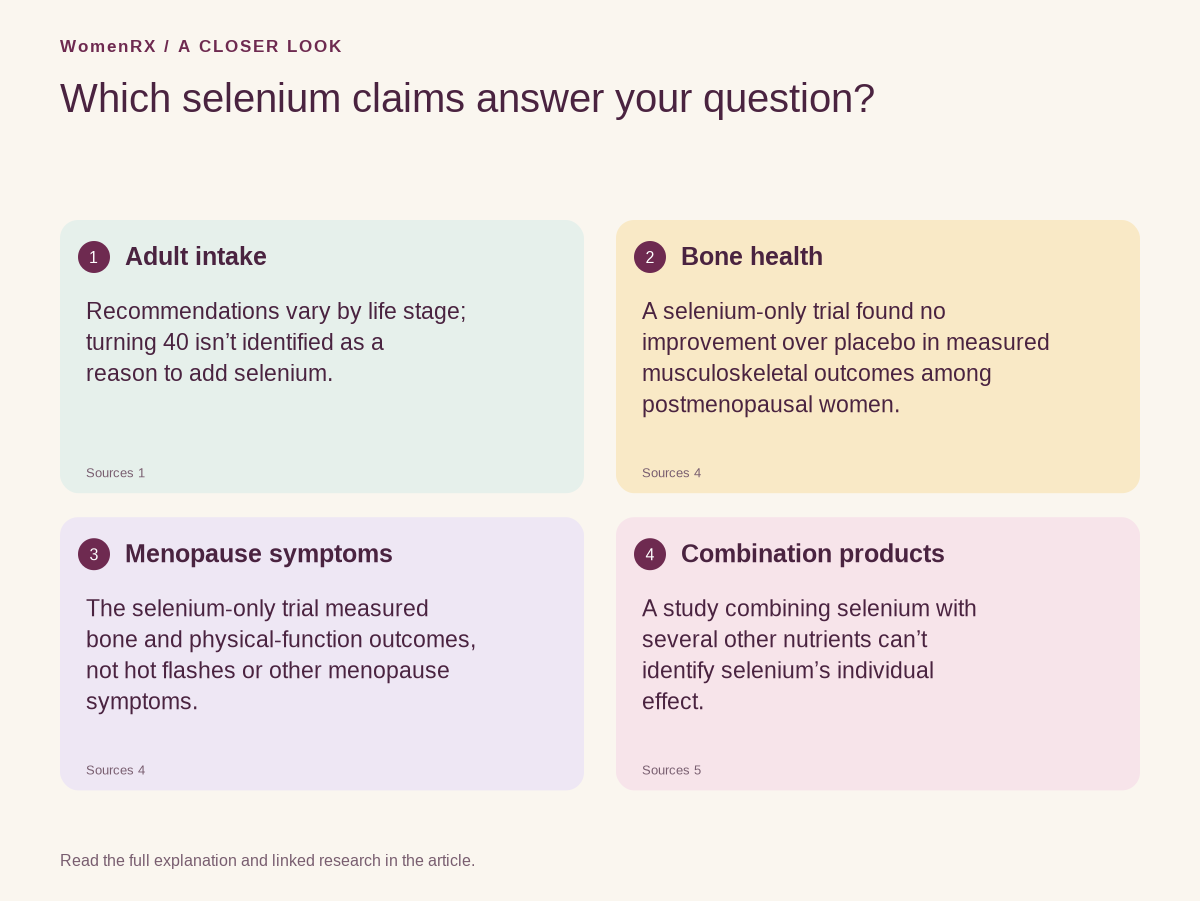
Which selenium claims answer your question?
Adult intake: Recommendations vary by life stage; turning 40 isn’t identified as a reason to add selenium.1
Bone health: A selenium-only trial found no improvement over placebo in measured musculoskeletal outcomes among postmenopausal women.4
Menopause symptoms: The selenium-only trial measured bone and physical-function outcomes, not hot flashes or other menopause symptoms.4
Combination products: A study combining selenium with several other nutrients can’t identify selenium’s individual effect.5
Read the figure as text
An evidence map separating adult intake guidance from studies that test specific health claims.- Adult intake: Recommendations vary by life stage; turning 40 isn’t identified as a reason to add selenium.1
- Bone health: A selenium-only trial found no improvement over placebo in measured musculoskeletal outcomes among postmenopausal women.4
- Menopause symptoms: The selenium-only trial measured bone and physical-function outcomes, not hot flashes or other menopause symptoms.4
- Combination products: A study combining selenium with several other nutrients can’t identify selenium’s individual effect.5
Sources you can check
- Selenium - Health Professional Fact SheetAccessed 2026-09-25Return to first citation
- Inadequate Micronutrient Intakes: Exploring the Vitamin and Mineral Intakes and Food Sources of New Zealand Aged-Care Residents.MacDonell SO, Miller JC, Fleming EA, Haszard JJ. · Journal of human nutrition and dietetics : the official journal of the British Dietetic Association · 2025Return to first citation
- Pregnant Dutch Women Have Inadequate Iodine Status and Selenium Intake.Mayunga KC, Lim-A-Po M, Lubberts J, Stoutjesdijk E, Touw DJ, Muskiet FAJ, Dijck-Brouwer DAJ. · Nutrients · 2022Return to first citation
- Effect of selenium supplementation on musculoskeletal health in older women: a randomised, double-blind, placebo-controlled trial.Walsh JS, Jacques RM, Schomburg L, Hill TR, Mathers JC, Williams GR, Eastell R. · The lancet. Healthy longevity · 2021Return to first citation
- Oral supplementation with antioxidant agents containing alpha lipoic acid: effects on postmenopausal bone mass.Mainini G, Rotondi M, Di Nola K, Pezzella MT, Iervolino SA, Seguino E, D'Eufemia D, Iannicelli I, Torella M. · Clinical and experimental obstetrics & gynecology · 2012Return to first citation