Selenium Supplements: How to Check Your Total Intake
The amount on one supplement label is only part of your selenium intake, and a safety limit isn’t a reason to take more.
Start with the micrograms of selenium per serving, add any selenium in your other supplements, then account for food. NIH describes adult recommended intakes ranging from 55 to 70 mcg daily by life stage; those are intake references, not supplement doses. EFSA’s separate European upper limit is 255 mcg daily for adults, including during pregnancy and breastfeeding. Being below it doesn’t mean a supplement will help. 1 3
Three numbers that answer different questions
A selenium label can show both micrograms (mcg) per serving and a percent Daily Value. Start with the micrograms. The FDA Daily Value is 55 mcg for adults and children ages four and older. It helps you compare labels, but it doesn’t tell you how much selenium you already eat or whether you need a supplement. 1
NIH describes recommended selenium intakes for adults as ranging from 55 to 70 mcg a day, depending on age and life stage. A recommended intake is a reference for meeting nutritional needs from your total diet, not an amount to add on top of food. Pregnancy and breastfeeding affect which intake reference applies; neither is, by itself, a reason to add a separate selenium supplement. 1
An upper intake level, or UL, answers a different question: how much total daily intake is unlikely to cause adverse effects. The European Food Safety Authority (EFSA) sets an adult selenium UL of 255 mcg a day, including for pregnant and breastfeeding women. That’s a European safety reference, not a U.S. upper limit, and it isn’t a target to aim for. 1 3
Try the check with a hypothetical label
Suppose one supplement lists 100 mcg of selenium per serving and a multivitamin you also use lists 55 mcg. Together, those products would provide 155 mcg a day. That’s already more than the 55-to-70-mcg adult recommended-intake range, before counting food. It doesn’t prove harm, but it does show why reading only one label misses the point. 1
Now imagine, strictly as an arithmetic example, that food contributed another 60 mcg that day. Your total would be 215 mcg, or 40 mcg below EFSA’s 255-mcg adult UL. The meal amount is hypothetical, not an estimate for your diet. Being below the UL would not show that taking both products is useful, and a day with more selenium-rich food could change the total. 1 3
To do your own check, use the amount for the serving you actually take, then look through every regular product, including multivitamins and prenatal supplements. Add their selenium amounts in mcg. Treat that sum as a supplement subtotal, not your daily total: food counts too.
Food is the hardest part to pin down
In U.S. diets, breads and grains, meat, poultry, seafood, and eggs are major selenium sources. Dairy and Brazil nuts can contribute as well. You may not find selenium listed on every food package because the FDA generally doesn’t require it unless selenium has been added. Selenium in plant foods can also vary with growing conditions. 1
Brazil nuts are worth a closer look if you eat them regularly. USDA data cited by NIH put their average selenium content at 544 mcg per ounce, but other measurements vary widely. That average is not a reliable count for an individual nut. It does show why a routine serving of Brazil nuts and a selenium supplement shouldn’t be considered separately when you think about total intake. 1 3
When to get a more individual answer
Most people in the United States get enough selenium, and deficiency is rare. Some vegetarian or vegan diets may provide less; people undergoing kidney dialysis and people living with HIV are among groups at greater risk of inadequate intake. Those circumstances call for a closer look at actual intake and health needs, not an automatic dose. 1
If you’re pregnant or breastfeeding, already use more than one selenium-containing product, or regularly eat Brazil nuts, it’s worth reviewing the combination before adding another supplement. The same applies if you’re taking selenium for a particular condition. A review of clinical trials found some improvements in metabolic markers in certain adult groups, but findings for polycystic ovary syndrome and postmenopausal women were inconclusive; longer, well-controlled trials are still needed to establish who benefits. 2
Excess selenium can cause harm. EFSA used hair loss, an early observable effect of excess exposure, when setting its upper limit. If your regular intake may be high, or you develop unexplained hair loss while taking selenium products, bring the product labels and your usual food pattern to a clinician for an individual assessment rather than assuming the symptom has only one cause. 3
Keep selenium numbers in their lanes
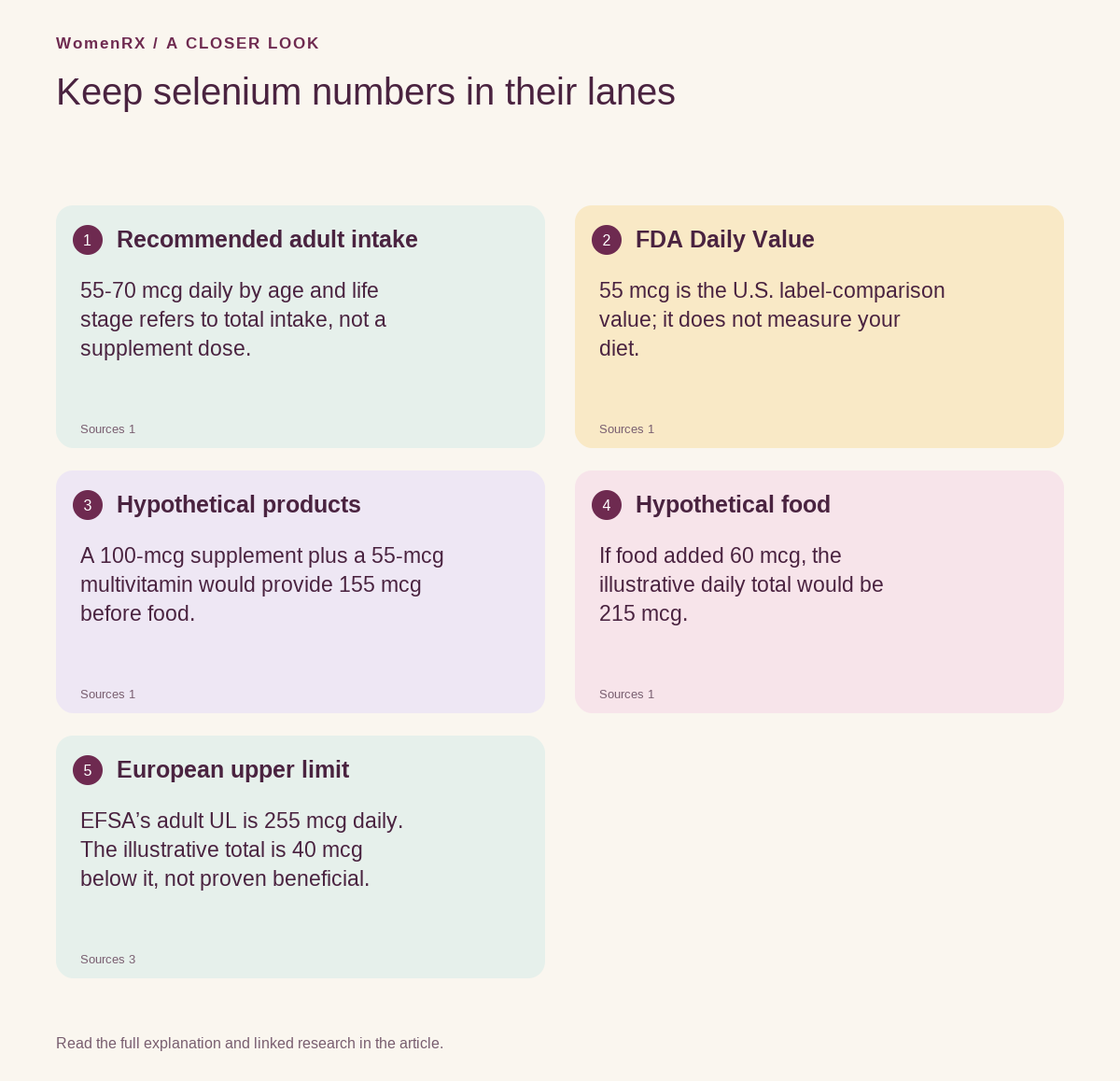
Recommended adult intake: 55-70 mcg daily by age and life stage refers to total intake, not a supplement dose.1
FDA Daily Value: 55 mcg is the U.S. label-comparison value; it does not measure your diet.1
Hypothetical products: A 100-mcg supplement plus a 55-mcg multivitamin would provide 155 mcg before food.1
Hypothetical food: If food added 60 mcg, the illustrative daily total would be 215 mcg.1
European upper limit: EFSA’s adult UL is 255 mcg daily. The illustrative total is 40 mcg below it, not proven beneficial.3
Read the figure as text
A hypothetical two-product example shows why a label percentage, an intake reference, a food contribution, and an upper limit aren’t interchangeable.- Recommended adult intake: 55-70 mcg daily by age and life stage refers to total intake, not a supplement dose.1
- FDA Daily Value: 55 mcg is the U.S. label-comparison value; it does not measure your diet.1
- Hypothetical products: A 100-mcg supplement plus a 55-mcg multivitamin would provide 155 mcg before food.1
- Hypothetical food: If food added 60 mcg, the illustrative daily total would be 215 mcg.1
- European upper limit: EFSA’s adult UL is 255 mcg daily. The illustrative total is 40 mcg below it, not proven beneficial.3
Sources you can check
- Selenium - Health Professional Fact SheetAccessed 2026-09-25Return to first citation
- Current Insights and Research Gaps in Selenium Supplementation for Metabolic Health: A Scoping Review.Morales-Juárez L, Domínguez-Uscanga A, Gutiérrez-Uribe JA, Luna-Vital DA, Escalante-Aburto A. · Nutrition reviews · 2026Return to first citation
- Scientific opinion on the tolerable upper intake level for selenium.EFSA Panel on Nutrition, Novel Foods and Food Allergens (NDA), Turck D, Bohn T, Castenmiller J, de Henauw S, Hirsch-Ernst KI, Knutsen HK, Maciuk A, Mangelsdorf I, McArdle HJ, Peláe... · EFSA journal. European Food Safety Authority · 2023Return to first citation