How to Compare Selenium Supplement Labels
Start with the selenium per serving and your total daily intake, then weigh the form and the quality details the label can actually verify.
Compare the amount of selenium per serving, check how many capsules make up that serving, and add selenium from your other supplements. Forms include selenomethionine, selenium-enriched yeast, sodium selenite, and sodium selenate, but thyroid research doesn’t establish a best form for everyone. For adults, the recommended intake is 55 mcg daily, including 60 mcg during pregnancy and 70 mcg while breastfeeding; the upper limit is 400 mcg daily from all sources. 1
Start with the serving, not the front label
Find the Supplement Facts panel and check two things together: the selenium amount and the serving size. If a bottle lists 100 mcg per serving and a serving is two capsules, that amount applies to the two-capsule serving, not to each capsule. Also check how often the label says to take a serving, so you can compare products on the same basis.
Next, count selenium in the other supplements you use. A multivitamin or prenatal vitamin may already contain it, and a separate selenium product can add to that total. The adult recommended dietary allowance (RDA) is 55 mcg a day; it’s 60 mcg during pregnancy and 70 mcg while breastfeeding. These are total daily intake targets from food and supplements combined, not suggested supplement doses. Most people in the United States get adequate selenium. 1
Compare forms without treating them as a ranking
Common supplemental forms include selenomethionine, selenium-enriched yeast, sodium selenite, and sodium selenate. Selenium-enriched yeast is predominantly selenomethionine. The body can absorb up to about 90% of selenium from these forms, but that fact alone doesn’t tell you which product will provide a meaningful health benefit. 1
Thyroid studies offer a specific example of why form claims need context. A review of 16 trials in adults with autoimmune thyroiditis, mainly women, found lower thyroid peroxidase antibody levels in participants taking selenium who were also treated with levothyroxine. In that analysis, selenomethionine lowered those antibodies more than sodium selenite. But separate trial reviews found no improvement in measures such as TSH or health-related quality of life. A change in an antibody result isn’t the same as a demonstrated improvement in symptoms or thyroid function. 1
So, don’t choose a product on the promise that one form treats thyroid disease. Research findings in people with a particular condition don’t establish that every person with a thyroid diagnosis needs selenium, or that a higher amount is better. A 2026 review of five randomized trials in 303 people with Graves’ orbitopathy found a possible improvement in one measure of disease activity, but not consistent benefits across quality of life, vision, or eyelid opening. That’s a narrow and still uncertain finding, not a general reason to buy selenium for thyroid health. 2
Treat “quality” as a question to verify
Look for a label that clearly states the selenium amount per serving and names the form. If a company makes a quality-testing claim, look for specifics: who did the testing, whether it applies to the product or batch you’re buying, and what was tested. A broad phrase such as “premium quality” doesn’t tell you whether a test checked the labeled selenium amount or other product characteristics.
This is a way to compare transparency, not a guarantee of benefit or a ranking of brands. The clinical evidence doesn’t show that a testing claim, by itself, makes one selenium form more effective for thyroid disease.
Keep the upper limit in view
For adults, including during pregnancy and breastfeeding, the U.S. tolerable upper intake level is 400 mcg per day from food and supplements combined. It’s a safety ceiling, not an intake goal. Add the selenium in your multivitamin, prenatal, standalone products, and diet before considering another product. 1
Chronically high intake can cause selenium toxicity, often marked by hair loss or brittle or lost nails; other signs can include a metallic taste, garlic-like breath, nausea, or diarrhea. If you receive cisplatin chemotherapy, raise selenium supplements with your oncology team: cisplatin can lower selenium levels, but whether that change matters clinically is unclear, and evidence that supplements relieve chemotherapy side effects is insufficient. 1
Pregnancy and breastfeeding call for a personal check
Pregnancy and breastfeeding change the RDA, but that doesn’t mean you should automatically add a standalone selenium supplement. Check whether a prenatal or other product already contains selenium and consider your total intake. If you’re pregnant and have thyroid antibodies, distinguish that situation from general pregnancy nutrition: the American Thyroid Association recommends against selenium supplementation for pregnant women who are TPO-antibody positive. That recommendation is specific to this group, not a blanket instruction for every pregnant person. 1
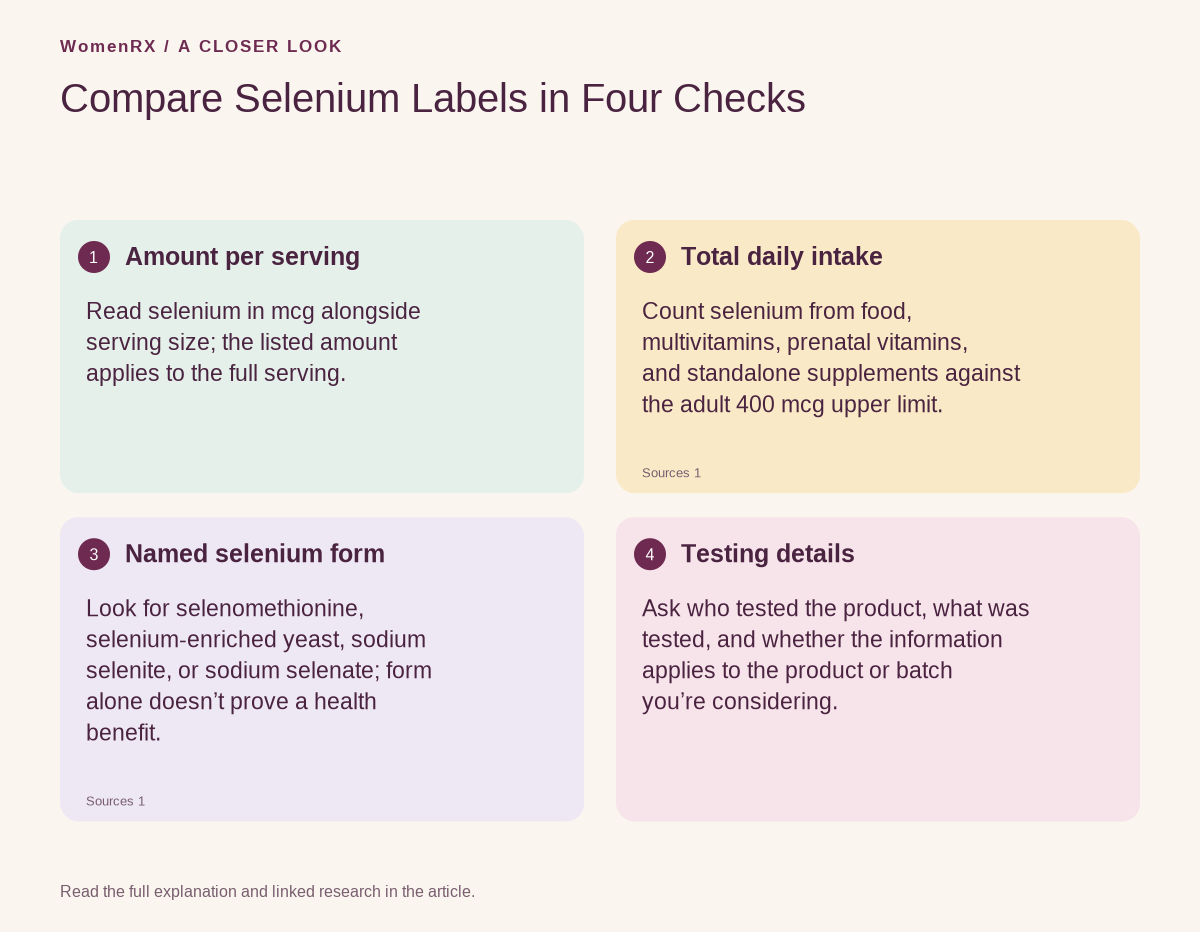
Compare Selenium Labels in Four Checks
Amount per serving: Read selenium in mcg alongside serving size; the listed amount applies to the full serving.
Total daily intake: Count selenium from food, multivitamins, prenatal vitamins, and standalone supplements against the adult 400 mcg upper limit.1
Named selenium form: Look for selenomethionine, selenium-enriched yeast, sodium selenite, or sodium selenate; form alone doesn’t prove a health benefit.1
Testing details: Ask who tested the product, what was tested, and whether the information applies to the product or batch you’re considering.
Read the figure as text
Use these checks in order: confirm the amount you would take, account for selenium already in your routine, then assess form and product-testing details.- Amount per serving: Read selenium in mcg alongside serving size; the listed amount applies to the full serving.
- Total daily intake: Count selenium from food, multivitamins, prenatal vitamins, and standalone supplements against the adult 400 mcg upper limit.1
- Named selenium form: Look for selenomethionine, selenium-enriched yeast, sodium selenite, or sodium selenate; form alone doesn’t prove a health benefit.1
- Testing details: Ask who tested the product, what was tested, and whether the information applies to the product or batch you’re considering.
More questions, answered
Does a higher selenium amount mean a better supplement?
No. The adult upper limit is 400 mcg daily from food and supplements, and it’s a ceiling rather than a target. Compare the amount with your total intake instead of assuming more will offer more benefit. 1
Should I choose selenomethionine for thyroid health?
Not as a general rule. Some research in autoimmune thyroiditis found a greater reduction in TPO antibodies with selenomethionine than with sodium selenite, but reviews did not find improvements in TSH or quality of life. Those findings don’t establish a best form for everyone or show that selenium treats thyroid disease. 1
Sources you can check
- Selenium - Health Professional Fact SheetAccessed 2026-09-25Return to first citation
- Efficacy of Selenium Supplementation in Graves' Orbitopathy: A Systematic Review and Meta-Analysis of Randomized Controlled Trials with Trial Sequential Analysis.Kostadinov N, Kirovakov Z, Penchev P. · Journal of clinical medicine · 2026Return to first citation