How to Check Selenium Supplement Use Over Time
Add up selenium from every supplement and food source before deciding whether a daily product still makes sense.
For an adult, compare your estimated total daily selenium from food and supplements with the 400 mcg upper limit, not just the amount in one pill. For each label, multiply mcg per serving by servings taken; servings taken equals pills taken divided by pills per serving. Include food sources such as Brazil nuts. Pregnancy and breastfeeding have different recommended intakes, but the adult upper limit is the same. 1
Start with the amount you actually take
Look at the Selenium entry on each Supplement Facts label. Note the micrograms (mcg) per serving and how many pills or capsules make up a serving. Calculate: mcg per serving × servings taken, where servings taken = pills or capsules taken ÷ pills or capsules per serving. For example, if a serving is two capsules and you take one, count half a serving. Then add selenium in any multivitamin, prenatal, vitamin E combination, or other product you use. A stand-alone supplement isn’t the only product that may contain it. 1
Keep a separate, approximate line for food. For a practical starting point, note the amounts in foods you eat regularly: a 3-ounce serving of cooked yellowfin tuna has 92 mcg, a large egg has 15 mcg, and a slice of whole-wheat bread has 8 mcg. Brazil nuts can contribute a lot: the NIH fact sheet reports an average of 544 mcg per ounce, while analyses vary. Food labels aren’t required to list selenium unless it has been added, and selenium in plant foods can vary, so a label scan or one-day food estimate won’t capture an exact total. 1
Your result is an estimate, not a precise measurement. Still, it can reveal a simple issue: taking a multivitamin plus a separate selenium product may mean you’re doubling up without realizing it.
Use the upper limit as a warning line, not a goal
For adults, the recommended dietary allowance (RDA) is 55 mcg a day. It rises to 60 mcg during pregnancy and 70 mcg while breastfeeding. The adult tolerable upper intake level (UL) is 400 mcg a day, including selenium from both food and supplements; it’s the highest daily intake unlikely to cause harm, not a target to aim for. The UL is also 400 mcg for adults who are pregnant or breastfeeding. 1
The RDA and UL answer different questions. The RDA is an intake goal for nearly all healthy people; the UL helps identify when total intake may be too high. Being below the UL doesn’t prove that a supplement is useful for you, or that taking it indefinitely is necessary.
Duration matters because excess can become a pattern
Chronic excess selenium can cause selenosis. Common signs include hair loss and brittle or lost nails. Other possible signs include a garlic odor on the breath, a metallic taste, rash, nausea, diarrhea, fatigue, irritability, and nervous-system changes. If you’ve taken selenium for a long time and notice these symptoms, include your products and estimated daily total in a prompt conversation with a clinician or pharmacist. Severe gastrointestinal or neurological symptoms or breathing problems after a large or accidental dose need urgent medical assessment. 1
A study lasting months or years doesn’t establish that a supplement is appropriate for everyone over the same period. For example, trials reviewed by NIH studied selenium for several years for cancer prevention, but found little to no effect on cancer incidence or mortality. That finding is about cancer outcomes, not proof that every dose and duration is unsafe; it does show why long use shouldn’t be assumed to provide a benefit. 1
Long-term findings also don’t apply equally to every group. In a cross-sectional study of adults over 65, people with prior bariatric surgery who used selenium supplements had higher plasma selenium and selenoprotein P levels than those with surgery who didn’t supplement. A “supersaturated” selenoprotein P level was reported in 28% of supplement users and 0% of nonusers in the surgery group; the clinical meaning was uncertain. This study doesn’t establish harm or a safe duration, but it shows why individual circumstances can matter when reviewing ongoing use. 2
Thyroid conditions don’t settle the question
Selenium is involved in thyroid hormone metabolism, but a thyroid diagnosis by itself doesn’t show that you need a supplement. In trials among people with autoimmune thyroiditis, supplements sometimes lowered thyroid antibody levels, but reviews found no consistent improvement in thyroid function or quality of life. The authors of a systematic review concluded that the evidence does not support selenium supplementation for autoimmune thyroiditis. 1
Pregnancy adds a specific consideration: the American Thyroid Association recommends against selenium supplements for pregnant women who test positive for thyroid peroxidase antibodies (TPOAb). That is distinct from meeting the usual pregnancy intake of 60 mcg a day through diet and any supplements already recommended for you. 1
If you take cisplatin chemotherapy, tell your cancer-care team about selenium products. Cisplatin can lower selenium levels measured in hair and blood, but whether that change matters clinically is unknown; evidence that supplements reduce chemotherapy side effects is insufficient. 1
A practical audit before continuing
Write down each product, its selenium amount per serving, how many pills or capsules make up a serving, and how many you take. Calculate the amount from each product using servings taken, then add the listed amounts across products. Separately note foods you eat regularly and use serving-based estimates where available; especially account for Brazil nuts, whose selenium content varies. Bring your labels and estimate to a clinician or pharmacist if your total approaches or exceeds 400 mcg a day, if you’re pregnant or breastfeeding and unsure how products add up, or if you have symptoms that could fit excess intake. A long-running supplement without a clear reason is also a good reason to review whether continuing still makes sense. If no one has identified a reason for supplementation, ask what benefit the product is meant to provide and when that reason should be reassessed. 1
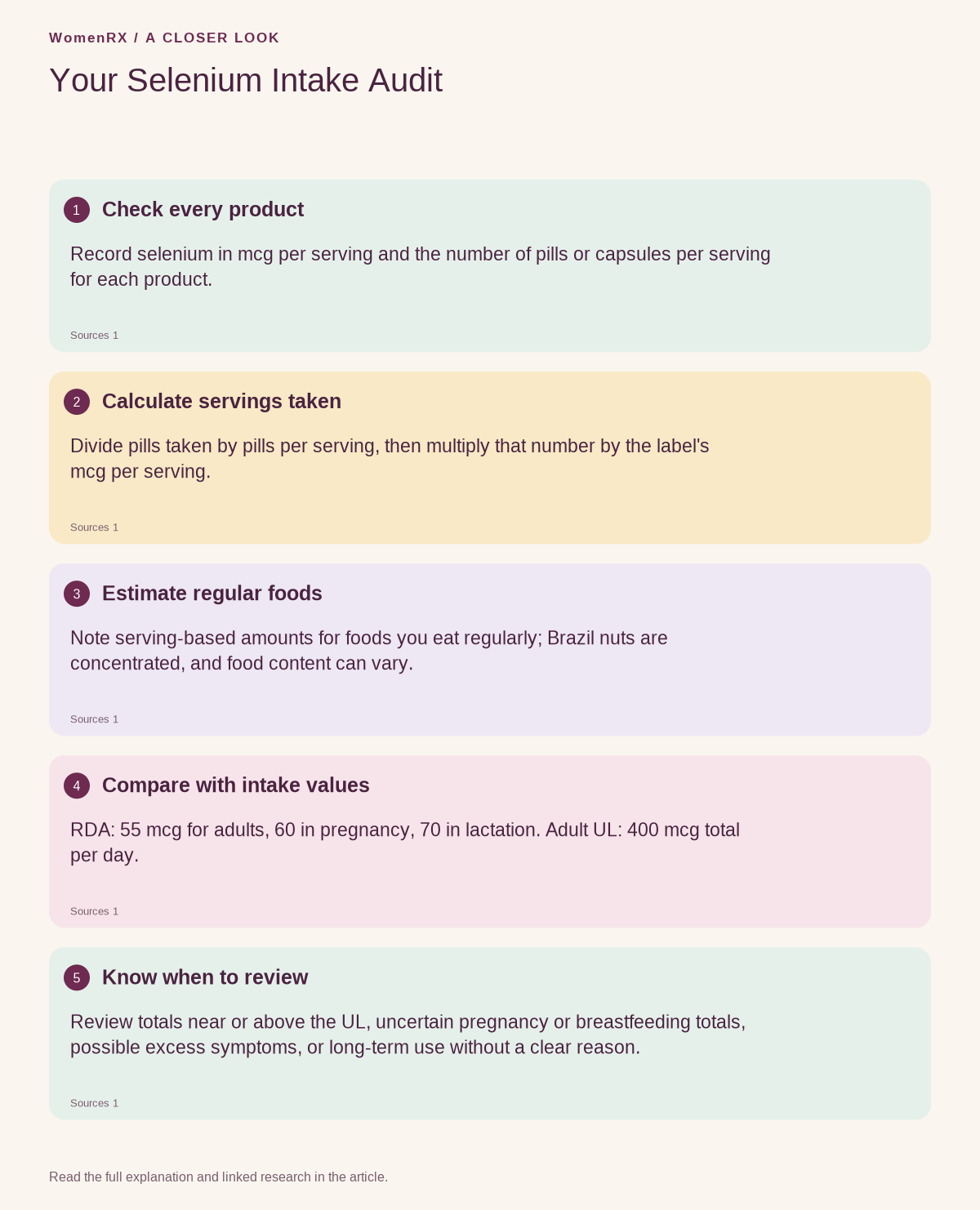
Your Selenium Intake Audit
Check every product: Record selenium in mcg per serving and the number of pills or capsules per serving for each product.1
Calculate servings taken: Divide pills taken by pills per serving, then multiply that number by the label's mcg per serving.1
Estimate regular foods: Note serving-based amounts for foods you eat regularly; Brazil nuts are concentrated, and food content can vary.1
Compare with intake values: RDA: 55 mcg for adults, 60 in pregnancy, 70 in lactation. Adult UL: 400 mcg total per day.1
Know when to review: Review totals near or above the UL, uncertain pregnancy or breastfeeding totals, possible excess symptoms, or long-term use without a clear reason.1
Read the figure as text
Use these steps to total selenium across products and foods, then identify when ongoing use deserves a closer review.- Check every product: Record selenium in mcg per serving and the number of pills or capsules per serving for each product.1
- Calculate servings taken: Divide pills taken by pills per serving, then multiply that number by the label's mcg per serving.1
- Estimate regular foods: Note serving-based amounts for foods you eat regularly; Brazil nuts are concentrated, and food content can vary.1
- Compare with intake values: RDA: 55 mcg for adults, 60 in pregnancy, 70 in lactation. Adult UL: 400 mcg total per day.1
- Know when to review: Review totals near or above the UL, uncertain pregnancy or breastfeeding totals, possible excess symptoms, or long-term use without a clear reason.1
Sources you can check
- Selenium - Health Professional Fact SheetAccessed 2026-09-25Return to first citation
- From suboptimal to supersaturation: Selenium status after bariatric surgery is modulated by supplementation.Eksteen G, Griner L, Van der Schueren B, Vangoitsenhoven R, Mertens A, Lannoo M, Deleus E, Vanuytsel T, Matthys C. · The Journal of nutritional biochemistry · 2026Return to first citation