Selenium Supplements: When Are They Needed?
A thyroid diagnosis alone doesn’t show that you need selenium; first consider whether there’s a specific reason to suspect deficiency.
Selenium supports thyroid hormone metabolism, but that doesn’t mean a supplement will treat a thyroid condition. Hashimoto’s studies report mixed findings, and changes in thyroid antibodies don’t by themselves establish better thyroid function or symptoms. Review food and supplement sources together, then ask whether your diet, health history, or a test points to a specific need. 134
A role in thyroid health isn’t proof of a treatment benefit
Your body uses selenium in thyroid hormone metabolism. But needing a nutrient doesn’t mean taking extra will improve Hashimoto’s, thyroid symptoms, or thyroid function. Correcting a deficiency is a different question from using selenium to treat a thyroid diagnosis or change an antibody result. 4
Hashimoto’s doesn’t automatically mean you’re selenium-deficient. In one retrospective study, selenium levels did not significantly differ between 270 people with Hashimoto’s and 350 healthy controls. That study used a level below 80 μg/L to identify deficiency for its treatment analysis, but a cutoff from one study is not a universal rule for testing or supplementation. 3
It helps to be clear about why you’re considering selenium: a suspected or identified deficiency, a diet that may provide little selenium, or the hope that it will help a thyroid condition. Those are separate questions, and a thyroid diagnosis alone doesn’t answer them.
What Hashimoto’s research can tell you
Reviews describe studies in which selenium lowered thyroid antibodies, but findings vary across conditions and study designs. Antibodies are one measure; a change in that measure alone doesn’t establish that thyroid function, symptoms, or day-to-day health improved. 45
For example, a retrospective study followed 60 people with Hashimoto’s identified as selenium-deficient who received supplementation. After six months, selenium levels rose, but TSH, free T3, and free T4 did not change significantly. Anti-TPO and anti-thyroglobulin antibody levels increased. Because this was a before-and-after study without a comparison group, it cannot show that supplementation caused those changes. 3
A separate matched retrospective cohort compared 2,347 people with Hashimoto’s who received selenium with 2,347 who did not. The selenium group had higher mean TSH, free T4, and TPO antibody levels in the reported follow-up. Those associations do not show that selenium caused the differences, and the study lacked baseline selenium measurements, so it could not assess whether participants were deficient before taking it. 2
Taken together, these studies don’t establish a reliable thyroid-function or symptom benefit for everyone with Hashimoto’s. Some research includes women-only groups, but the findings don’t establish a separate selenium recommendation for women. 45
Review your total intake before adding a product
For adults, the recommended dietary allowance is 55 micrograms (mcg) a day. It’s 60 mcg during pregnancy and 70 mcg while breastfeeding. These are recommended amounts from all sources, not instructions to take that amount as a supplement. 1
Seafood, meat, poultry, eggs, grains, and dairy can all contribute selenium. Selenium amounts in plant foods can vary with growing conditions. Supplements may also be included in multivitamins, prenatal vitamins, or standalone products, so check all the labels rather than looking at a new product in isolation. 1
Excessive selenium intake can be harmful. If you’re considering a supplement, bring a complete picture of what you already take and eat into the discussion. You might ask: Does my diet or health history make low selenium plausible? Would a test meaningfully change the decision? What sources of selenium am I already getting? A threshold used in one study shouldn’t be treated as a universal testing or treatment rule. 134
Pregnancy and breastfeeding change the intake reference
The recommended intake is higher during pregnancy and breastfeeding than for other adults, but that doesn’t mean an extra selenium product is automatically needed. Check whether your prenatal or other supplements already contain selenium before adding another source. 1
A secondary analysis of a multicountry maternal nutrition trial found no significant associations between maternal selenium levels during pregnancy and the birth outcomes it examined. The study supplement did not raise maternal selenium levels. These findings don’t determine an individual’s needs in pregnancy or while breastfeeding; they’re a reason to consider life stage and total intake rather than assume that extra selenium will improve outcomes. 6
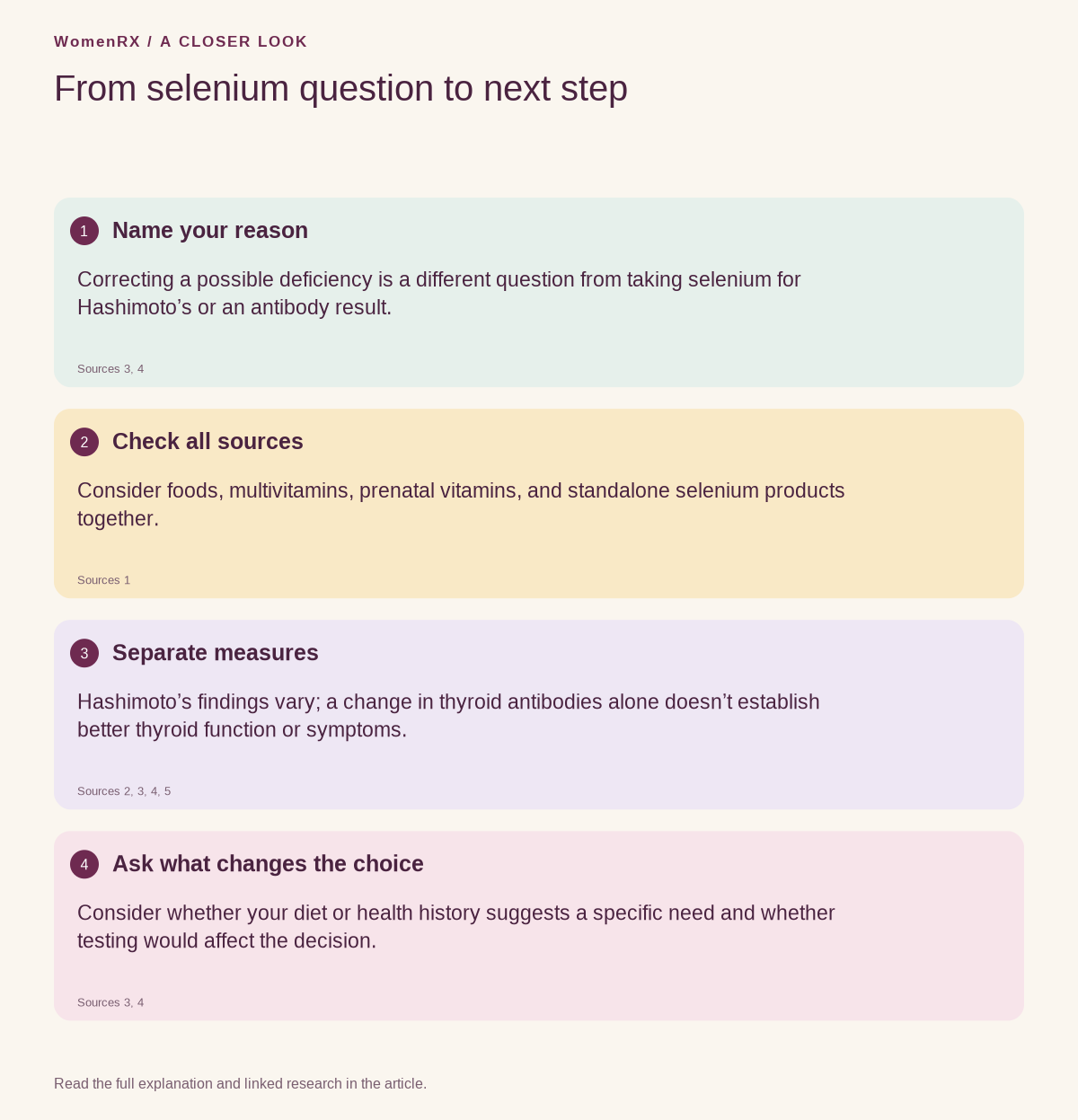
From selenium question to next step
Name your reason: Correcting a possible deficiency is a different question from taking selenium for Hashimoto’s or an antibody result.34
Check all sources: Consider foods, multivitamins, prenatal vitamins, and standalone selenium products together.1
Separate measures: Hashimoto’s findings vary; a change in thyroid antibodies alone doesn’t establish better thyroid function or symptoms.2345
Ask what changes the choice: Consider whether your diet or health history suggests a specific need and whether testing would affect the decision.34
Read the figure as text
Separate the reason for considering selenium from your current intake and the evidence for using it in your situation.- Name your reason: Correcting a possible deficiency is a different question from taking selenium for Hashimoto’s or an antibody result.34
- Check all sources: Consider foods, multivitamins, prenatal vitamins, and standalone selenium products together.1
- Separate measures: Hashimoto’s findings vary; a change in thyroid antibodies alone doesn’t establish better thyroid function or symptoms.2345
- Ask what changes the choice: Consider whether your diet or health history suggests a specific need and whether testing would affect the decision.34
More questions, answered
Does Hashimoto’s mean I should take selenium?
No. Hashimoto’s alone doesn’t establish selenium deficiency, and the research doesn’t show a dependable benefit for everyone with the condition. Consider your own diet and health history, and ask whether assessing selenium status would change the decision. 234
If my thyroid antibodies change, does that mean selenium is helping?
Not necessarily. Studies report different antibody findings, and an antibody change alone doesn’t establish improved thyroid function or symptoms. 345
Sources you can check
- Selenium - Health Professional Fact SheetAccessed 2026-09-25Return to first citation
- Clinical Outcomes of Selenium Supplementation in Hashimoto's Thyroiditis Without Selenium Deficiency: A Large-Scale Retrospective Cohort Study.Toraih EA, Yaghi S, Ardis C, Tran L, Abdelmaksoud A, Elshazli RM, Hussein MH, Patel H, Elmorsy EM, Jishu JA, Aiash H, Fawzy MS. · Endocrinology, diabetes & metabolism · 2026Return to first citation
- The Impact of Selenium Deficiency and Supplementation on Hashimoto's Thyroiditis: A Clinical Evaluation.Acik H, Aydin Y. · Endocrine, metabolic & immune disorders drug targets · 2026Return to first citation
- Selenium status and supplementation in thyroid disorders: A narrative review of current evidence.Linn YH, Aziz S, Mok SL. · Journal of trace elements in medicine and biology : organ of the Society for Minerals and Trace Elements (GMS) · 2025Return to first citation
- Current literature support and opposition for therapeutic use of selenium supplementation in autoimmune thyroid conditions.Nannapaneni A, Wilson V, Chughtai S. · Biochemistry and biophysics reports · 2025Return to first citation
- A Multicountry Analysis of Maternal Selenium Status in Pregnancy and Lactation and Infant Birth Outcomes: Findings from the Women First Maternal Preconception Study.Gilley SP, Westcott JL, Kemp JF, Long JM, Hambidge KM, Shankar K, Krebs NF, Women First Trial Group. · The Journal of nutrition · 2026Return to first citation