Selenium: When to Take It and When to Skip It
For most people in the United States, food supplies enough selenium; check your full daily intake before adding a supplement.
If you’re considering selenium, first check whether you have a documented need and what you already get from food, a multivitamin, and other supplements. Most people in the United States get enough from food. There’s no routine time-of-day recommendation; the more useful check is your total intake. Needs rise during pregnancy and breastfeeding, but that doesn’t mean a supplement is automatically needed. Too much can cause harm. 1
Start with need, not the clock
Selenium helps the body make proteins involved in thyroid hormone metabolism and other functions. That role doesn’t mean taking extra selenium will improve thyroid health if you already get enough. Most people in the United States consume adequate amounts, and the general guidance is to meet nutrient needs mainly through food. 1
A 2026 market-and-risk analysis of 70 selenium supplements from the United States and Germany also concluded there was no basis to recommend starting a supplement without a medically diagnosed deficiency. This was a product analysis and literature review, not a clinical trial, so it doesn’t establish whether a particular person needs selenium. 2
For routine use, guidance sets daily intake amounts, not a best time of day. So the practical question is usually whether a supplement is needed at all, rather than whether to take it in the morning or evening. If you’ve been advised to take selenium for a specific reason, follow the directions you were given and include the product when you review your supplements with a clinician or pharmacist.
Count food and every supplement
For adult women ages 19 and older, the recommended daily intake is 55 micrograms (mcg). It’s 60 mcg during pregnancy and 70 mcg while breastfeeding. These are total daily intake targets, not suggested supplement doses. 1
Selenium comes from foods such as seafood, meat, poultry, eggs, grains, and dairy. Amounts in plant foods can vary with where they were grown. Brazil nuts are especially concentrated: one can contain about 68 to 91 mcg, and the amount varies. 1
Check the Supplement Facts panel on each product you use, including multivitamins and combination products. Some multivitamins contain 55 mcg of selenium, while selenium-only supplements commonly contain more. Add those amounts to any selenium listed for foods or fortified products. For example, a 200-mcg supplement plus one Brazil nut could provide roughly 268 to 291 mcg before counting anything else you eat that day. 1
The U.S. upper limit for adults, including during pregnancy and lactation, is 400 mcg per day from food and supplements combined. It’s a ceiling intended to help prevent harm, not a goal to reach. 1
Thyroid interest doesn’t automatically mean a supplement
Selenium is part of normal thyroid biology, but that alone doesn’t establish that a supplement treats thyroid disease. In a review of trials involving 1,494 adults, mostly women, selenium lowered some thyroid antibody levels in certain groups with autoimmune thyroiditis. Other trial results were mixed. A separate review found no improvement in TSH levels or quality of life in trials of selenium alone. 1
Pregnancy deserves particular care. Trials in pregnant women with thyroid antibodies had mixed results, and the American Thyroid Association recommends against selenium supplementation for pregnant women who test positive for thyroid peroxidase antibodies. Don’t start selenium to treat a thyroid condition or prevent postpartum thyroid problems based only on its role in thyroid function. 1
Know the signs of too much
Long-term excessive selenium intake can cause selenosis. Possible signs include a garlic-like breath odor or metallic taste, hair loss, and brittle or lost nails. Other reported symptoms include nausea, diarrhea, skin rash, fatigue, irritability, and nervous system problems. If these signs appear while you’re using a selenium product, review the product and your total intake with a clinician. 1
One medicine to flag
Cisplatin, a chemotherapy drug, can lower selenium levels measured in hair and blood, but whether that change is clinically important is unknown. Evidence is insufficient to show that selenium supplements reliably ease chemotherapy side effects. If you receive cisplatin, tell your oncology team about any selenium supplement rather than adding one to counter a possible change in levels. 1
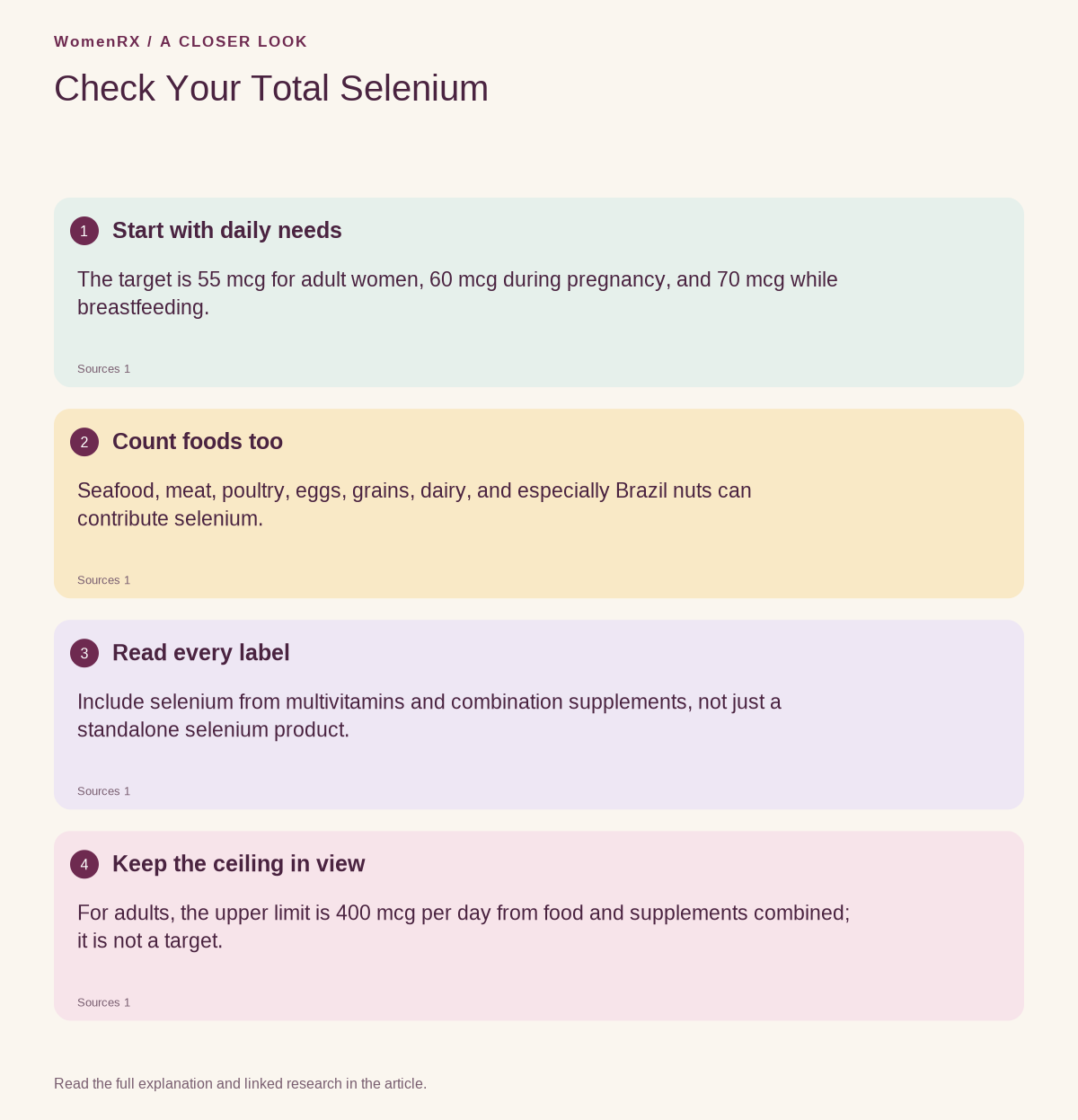
Check Your Total Selenium
Start with daily needs: The target is 55 mcg for adult women, 60 mcg during pregnancy, and 70 mcg while breastfeeding.1
Count foods too: Seafood, meat, poultry, eggs, grains, dairy, and especially Brazil nuts can contribute selenium.1
Read every label: Include selenium from multivitamins and combination supplements, not just a standalone selenium product.1
Keep the ceiling in view: For adults, the upper limit is 400 mcg per day from food and supplements combined; it is not a target.1
Read the figure as text
Use these checks to see whether a supplement may add selenium you already get from food or another product.- Start with daily needs: The target is 55 mcg for adult women, 60 mcg during pregnancy, and 70 mcg while breastfeeding.1
- Count foods too: Seafood, meat, poultry, eggs, grains, dairy, and especially Brazil nuts can contribute selenium.1
- Read every label: Include selenium from multivitamins and combination supplements, not just a standalone selenium product.1
- Keep the ceiling in view: For adults, the upper limit is 400 mcg per day from food and supplements combined; it is not a target.1
Sources you can check
- Selenium - Health Professional Fact SheetAccessed 2026-09-25Return to first citation
- Selenium containing dietary supplements: Market-, efficacy- and risk analysis.Donner K, Seifert R. · Journal of trace elements in medicine and biology : organ of the Society for Minerals and Trace Elements (GMS) · 2026Return to first citation