Selenium: How to Compare Food Intake and Supplement Labels
Adult U.S. women average 94 mcg of selenium a day from food and beverages, so check every supplement label before adding another source.
For women ages 19 and older, the recommended intake is 55 mcg a day; it’s 60 mcg during pregnancy and 70 mcg while breastfeeding. These amounts include food and supplements, not just a pill. Add the selenium listed per serving on every supplement label, then consider food sources too, especially Brazil nuts, which can contain a lot. The recommendation is not a safety ceiling. 1
Start with the total, not the bottle
The selenium recommendation for women ages 19 and older is 55 micrograms (mcg) per day. It rises to 60 mcg during pregnancy and 70 mcg while breastfeeding. These are total-intake targets: selenium from food counts alongside selenium from supplements. They’re not instructions to take that amount as a supplement. 1
That distinction matters when you’re comparing labels. A multivitamin may already contain selenium, and a separate selenium product can add more. The NIH Office of Dietary Supplements reports that many multivitamins contain 55 mcg, while selenium-only supplements commonly contain 100 to 400 mcg. Check the amount per serving and the serving size, not only the product name. 1
As a simple example, a hypothetical multivitamin with 55 mcg and a separate supplement with 100 mcg would provide 155 mcg from supplements alone, before food. The point isn’t to estimate your exact daily intake from one day’s meals; it’s to notice when products overlap.
Food adds up, but estimates have limits
Seafood, meat, poultry, eggs, grains, and dairy can all contribute selenium. For a sense of scale, the NIH fact sheet lists 92 mcg in 3 ounces of cooked yellowfin tuna, 15 mcg in one hard-boiled egg, and 13 mcg in a cup of cooked oatmeal. These are reference values for particular portions, not a guarantee that every serving contains exactly that amount. 1
Plant foods vary more by where they were grown because soil selenium affects the amount in crops. Brazil nuts stand out: the fact sheet reports an average of 544 mcg per ounce, about 6 to 8 nuts, and notes that measured amounts vary widely. That makes Brazil nuts a food to count rather than treat as a predictable, modest source. 1
U.S. survey estimates offer another useful, but not individual, reference point: adult women averaged 94 mcg per day from food and beverages, and 102 mcg per day when supplements were included. These population averages don’t tell you what you personally eat, but they show why it’s worth counting food as well as products. 1
A practical label check
Before adding a product, make a short inventory:
- Check the serving size. Note how many tablets or capsules make up one serving, then use the selenium amount for that serving.
- Add products together. Include your multivitamin, prenatal or postnatal product, and any stand-alone selenium or combination supplement. Use the label amount for each product’s serving.
- Keep food in view. You don’t need to calculate every meal precisely. Just remember that selenium also comes from common foods, and that Brazil nuts can contain unusually high amounts.
- Compare with the right life-stage reference. Use 55 mcg for most adult women, 60 mcg in pregnancy, or 70 mcg while breastfeeding. These values describe recommended total daily intake, not an upper safety limit. An amount above the recommendation does not, by itself, tell you whether your total intake is excessive or safe. 1
If a product is being considered for a specific reason, check whether another product already supplies selenium and whether the proposed use has evidence for that reason. Adding up labels can reveal overlap, but comparing the result with the recommended intake alone cannot establish a safe upper amount. 1
Read thyroid promises with care
Selenium has a role in thyroid biology, but that doesn’t establish that taking a supplement will improve thyroid health. A U.S. analysis of NHANES data examined dietary selenium and thyroid hormone measures in 5,575 adults. It found associations, not proof that selenium caused changes; the reported sex-stratified associations were more pronounced in men. 2
Another cross-sectional analysis of U.S. adults found an association between dietary selenium intake and Hashimoto’s thyroiditis. Because it was observational, it can’t show that taking selenium prevents or treats the condition. A thyroid-related claim on a supplement label is not, on its own, evidence that you need extra selenium. 3
A useful next step is to total the selenium in products you already use, keep food contributions in view, and question any thyroid claim that jumps from a biological role or an association to a promised benefit.
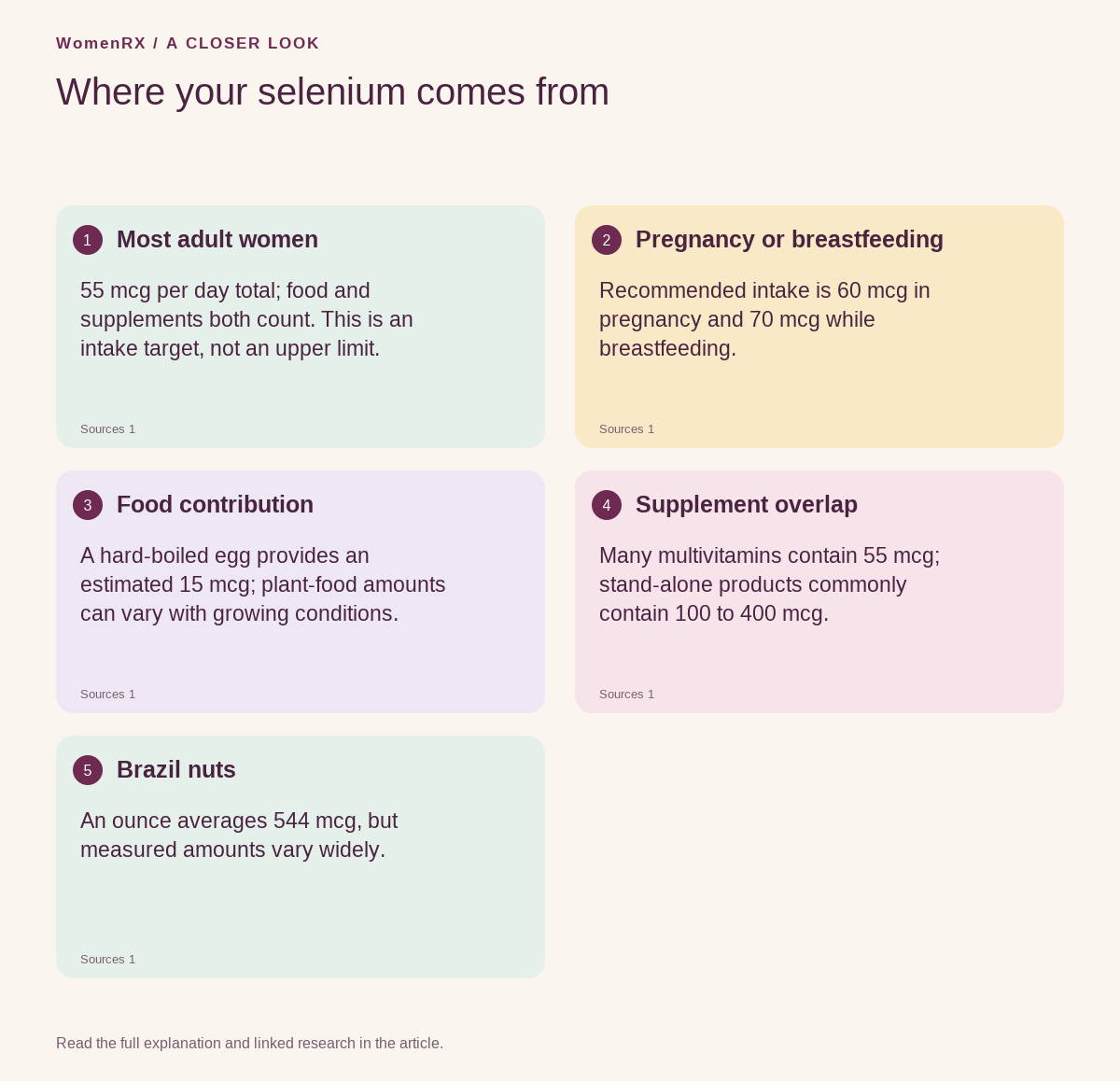
Where your selenium comes from
Most adult women: 55 mcg per day total; food and supplements both count. This is an intake target, not an upper limit.1
Pregnancy or breastfeeding: Recommended intake is 60 mcg in pregnancy and 70 mcg while breastfeeding.1
Food contribution: A hard-boiled egg provides an estimated 15 mcg; plant-food amounts can vary with growing conditions.1
Supplement overlap: Many multivitamins contain 55 mcg; stand-alone products commonly contain 100 to 400 mcg.1
Brazil nuts: An ounce averages 544 mcg, but measured amounts vary widely.1
Read the figure as text
Compare life-stage intake targets with food contributions and amounts that can appear on supplement labels. The targets are not safety ceilings.- Most adult women: 55 mcg per day total; food and supplements both count. This is an intake target, not an upper limit.1
- Pregnancy or breastfeeding: Recommended intake is 60 mcg in pregnancy and 70 mcg while breastfeeding.1
- Food contribution: A hard-boiled egg provides an estimated 15 mcg; plant-food amounts can vary with growing conditions.1
- Supplement overlap: Many multivitamins contain 55 mcg; stand-alone products commonly contain 100 to 400 mcg.1
- Brazil nuts: An ounce averages 544 mcg, but measured amounts vary widely.1
More questions, answered
Does the selenium Daily Value on a U.S. label match my needs?
The U.S. Daily Value is 55 mcg for adults and children age 4 and older. That matches the RDA for most adult women, but pregnancy and breastfeeding have higher recommended intakes: 60 mcg and 70 mcg, respectively. Neither the Daily Value nor the RDA is an upper safety limit. 1
Should I add selenium because I have a thyroid condition?
The evidence cited here includes observational associations, which can’t establish that supplements improve thyroid health or treat a condition. Review the exact product and its selenium amount rather than relying on a broad thyroid claim. 2 3
Sources you can check
- Selenium - Health Professional Fact SheetAccessed 2026-09-25Return to first citation
- Relationship between dietary selenium intake and serum thyroid function measures in U.S. adults: Data from NHANES 2007-2012.Liu F, Wang K, Nie J, Feng Q, Li X, Yang Y, Deng MG, Zhou H, Wang S. · Frontiers in nutrition · 2022Return to first citation
- The association between dietary selenium intake and Hashimoto's thyroiditis among US adults: National Health and Nutrition Examination Survey (NHANES), 2007-2012.Zheng G, Cai Y, Guo Y, Song F, Hu Y, Li L, Zhu L. · Journal of endocrinological investigation · 2023Return to first citation