How to Compare Vitamin B12 Supplement Labels
A useful B12 comparison starts with the amount per serving, then considers the form, testing claims and your own need.
Start with the B12 amount in micrograms (mcg) per serving and check how many pills or drops make up that serving. Then read the form and any testing claim without assuming either proves a better result. Whether you need B12 depends partly on your diet and how well you absorb it; pregnancy and breastfeeding add reasons to check what fits your circumstances. 14
A B12 label can make a simple purchase feel like a contest: more micrograms, a different form, a tablet that dissolves under your tongue. You can compare those details without letting the biggest number or boldest claim make the decision for you.
Start with what one serving contains
Find Vitamin B12 in the Supplement Facts panel and read its amount in mcg. Then check the serving size. If one product lists one tablet as a serving and another lists two, comparing only the front-of-bottle numbers won’t tell you what you’d get from each tablet. Notice whether B12 comes on its own or as part of a multivitamin or B-complex product, which may contain a different amount of B12 and other ingredients. 1
You’ll also see a percentage of Daily Value (%DV). For B12, the U.S. label Daily Value is 2.4 mcg for adults and children age 4 and older. It helps you compare nutrient amounts across products; it isn’t a personal target or evidence that a high-%DV product is the best choice for you. 1
A larger listed amount doesn’t mean the same proportion is absorbed. In a small human study of cyanocobalamin, mean bioavailability was 46.2% after a 2.3-mcg oral dose (n=11) and 7.6% after an 18.3-mcg dose (n=4). Those results illustrate dose-dependent absorption. They don’t provide a formula for choosing your supplement or compare cyanocobalamin with methylcobalamin. 5
Read the form, not the promise attached to it
Cyanocobalamin is a common form in supplements. Your body converts it into biologically active forms of B12. Methylcobalamin is itself a metabolically active form. So a label that calls methylcobalamin “active” describes a real distinction, but that word alone doesn’t show that the product will work better for you. 1
Format is another choice. You may prefer a regular tablet, a lozenge or a tablet that dissolves under your tongue. The NIH Office of Dietary Supplements says evidence suggests no difference in efficacy between oral and sublingual B12. Sublingual format alone, then, isn’t proof of a better result. 1
Ask what “tested” actually means
Treat “quality tested” as the start of a question, not the end of your comparison. Does the manufacturer say who performed the testing, what was tested and whether the results are available? A broad claim without those details gives you little to compare. Even clear testing information answers a product-quality question, not the separate question of whether you need B12.
That distinction matters if you’re shopping because you feel tired. B12 supplementation helps tiredness caused by low B12; tiredness alone doesn’t establish that B12 is the cause. 3
Put the label beside your diet and circumstances
B12 occurs naturally in animal foods, not plant foods. Some breakfast cereals and nutritional yeasts are fortified with it. If you eat few or no animal foods, look at whether B12-fortified foods are actually a regular part of what you eat rather than relying on the name of your dietary pattern. 1
If you’re pregnant or breastfeeding, the right comparison includes your overall intake, not just a bottle marketed to women. A review of vegetarian diets in pregnancy and lactation identifies B12 as a nutrient needing special consideration and emphasizes that nutritional adequacy depends on the foods and amounts someone actually consumes. Check your individualized B12 guidance, especially if your diet limits animal foods. The review doesn’t establish a best form or dose for every pregnant or breastfeeding person. 4
Finally, consider why B12 might be low. B12 added to supplements and fortified foods is already in free form; B12 naturally present in food must first be released during digestion. But some conditions or treatments can still interfere with getting enough B12. If you’ve been told you have a deficiency or an absorption problem, choosing between two over-the-counter labels is a different task from working out what treatment you need. 12
For a side-by-side comparison, write down each product’s mcg per serving, units per serving, B12 form, other ingredients and specific testing information. Then ask whether either product fits the reason you’re considering B12 in the first place.
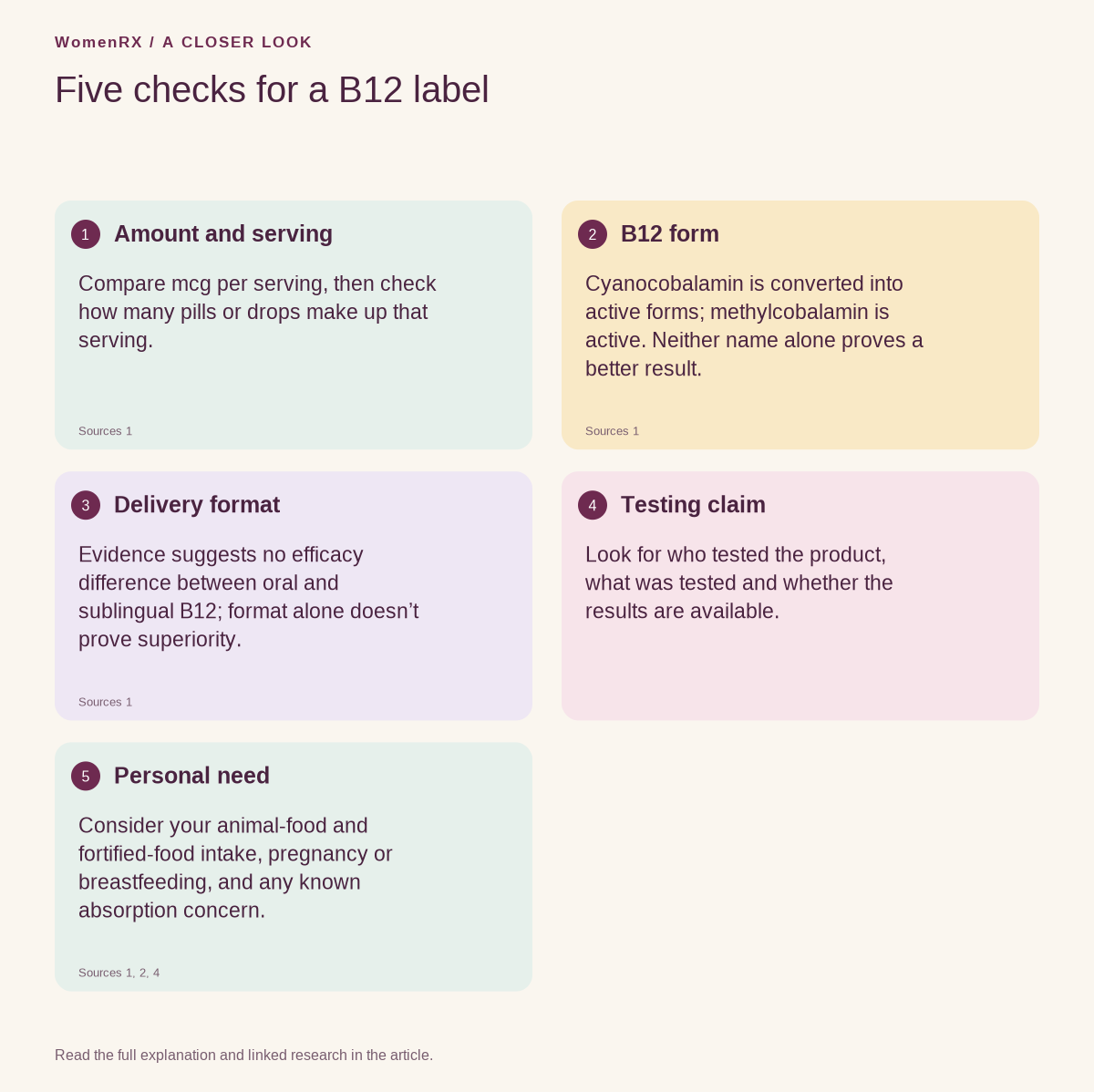
Five checks for a B12 label
Amount and serving: Compare mcg per serving, then check how many pills or drops make up that serving.1
B12 form: Cyanocobalamin is converted into active forms; methylcobalamin is active. Neither name alone proves a better result.1
Delivery format: Evidence suggests no efficacy difference between oral and sublingual B12; format alone doesn’t prove superiority.1
Testing claim: Look for who tested the product, what was tested and whether the results are available.
Personal need: Consider your animal-food and fortified-food intake, pregnancy or breastfeeding, and any known absorption concern.124
Read the figure as text
Use these checks to compare products without confusing a label claim with a personal need.- Amount and serving: Compare mcg per serving, then check how many pills or drops make up that serving.1
- B12 form: Cyanocobalamin is converted into active forms; methylcobalamin is active. Neither name alone proves a better result.1
- Delivery format: Evidence suggests no efficacy difference between oral and sublingual B12; format alone doesn’t prove superiority.1
- Testing claim: Look for who tested the product, what was tested and whether the results are available.
- Personal need: Consider your animal-food and fortified-food intake, pregnancy or breastfeeding, and any known absorption concern.124
Sources you can check
- Vitamin B12 - Health Professional Fact SheetAccessed 2026-09-25Return to first citation
- About cyanocobalamin - NHSAccessed 2026-09-25Return to first citation
- Common questions about cyanocobalamin - NHSAccessed 2026-09-25Return to first citation
- [Vegetarian diet in pregnancy and lactation - safety and rules of balancing meal plan in the aspect of optimal fetal and infant development].Karcz K, Królak-Olejnik B, Paluszyńska D. · Polski merkuriusz lekarski : organ Polskiego Towarzystwa Lekarskiego · 2019Return to first citation
- Measuring vitamin B-12 bioavailability with [13C]-cyanocobalamin in humans.Devi S, Pasanna RM, Shamshuddin Z, Bhat K, Sivadas A, Mandal AK, Kurpad AV. · The American journal of clinical nutrition · 2020Return to first citation