How to Compare Vitamin C Supplements Without a Brand Ranking
The most useful comparison is the vitamin C amount per serving, what else is in the product, and whether its quality claims can be checked.
Start with the Supplement Facts panel: compare vitamin C per serving, the number of pills or scoops in that serving, and any added ingredients. Ascorbic acid is a reasonable baseline because it’s well absorbed, and the limited human comparisons haven’t established a consistent advantage for pricier forms. Then compare cost per serving and look for specifics behind any testing claim. 1
First, make sure you’re comparing the same amount
Find vitamin C per serving on the Supplement Facts panel, then check how many tablets, capsules, gummies, or scoops make up that serving. Two bottles can advertise similar amounts while asking you to take very different numbers of pills.
The % Daily Value (%DV) gives you another way to compare labels. The Daily Value for vitamin C is 90 mg for adults and children age 4 and older. It’s a labeling reference, not a recommendation to get that amount from a supplement on top of your food. 1
A bigger number isn’t automatically a better buy. Vitamin C absorption is about 70% to 90% at moderate intakes of 30 to 180 mg per day, but falls below 50% at intakes above 1,000 mg per day. Absorbed vitamin C that the body doesn’t use can be excreted in urine. Those figures describe absorption at different intakes, not a target dose for you. 1
Use plain ascorbic acid as your comparison point
Ascoric acid is the most common form in supplements. It has bioavailability equivalent to naturally occurring ascorbic acid in foods. You’ll also see calcium or sodium ascorbate, vitamin C with bioflavonoids, and combination forms such as Ester-C. 1
A few human studies have compared these forms, with mixed findings. One found no difference in plasma vitamin C or urinary excretion among ascorbic acid, Ester-C, and ascorbic acid with bioflavonoids. Another found similar plasma levels for Ester-C and ascorbic acid, but higher vitamin C levels in white blood cells 24 hours after Ester-C. That single difference doesn’t establish that a premium form delivers better health outcomes. 1
If a product costs more because of its form, ask what you’re paying for. The label can tell you whether it adds a mineral or bioflavonoids; it can’t, by itself, show that the addition will work better for you.
Read beyond the vitamin C line
Check the full ingredient list, especially when comparing a plain tablet with a flavored gummy, drink mix, or multi-ingredient powder. Note which ingredients you want and which you’d rather skip. If you already take a multivitamin or prenatal vitamin, check its vitamin C amount before treating another bottle as a separate need.
For price, divide the bottle price by its number of servings. Compare cost per serving only after checking that the serving amounts are reasonably similar. Otherwise, a low price per serving may simply reflect a smaller amount of vitamin C. This is a shopping comparison, not a reason to choose the largest serving.
Ask what a quality claim actually covers
“Quality tested” is less useful than a statement you can check. Look for who performed the testing, whether it applies to the finished product you’re buying, and what was assessed, such as ingredient amounts or contaminants. Don’t assume a seal or testing claim means a supplement has been shown to improve health.
Quality control is a distinct question from absorption. Ingredients can pick up contaminants during cultivation, processing, or storage, particularly in plant-based formulations and extracts. That concern makes testing details worth examining, but it doesn’t mean every plain vitamin C product has the same risks as a complex botanical blend. 3 A clinical trial reported NSF testing for its particular multi-ingredient study product; that report cannot verify a different product or brand. 4
Does the word “women’s” change the choice?
A women-branded label doesn’t establish that you need a special form of vitamin C. Pregnancy and breastfeeding can change how nutrient needs are considered, though authorities differ in their vitamin C recommendations for those life stages. If you’re pregnant or breastfeeding, account for vitamin C already in your food and any prenatal or other supplements before deciding whether a separate product fills a need. 1 2
A useful comparison comes down to five questions: How much vitamin C is in a serving? What form is it? What else is included? Can you verify the quality claim? And what does a comparable serving cost?
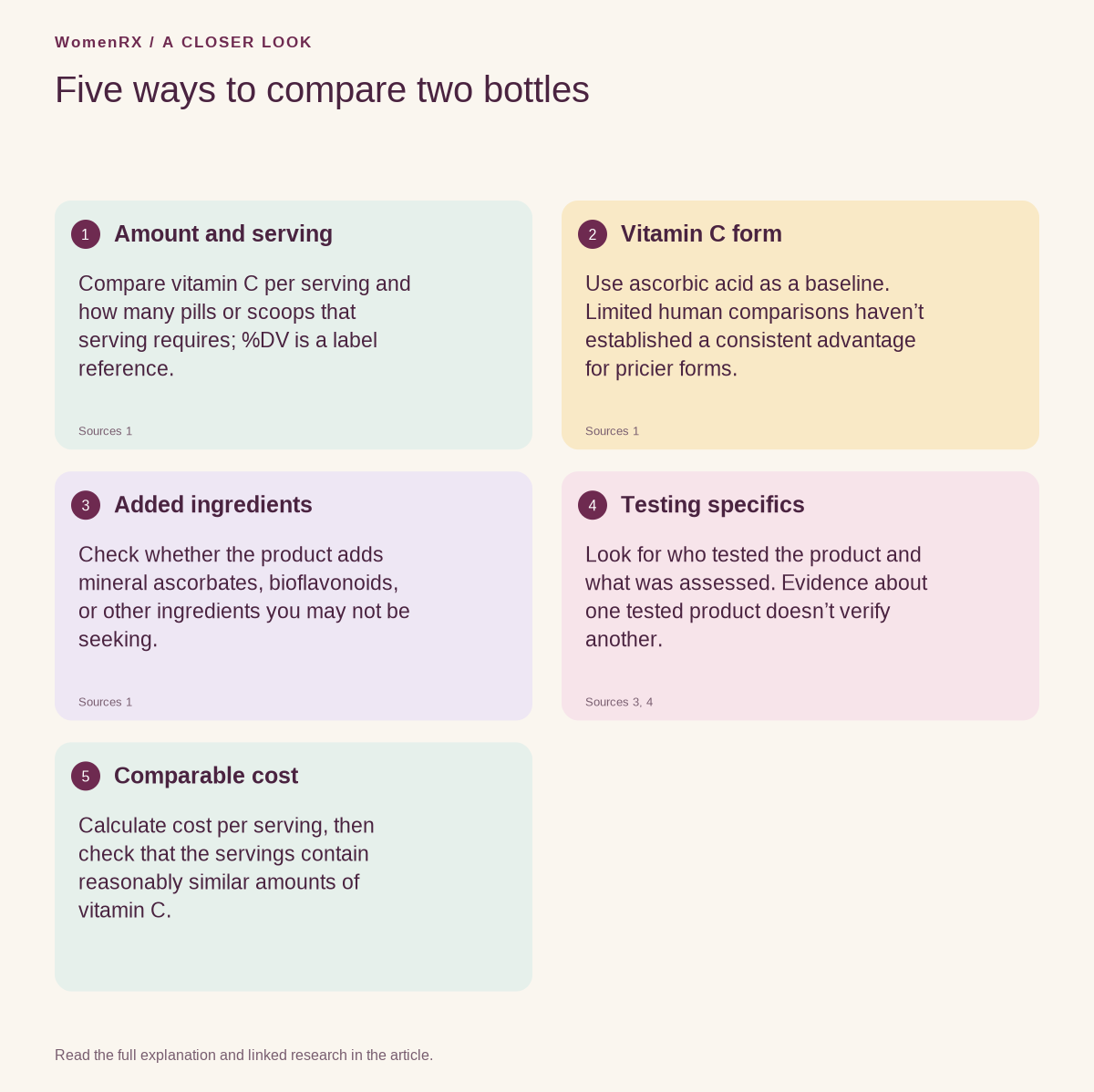
Five ways to compare two bottles
Amount and serving: Compare vitamin C per serving and how many pills or scoops that serving requires; %DV is a label reference.1
Vitamin C form: Use ascorbic acid as a baseline. Limited human comparisons haven’t established a consistent advantage for pricier forms.1
Added ingredients: Check whether the product adds mineral ascorbates, bioflavonoids, or other ingredients you may not be seeking.1
Testing specifics: Look for who tested the product and what was assessed. Evidence about one tested product doesn’t verify another.34
Comparable cost: Calculate cost per serving, then check that the servings contain reasonably similar amounts of vitamin C.
Read the figure as text
Use the same questions for each product rather than judging by its front-of-bottle promise.- Amount and serving: Compare vitamin C per serving and how many pills or scoops that serving requires; %DV is a label reference.1
- Vitamin C form: Use ascorbic acid as a baseline. Limited human comparisons haven’t established a consistent advantage for pricier forms.1
- Added ingredients: Check whether the product adds mineral ascorbates, bioflavonoids, or other ingredients you may not be seeking.1
- Testing specifics: Look for who tested the product and what was assessed. Evidence about one tested product doesn’t verify another.34
- Comparable cost: Calculate cost per serving, then check that the servings contain reasonably similar amounts of vitamin C.
More questions, answered
Is vitamin C with bioflavonoids better absorbed?
A human comparison described by the NIH Office of Dietary Supplements found no difference in plasma vitamin C levels or urinary excretion among ascorbic acid, Ester-C, and ascorbic acid with bioflavonoids. That doesn’t establish an absorption advantage for the added bioflavonoids. 1
Does a high %DV mean I need that much?
No. %DV compares a product’s vitamin C amount with the labeling Daily Value. It isn’t an individualized recommendation or a measure of how much you need from a supplement. 1
Sources you can check
- Vitamin C - Health Professional Fact SheetAccessed 2026-09-25Return to first citation
- Discrepancies in global vitamin C recommendations: a review of RDA criteria and underlying health perspectives.Carr AC, Lykkesfeldt J. · Critical reviews in food science and nutrition · 2021Return to first citation
- Effects of a Commercial Fruit, Vegetable and Berry Juice Powder Concentrate on Metabolic Safety and Cardiovascular Health in Older Adults: 6-Month Results of a Randomized Controlled Trial.Ziegler T, Darko A, Ledinski G, Kager G, Hörl G, Seemann A, Cvirn G, Lamprecht M. · Nutrients · 2026Return to first citation
- Absorption kinetics of vitamins and minerals from a novel nutritional product in physically active adults: a randomized, double-blind, placebo-controlled crossover trial.Sapp PA, Townsend JR, Kirby TO, Edwards CG, La Monica MB, Ziegenfuss TN, Vergne MJ, Akers WS, Esposito R. · Frontiers in nutrition · 2026Return to first citation