How to Compare Vitamin D Supplements Without a Brand Ranking
The best label comparison starts with the amount in a full serving, not the biggest number on the bottle.
Check four things: whether the supplement contains vitamin D2 or D3, the amount of vitamin D in a full serving, how many pills or drops make up that serving, and what any quality-verification claim actually covers. Compare the amount with your intended regimen and any vitamin D already in a multivitamin. Being marketed to women doesn’t, by itself, make a product the right fit. 1
A vitamin D label can help you narrow your choices, but it can’t tell you which amount you personally need. Start with the Supplement Facts panel, then ask whether the product fits the reason you’re considering it.
Read the serving size before comparing amounts
Find the vitamin D amount per serving, then look at how many capsules, tablets, or drops count as one serving. If two bottles list the same amount but one requires more pills to provide it, they may fit differently into your routine. The front-of-bottle number is less useful without that serving-size detail.
Next, check anything else you take. Vitamin D is included in many multivitamins, so a separate vitamin D supplement may add to an amount you’re already getting. 1 This is especially worth checking if you’re choosing between products with very different amounts. High doses of some vitamins can cause problems; more isn’t automatically a better purchase. 2
Compare D2 and D3 without making form the whole decision
Vitamin D supplements contain either D2 or D3. Both can increase vitamin D in the blood, although D3 might raise it higher and keep it higher longer than D2. That makes form a useful label detail, not a reason to ignore the amount per serving or the regimen you’re trying to match. 1
Vitamin D is fat soluble, and MedlinePlus says it may be absorbed better with a meal or snack that contains some fat. If you’re comparing formats, think about which one you can readily fit into that routine. 1
Match the product to your circumstances, not its marketing
A bottle labeled “for women” doesn’t account for the differences between pregnancy, breastfeeding, older age, and individual health circumstances. For perspective, MedlinePlus lists a recommended amount of 600 IU per day during pregnancy or breastfeeding and 800 IU per day for adults age 71 and older. Those are daily intake references, not instructions to buy a supplement containing exactly that amount. MedlinePlus also notes that some people, including those with obesity or a history of gastric bypass surgery, may need extra vitamin D. 1
If you already have an intended regimen, use it to screen labels: does a full serving provide the amount you’re looking for, and does it still fit once you account for other supplements? If you don’t know whether you need vitamin D or how much, that question comes before choosing a bottle. A clinician may consider a vitamin D test when assessing whether you’re getting enough. 1
Ask what a quality claim verifies
Treat “quality tested” as a question, not an answer. Does the package name a verifier? Can you tell what was checked and whether the claim applies to the specific product you’re holding? If those details aren’t clear, you can’t use the claim to distinguish that product from another. A verification claim also doesn’t replace reading the form, amount, and serving size.
For a quick side-by-side comparison, write down those three label details for each option, plus the exact wording of any verification claim. Then cross out products that don’t fit your intended regimen. What remains is a more useful shortlist than a brand ranking that may not reflect the products or labels in front of you.
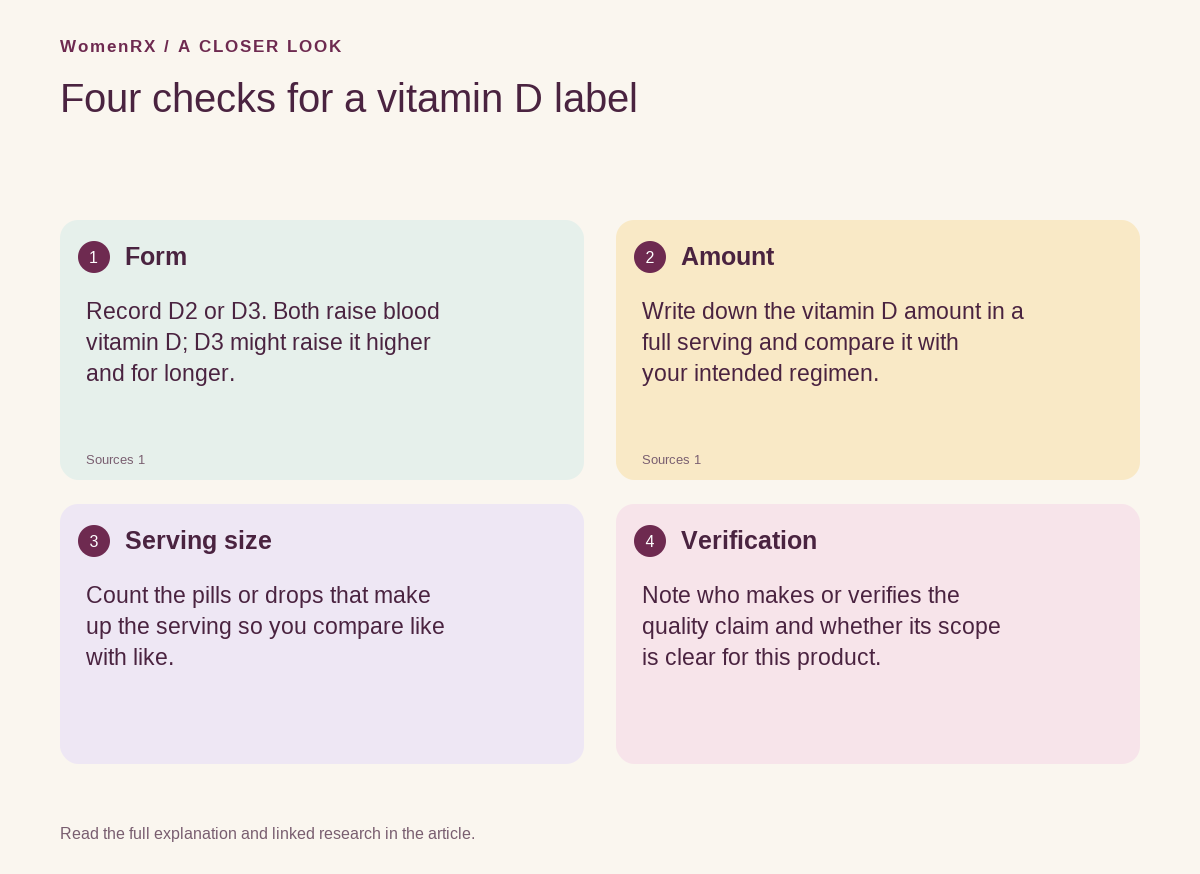
Four checks for a vitamin D label
Form: Record D2 or D3. Both raise blood vitamin D; D3 might raise it higher and for longer.1
Amount: Write down the vitamin D amount in a full serving and compare it with your intended regimen.1
Serving size: Count the pills or drops that make up the serving so you compare like with like.
Verification: Note who makes or verifies the quality claim and whether its scope is clear for this product.
Read the figure as text
Use these columns to compare two products without treating a brand name or a front-label number as the whole answer.- Form: Record D2 or D3. Both raise blood vitamin D; D3 might raise it higher and for longer.1
- Amount: Write down the vitamin D amount in a full serving and compare it with your intended regimen.1
- Serving size: Count the pills or drops that make up the serving so you compare like with like.
- Verification: Note who makes or verifies the quality claim and whether its scope is clear for this product.
More questions, answered
Is D3 always the better choice?
Not necessarily. Both D2 and D3 raise vitamin D in the blood; D3 might raise it higher and for longer. The amount per serving and whether the product fits your intended regimen still matter. 1
Sources you can check
- Vitamin D: MedlinePlusAccessed 2026-09-25Return to first citation
- Vitamins: MedlinePlusAccessed 2026-09-25Return to first citation